
Kigali Genocide Memorial’s hillside of remembrance in Kigali
Published on 09/14/2026 at 11:58 | Editorial responsibility: Rafael Müller, Editor-in-Chief AD HOC NEWS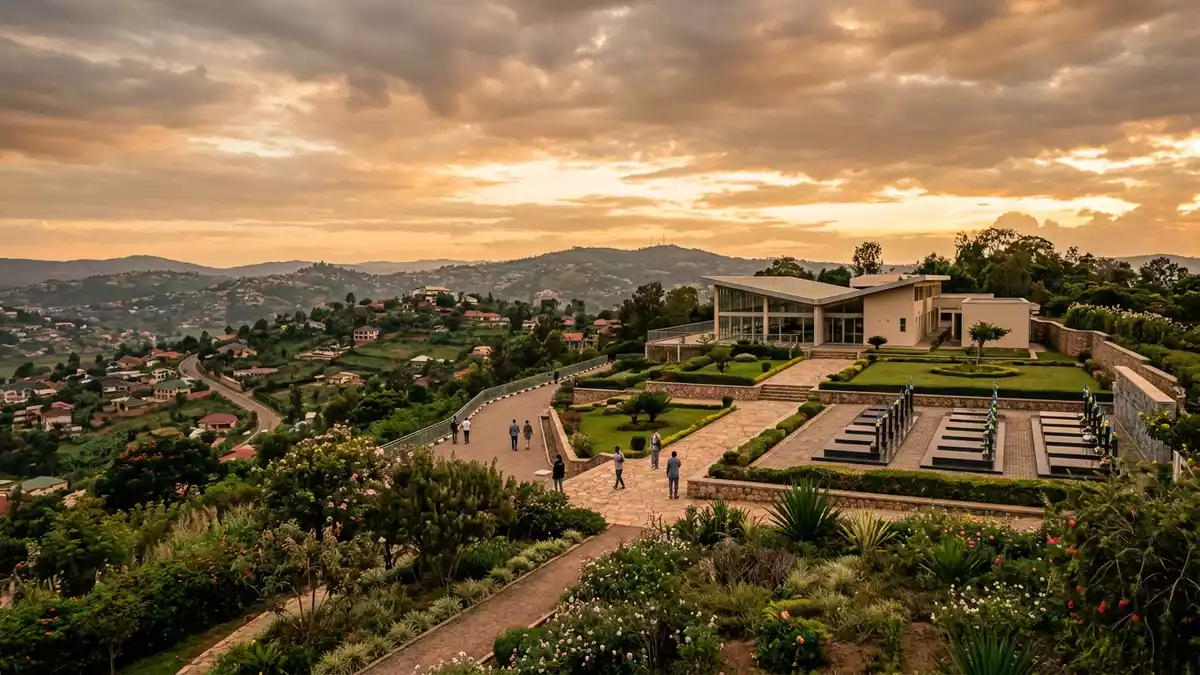
Kigali Genocide Memorial stands on a hillside in the Gisozi district of Kigali, bringing graves, galleries and gardens together in one place dedicated to remembrance of the 1994 Genocide against the Tutsi. Opened in 2004 in collaboration between Rwandan authorities and the Aegis Trust, it combines a vast burial ground with exhibition halls and quiet outdoor spaces that face the city spread across the surrounding hills.
A hillside cemetery for a city’s dead
The memorial occupies a slope in Gisozi, a neighbourhood north of central Kigali, with the grounds stepping down the hill in terraces of concrete, lawn and planting. Beneath the largest concrete slabs lie mass graves holding the remains of more than 250,000 people killed in the genocide against the Tutsi, many brought here from different parts of the city for a single dignified resting place.The Kigali Genocide Memorial is the final resting-place for 250,000 victims The city’s authorities chose this site after 1994, turning a residential hillside into a communal cemetery that looks out over Kigali’s other ridges and valleys.Kigali’s authorities chose this hillside in Gisozi for mass graves
Above the burial terraces, the main memorial building sits close to the top of the hill, its entrance facing a forecourt lined with stone and planting. Steps and paths connect the levels, so that visitors move between open-air sections where names are inscribed and enclosed rooms where photographs and personal stories are displayed. The relationship between the building and the graves is immediate, with the architecture arranged around the reality of the mass burial ground rather than separated from it.
From mass graves to a centre of learning
Kigali Genocide Memorial grew out of cooperation between Kigali’s administration, Rwanda’s National Commission for the Fight against Genocide and the Aegis Trust, an organisation originating at the National Holocaust Centre in the United Kingdom.The memorial is the result of collaboration between Rwandan authorities and the Aegis Trust Construction of the memorial began in 1999, and the site was inaugurated in April 2004 on the tenth anniversary of the genocide.The memorial was inaugurated in April 2004 The result is both a cemetery and a museum, set within one coordinated complex.
Inside, the permanent exhibition presents the lead-up to the genocide, the killings of 1994 and their aftermath in a sequence of rooms that combine text, photographs and artefacts. One section is devoted to children, with individual portraits and details of their lives before they were murdered, while another places the Rwandan experience alongside other genocides to underline patterns that recur across history.The Memorial also houses the Genocide Archive Rwanda, and exhibitions on the history of the Rwandan genocide and of other genocides The Genocide Archive Rwanda, housed on site, collects documents, testimonies and imagery, turning the memorial into a research resource as well as a public exhibition space.
Gardens, names and the wider city
Surrounding the main structures, Kigali Genocide Memorial includes planted gardens that form part of the commemorative landscape. Paths wind between low walls, hedges and small trees, with viewpoints back towards the city and across the burial terraces. Some garden sections carry specific themes in the wider masterplan, such as areas identified as a Forest of Memory or a Stream of Tears, which extend the memorial beyond a single plaza into a broader park.The overall masterplan includes memorial features such as the Forest of Memory, Stream of Tears, and Lake of Reflection The landscape masterplan has involved practices including John McAslan + Partners and MASS Design Group, adding further layers of design around the central burial ground.The masterplan, developed by John McAslan + Partners, represents an ambitious scheme
On the walls of one of the memorial’s exterior sections, names of victims are gradually being inscribed, marking individuals within the collective burial site. Other plaques and panels explain the role of the memorial in Rwanda’s educational system, where visits and learning materials are integrated into the national curriculum.The Memorial became the starting-point for peace and values education now built into Rwanda’s national schools curriculum Standing in the gardens, visitors see Kigali’s urban growth around the memorial’s hill, a reminder that this place of mourning is embedded within the daily life of Rwanda’s capital.
Visiting Kigali Genocide Memorial: what travellers from Western Europe should know
- Kigali Genocide Memorial stands in the Gisozi district of Kigali, on KG 14 Avenue, north of the city centre and reached by road from central districts.
- The grounds are terraced on a hillside, with steps and sloping paths between levels, so moving around the site involves walking up and down inclines.
- The memorial’s exhibition areas are indoors, while the burial terraces and gardens are outside, so a visit combines time under cover with time in the open air.
- The official language in Rwanda is Kinyarwanda alongside English and French, and the currency is the Rwandan franc.
- Entry requirements depend on your nationality; UK travellers can check the FCDO travel advice at gov.uk/foreign-travel-advice, Irish travellers the Department of Foreign Affairs at ireland.ie.
Searching for Kigali Genocide Memorial on social platforms
These links open searches for Kigali Genocide Memorial on each platform.
Frequently asked questions about Kigali Genocide Memorial
Where is Kigali Genocide Memorial located in Kigali?
Kigali Genocide Memorial stands in the Gisozi district of Kigali, on a hillside north of the city centre, with its entrance on KG 14 Avenue.
What should a visitor expect during a visit?
A visit combines time in indoor exhibitions, which present the history and testimonies, with time in outdoor areas that include mass graves, gardens and spaces for quiet reflection.
What makes Kigali Genocide Memorial distinctive among memorial sites?
It brings together a large communal burial ground, detailed historical exhibitions and an archive in a single integrated complex that also plays a role in Rwanda’s national education programme.


