
Khoja Ahmed Yasawi Keshenesi, Timurid brick monument in Turkistan
Published on 09/01/2026 at 14:16 | Editorial responsibility: Rafael Müller, Editor-in-Chief AD HOC NEWS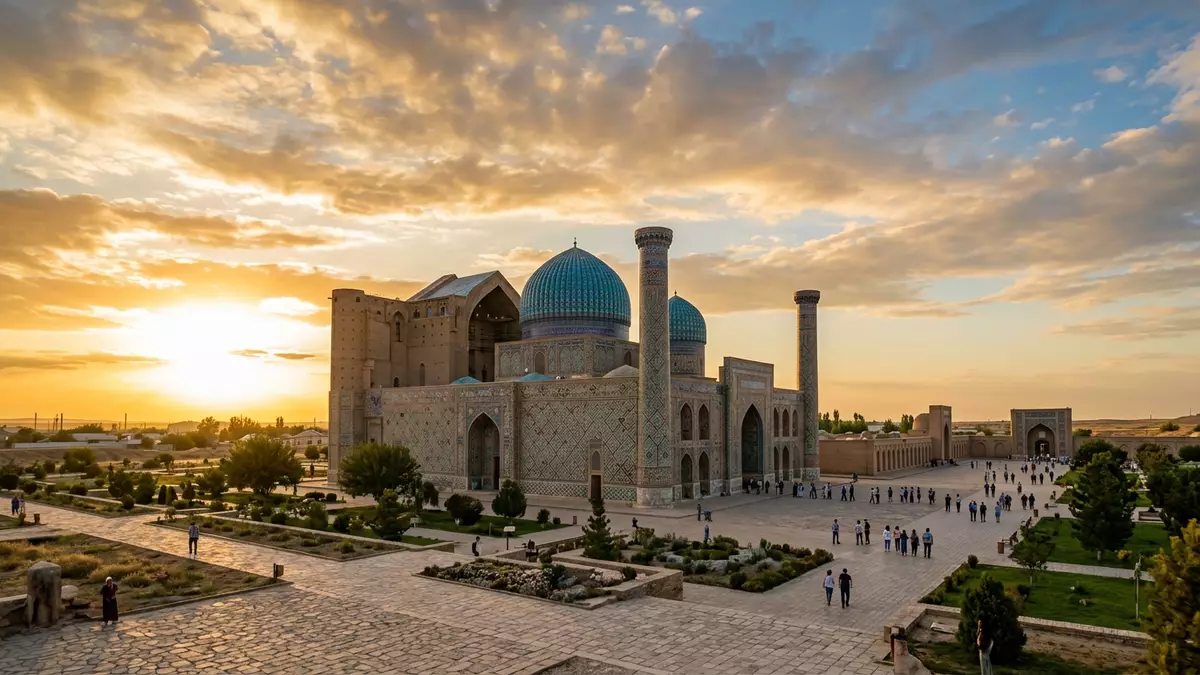
In the north-eastern quarter of Turkistan in southern Kazakhstan, Khoja Ahmed Yasawi Keshenesi rises as a monumental Timurid-era brick mausoleum over the former citadel of the old town of Yasi. Built between 1389 and 1405 under the rule of Timur, the complex commemorates the twelfth-century Sufi master Khoja Ahmed Yasawi and has become a defining landmark in the historic fabric of Turkistan.Built between 1389 and 1405
Timurid architecture in baked brick and tile
Khoja Ahmed Yasawi Keshenesi is a large rectangular brick structure aligned on a south-east to north-west axis within the former fortified core of Yasi, the earlier name of Turkistan.Within the former citadel The building belongs to the Timurid architectural tradition that flourished in Central Asia at the end of the fourteenth century, and it combines structural mass with glazed decoration in a way that is characteristic of that period.Timurid architectural style
The mausoleum’s plan is rectangular, with sides of roughly 45.8 m and 62.7 m, and the structure reaches a total height of about 38.7 m, making it one of the largest surviving buildings of the Timurid period.Rectangular plan and height Its walls are built of baked brick, and large areas are faced with patterned brickwork and ceramic tiles, including turquoise elements that highlight the main elevations. From the outside, the building reads as a composition of volumes of different heights, with clustered domes rising over key interior spaces and a dominant portal defining the principal approach.
A complex of halls for devotion and commemoration
Khoja Ahmed Yasawi Keshenesi is more than a single funerary chamber; it is a multi-functional religious complex that brings together spaces for commemoration, prayer and teaching within one continuous architectural shell.Multi-functional complex The interior is divided into numerous rooms organised around major halls, including the large Kazandyk Hall and the burial chamber that marks the resting place of Khoja Ahmed Yasawi, whose twelfth-century grave had previously been marked by a smaller mausoleum.Earlier smaller mausoleum
The complex incorporates mosque functions, spaces associated with a khanqah and areas used historically as madrasa rooms, creating a layered programme typical of major Islamic monuments in Central Asia.Mosque and other functions According to detailed descriptions, the building contains several dozen rooms, all linked by corridors and axial relationships that reflect Timurid planning principles rather than a single linear route.Rooms within the complex Within this network, the Kazandyk Hall, with its large central space and structural emphasis, forms one of the architectural focal points of a visit.
Khoja Ahmed Yasawi, Timur and the World Heritage designation
The building known as Khoja Ahmed Yasawi Keshenesi marks the burial site of Khoja Ahmed Yasawi, a Turkic poet and Sufi mystic born in the twelfth century who became a distinguished spiritual figure in the region.Khoja Ahmed Yasawi as a Sufi master In the late fourteenth century, Timur, the ruler of a Central Asian empire, ordered the construction of the present mausoleum over Yasawi’s smaller earlier tomb, using Persian master builders who tested structural and decorative solutions here that would later appear in the buildings of Samarkand.Commissioned by Timur
Khoja Ahmed Yasawi Keshenesi stands within the old walled city area of Turkistan in southern Kazakhstan and has been recognised as an architectural monument through its inscription as a UNESCO World Heritage Site since 2003.UNESCO inscription World Heritage documentation describes it as one of the largest and best-preserved constructions of the Timurid period, underlining both its scale and its state of conservation among comparable monuments.Timurid-period monument
Visiting Khoja Ahmed Yasawi Keshenesi: what travellers from Western Europe should know
- Khoja Ahmed Yasawi Keshenesi stands in the north-eastern part of Turkistan, a city in southern Kazakhstan reached by overland routes and regional transport connections from other urban centres.Location in Turkistan
- The mausoleum complex occupies the former citadel area and includes interior halls, corridors and stairways; visiting involves walking over historic surfaces and moving between enclosed spaces of varying size.Within the citadel
- The official language is Kazakh and the currency is the Kazakhstani tenge.
- Entry requirements depend on your nationality; UK travellers can check the FCDO travel advice at gov.uk/foreign-travel-advice, Irish travellers the Department of Foreign Affairs at ireland.ie.
Searching for Khoja Ahmed Yasawi Keshenesi on social platforms
These links open searches for Khoja Ahmed Yasawi Keshenesi on each platform.
Frequently asked questions about Khoja Ahmed Yasawi Keshenesi
Where is Khoja Ahmed Yasawi Keshenesi located?
Khoja Ahmed Yasawi Keshenesi stands in Turkistan, a city in southern Kazakhstan, within the north-eastern part of the historic old town area.Location in southern Kazakhstan
What can visitors expect when exploring the complex?
Visitors encounter a large Timurid brick mausoleum with tile decoration, axial halls and numerous rooms, including major interior spaces such as the Kazandyk Hall and the burial chamber.
What makes Khoja Ahmed Yasawi Keshenesi distinctive among regional monuments?
Its combination of scale, Timurid-era brick and tile architecture, multi-functional religious spaces and association with the Sufi master Khoja Ahmed Yasawi, together with UNESCO World Heritage status, give it particular prominence.World Heritage recognition


