
Khoja Ahmed Yasawi Keshenesi and Turkistan’s Timurid brick
Published on 09/14/2026 at 14:56 | Editorial responsibility: Rafael Müller, Editor-in-Chief AD HOC NEWS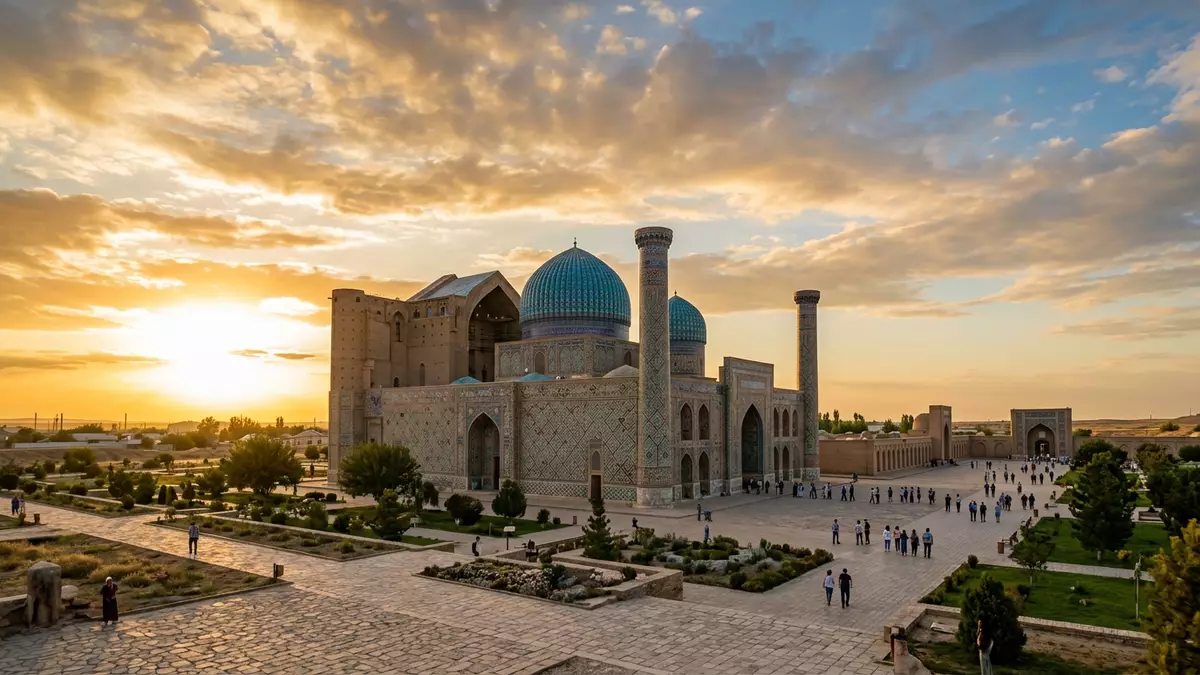
Khoja Ahmed Yasawi Keshenesi rises in Turkistan as a Timurid brick monument with a vast rectangular plan and a dominant dome. Built under Timur’s patronage, it belongs to the late fourteenth and early fifteenth centuries.
Timurid brickwork in Turkistan
The building sits in the town of Yasi, now Turkistan, and its scale is one of its defining features. UNESCO describes it as one of the largest and best-preserved constructions of the Timurid periodlargest and best-preserved constructions.
The complex combines mausoleum, mosque and khanqah functions in one structure. Fired brick, glazed tile and muqarnas ornament give the exterior and interior a distinctly Timurid character.
Khoja Ahmed Yasawi and the Tamerlane era
The shrine honours Khoja Ahmed Yasawi, a twelfth-century Sufi master and poet whose tomb became the focus of a major building campaign. The monument was erected between 1389 and 1405, and work stopped with Timur’s deathbetween 1389 and 1405.
That unfinished state is part of its historical interest. The site preserves a rare combination of grand form, visible structural ambition and original material from the Timurid ageoriginal material.
World Heritage status and architectural detail
The mausoleum was inscribed on the UNESCO World Heritage List in 2003, and the listing treats it as an architectural monument. Its formal designation gives the site a place within the wider history of Central Asian Islamic architectureWorld Heritage List in 2003.
Inside, the Kazandyk hall, burial chamber and other rooms give the complex its layered plan. The exterior portal, dome and decorative bands create a strong visual hierarchy across the façadeKazandyk hall.
Visiting Khoja Ahmed Yasawi Keshenesi: what travellers from Western Europe should know
- The monument stands in Turkistan in southern Kazakhstan, in the north-eastern part of the historic urban area. Rail and road links serve the city, and the mausoleum lies within the old town district.
- The building is large and enclosed, with a monumental portal, a main hall and smaller rooms. Its brick surfaces, domes and tiled ornament are visible from close range.
- The site belongs to a dry inland setting on the Kazakh steppe. The open urban setting leaves the mausoleum visually prominent against a low skyline.
- The official language is Kazakh and the currency is the tenge.
Searching for Khoja Ahmed Yasawi Keshenesi on social platforms
These links open searches for Khoja Ahmed Yasawi Keshenesi on each platform.
Frequently asked questions about Khoja Ahmed Yasawi Keshenesi
Where is Khoja Ahmed Yasawi Keshenesi?
It stands in Turkistan, in southern Kazakhstan. The mausoleum occupies the north-eastern section of the historic town area.
What does a visit involve?
The site presents a large brick complex with a portal, halls and smaller chambers. Its domes, tilework and unfinished surfaces are part of what remains visible.
What makes it distinctive?
The monument combines Timurid construction, a Sufi shrine and UNESCO World Heritage status. Its scale and brick architecture mark it as a major building of the period.


