
Khoja Ahmed Yasawi Keshenesi and the Timurid skyline of Turkistan
Published on 08/27/2026 at 11:48 | Editorial responsibility: Rafael Müller, Editor-in-Chief AD HOC NEWS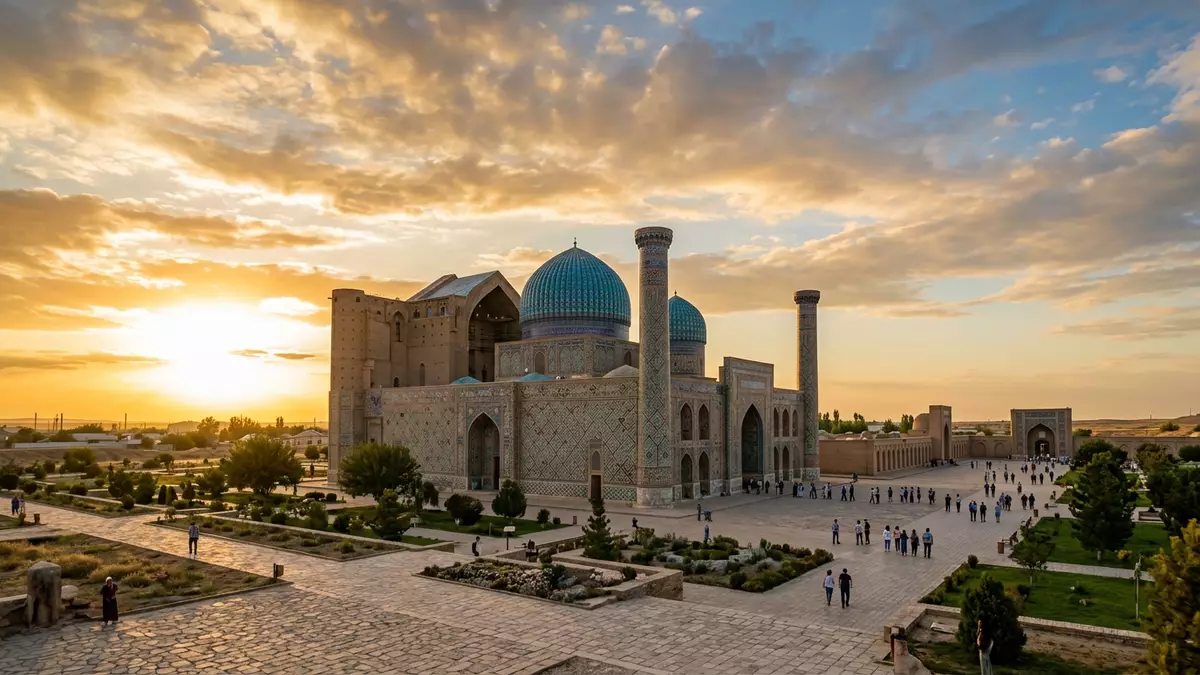
Kohja Ahmed Yasawi Keshenesi in Turkistan, Kazakhstan, is a monumental Timurid-era mausoleum complex that rises over the old citadel and honours the Sufi poet Khoja Ahmed Yasawi, who died in the twelfth century. Built under the rule of Timur between 1389 and 1405, it remains one of the most substantial surviving brick structures from the Timurid Empire and anchors the historic heart of this southern Kazakh city.
A Timurid monument for a twelfth-century Sufi master
The building known as Khoja Ahmed Yasawi Keshenesi is the large brick mausoleum that stands over the burial place of Khoja Ahmed Yasawi, a Turkic poet and Sufi mystic whose lifetime is usually placed in the twelfth century. His grave became an important pilgrimage site, and the present mausoleum replaced an earlier, smaller shrine on the same spot during the reign of Timur, also known as Tamerlane, who ordered the new structure in the late fourteenth century.Built between 1389 and 1405, the project was left unfinished after Timur’s death, leaving a rare example of a major Timurid monument where some intended elements were never completed.
The mausoleum stands inside the former citadel of Yasi, the earlier name of Turkistan, in the north-eastern part of the historic town.The town was known as Yasi and Hazrat-e Turkestan, and it formed a key node on caravan routes across the steppe. The monument is recognised as an architectural masterpiece of the Timurid period and was inscribed on the UNESCO World Heritage List in 2003, reflecting both its scale and the state of preservation of its medieval brickwork.UNESCO listed the mausoleum in 2003
Brick, domes and a vast ceremonial hall
Khoja Ahmed Yasawi Keshenesi is a broad, rectangular complex in baked brick, with a footprint that measures roughly 65.5 by 46.5 metres and an alignment that runs from south-east to north-west.Its overall dimensions are given as 65.5 by 46.5 metres The exterior is dominated by a monumental entrance portal, articulated in deep niches and flanked by massive walls whose surface carries traces of glazed tilework in turquoise and blue hues. Behind the portal, a high drum supports the principal brick dome, one of the largest of its kind in Central Asia, which marks the building on the skyline of Turkistan.
Inside, the plan is arranged around the Kazandyk Hall, a great domed chamber that functions as the ceremonial centre of the complex and contains a vast bronze cauldron, with the burial chamber of Khoja Ahmed Yasawi located further within the structure.The main dome reaches a height of about 44 metres Around these central spaces lie a series of side rooms that together bring the total number of chambers in the building to the mid-thirties, including spaces used historically for prayer, teaching and accommodation for pilgrims.The building consists of 34 rooms
A multi-purpose sacred complex in the steppe city of Turkistan
Beyond the tomb chamber itself, Khoja Ahmed Yasawi Keshenesi forms a multi-purpose religious complex that has served as mausoleum, mosque, khanqah and madrasa within a single envelope.It combines the functions of mausoleum, mosque, khanqah and madrasa The interior includes prayer halls, corridors and cells that open off the main axes, as well as service spaces and stair passages in the thickness of the brick walls. The combination of functions reflects Khoja Ahmed Yasawi’s status as a Sufi teacher whose followers gathered for instruction and devotional practice at his resting place.
The mausoleum occupies a prominent position within an archaeological zone that preserves traces of the earlier citadel and urban fabric of Yasi.The structure stands within the former citadel in the north-eastern part of the ancient town Around the main building, visitors encounter remains of fortifications and ancillary religious structures, which together convey the layered religious and political significance of Turkistan within Central Asia. The World Heritage inscription covers both the mausoleum itself and its immediate setting, protecting the ensemble of walls, open spaces and archaeological remains that frame the brick mass of the Keshenesi.
Visiting Khoja Ahmed Yasawi Keshenesi: what travellers from Western Europe should know
- Kohja Ahmed Yasawi Keshenesi stands in the city of Turkistan in southern Kazakhstan, within the area of the historic citadel at the edge of the old town.
- The mausoleum complex is built in brick with high walls, interior stair passages and uneven historic surfaces, and moving through it involves walking on stone and climbing steps.
- Turkistan lies in a continental climate zone with hot summers and cold winters, so conditions around the open courtyards and walkways can vary strongly with the season.
- The official language is Kazakh and the currency is the Kazakh tenge.
- Entry requirements depend on your nationality; UK travellers can check the FCDO travel advice at gov.uk/foreign-travel-advice, Irish travellers the Department of Foreign Affairs at ireland.ie.
Searching for Khoja Ahmed Yasawi Keshenesi on social platforms
These links open searches for Khoja Ahmed Yasawi Keshenesi on each platform.Frequently asked questions about Khoja Ahmed Yasawi Keshenesi
Where is Khoja Ahmed Yasawi Keshenesi located?
Kohja Ahmed Yasawi Keshenesi is located in the city of Turkistan in southern Kazakhstan, within the historic citadel area in the north-eastern part of the old town.
What can visitors expect when exploring the mausoleum complex?
Visitors encounter a vast Timurid brick monument with a high entrance portal, a domed central hall, the tomb chamber of Khoja Ahmed Yasawi and numerous side rooms and passages.
What makes Khoja Ahmed Yasawi Keshenesi distinctive among Central Asian monuments?
Its combination of mausoleum, mosque, khanqah and madrasa functions, its large brick dome and its association with Timur and the Sufi master Khoja Ahmed Yasawi give the complex special significance.


