
Khoja Ahmed Yasawi Keshenesi and the Timurid brick monument of Turkistan
Published on 09/18/2026 at 19:23 | Editorial responsibility: Rafael Müller, Editor-in-Chief AD HOC NEWS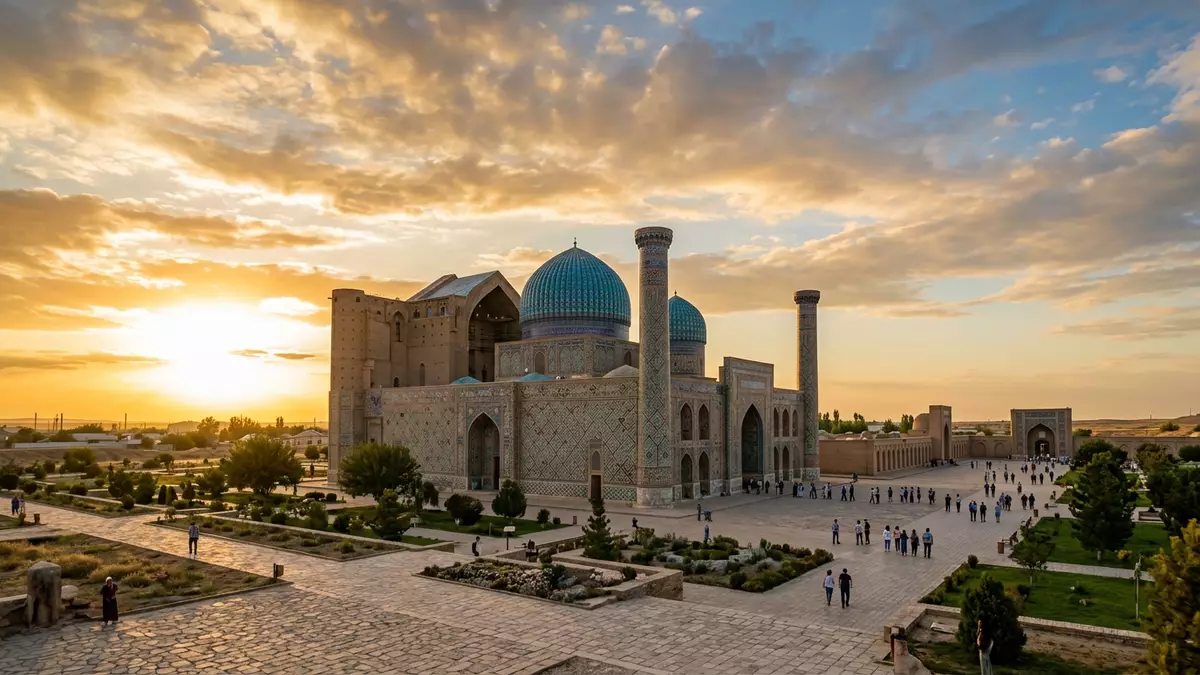
Khoa Ahmed Yasawi Keshenesi in Turkistan, southern Kazakhstan, is the monumental brick mausoleum complex raised over the burial place of the Sufi poet and mystic Khoja Ahmed Yasawi in the late fourteenth century. Commissioned under the rule of Timur, better known in Western historiography as Tamerlane, it became one of the major surviving brick monuments of the Timurid period and shapes the historic core of Turkistan as it appears today.
A Timurid mausoleum for a twelfth-century Sufi master
The building known internationally as the Mausoleum of Khoja Ahmed Yasawi stands in the north-eastern sector of Turkistan, on the site of the older town of Yasi on the caravan routes across southern Kazakhstan.The Mausoleum of Khoja Ahmed Yasawi is inscribed as a cultural property on the UNESCO World Heritage List, recognising both its architectural scale and its importance in the religious history of Central Asia.UNESCO World Heritage Site
Khoa Ahmed Yasawi himself was a Turkic poet and Sufi master who lived in the twelfth century and is closely associated with the development of Sufi traditions across the steppe regions of Central Asia.Khoja Ahmed Yasawi, a philosopher and Sufi leader The mausoleum built over his burial place replaced an earlier, smaller structure and turned the site into a major centre of veneration. It remains anchored in the religious landscape of southern Kazakhstan while also standing as a key reference point for Timurid architecture.
Brick, scale and layout of Khoja Ahmed Yasawi Keshenesi
The structure of Khoja Ahmed Yasawi Keshenesi is executed primarily in baked brick, a material associated with Timurid monumental building across Central Asia.Mazar-i Khwaja Ahmad Yasavi The complex occupies a roughly rectangular footprint whose dimensions are recorded as about 65.5 m by 46.5 m (215 ft by 152 ft), which gives a sense of its bulk in the relatively low-lying townscape of Turkistan.overall dimensions of the complex Within this outline the building is organised into a series of interior spaces arranged along and around a main axis.
Descriptions of the complex refer to a sequence of halls, chambers and ancillary rooms that together make up the mausoleum ensemble, including the large Kazandyk Hall, the burial chamber and spaces used historically for ritual, teaching and hospitality.a unique architectural complex Brick façades, decorative tilework and monumental portal elements mark the exterior, while the interior offers a progression from broad, vaulted halls into more enclosed rooms. From outside, the mass and height of the central volume are visible above the remains of the old citadel walls of Yasi, giving the impression of a single dominating brick structure rising from the archaeological landscape.
Timurid experimentation and UNESCO recognition
The mausoleum was built between 1389 and 1405 during the reign of Timur, who ruled a large Central Asian empire from his capital at Samarkand.built at the time of Timur Within this period, Persian master builders working for Timur experimented with structural and decorative solutions at Turkistan that were later applied in Samarkand, giving the building a particular place within Timurid architectural history.Persian master builders experimented with architectural solutions Although some parts of the project remain unfinished, the mausoleum is described as one of the largest and best-preserved constructions of the Timurid period.
In 2003 the Mausoleum of Khoja Ahmed Yasawi and its surrounding archaeological area were inscribed on the UNESCO World Heritage List, formalising its status as an architectural monument within the South Kazakhstan region.inscribed 2003 The documentation for the property describes it as lying within a core zone and buffer zone in Turkistan, embracing both the mausoleum itself and the traces of the older town of Yasi that surround it.World Heritage documentation for the mausoleum For visitors interested in architecture, this UNESCO status underlines that Khoja Ahmed Yasawi Keshenesi is a key site for understanding the evolution of Islamic monumental building in Central Asia.
Visiting Khoja Ahmed Yasawi Keshenesi: what travellers from Western Europe should know
- Khoa Ahmed Yasawi Keshenesi stands in the city of Turkistan in southern Kazakhstan, in the north-eastern part of the historic town area associated with the older name Yasi.
- The building rises within the former citadel, and approaches on foot involve walking across level archaeological ground and then climbing steps at the main portal into the interior halls.
- The wider complex sits within an urban setting, with other historic structures and remains of fortification walls nearby, so moving between different parts of the site involves short walks on paved and compacted surfaces.
- Kazakhstan’s official language is Kazakh, and Russian is also widely used; the national currency is the Kazakh tenge.
- Entry requirements depend on your nationality; UK travellers can check the FCDO travel advice at gov.uk/foreign-travel-advice, Irish travellers the Department of Foreign Affairs at ireland.ie.
Searching for Khoja Ahmed Yasawi Keshenesi on social platforms
These links open searches for Khoja Ahmed Yasawi Keshenesi on each platform.
Frequently asked questions about Khoja Ahmed Yasawi Keshenesi
Where is Khoja Ahmed Yasawi Keshenesi located?
Khoa Ahmed Yasawi Keshenesi is located in Turkistan in southern Kazakhstan, in the north-eastern part of the historic town area that corresponds to the older settlement of Yasi.
What can visitors expect when entering the complex?
Visitors encounter a monumental brick portal leading into large vaulted halls and a sequence of interior chambers, including spaces associated with the mausoleum, mosque functions and historical ritual use.
What makes Khoja Ahmed Yasawi Keshenesi distinctive among Central Asian monuments?
It combines the mausoleum of a twelfth-century Sufi poet with Timurid-era architectural experimentation in brick construction and holds formal recognition as a UNESCO World Heritage Site within the South Kazakhstan region.


