
Khoja Ahmed Yasawi Keshenesi, a Timurid monument over Turkistan’s old citadel
Published on 08/31/2026 at 12:58 | Editorial responsibility: Rafael Müller, Editor-in-Chief AD HOC NEWS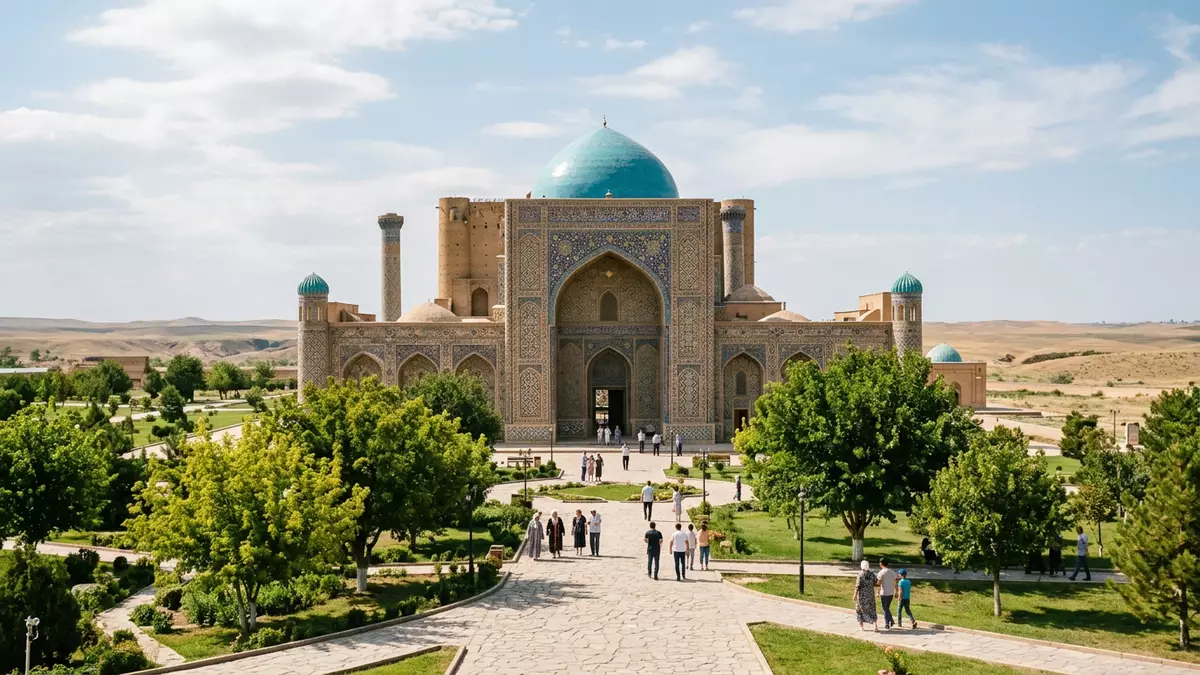
Khoja Ahmed Yasawi Keshenesi in Turkistan is a vast brick mausoleum complex raised over the burial place of the twelfth-century Sufi poet Khoja Ahmed Yasawi and aligned with the old citadel of the city. Built under the rule of Timur between 1389 and 1405, it stands as one of the most substantial surviving monuments of the Timurid period in southern Kazakhstan.
A Timurid mausoleum for a revered Sufi master
The building known as Khoja Ahmed Yasawi Keshenesi is the large mausoleum that marks the resting place of Khoja Ahmed Yasawi, a Turkic poet and Sufi mystic who died in the twelfth century and whose teachings helped shape spiritual life across Central Asia.Mausoleum of Khoja Ahmed Yasawi Timur, also known as Tamerlane, ordered the construction of the present structure at the end of the fourteenth century, replacing a smaller mausoleum that had drawn pilgrims to Yasi, the earlier name of Turkistan.built between 1389 and 1405
Kazakh and international accounts describe Khoja Ahmed Yasawi as a prominent philosopher, poet and Sufi spiritual leader, remembered with the honorific “Sultan al-Arifin”, and his tomb chamber sits within a complex that also functions as a mosque and khanqah, or Sufi lodge.multifunctional mausoleum complex The mausoleum occupies part of the former citadel of Yasi in the north-eastern section of Turkistan, placing it at the historic core of an ancient caravan town that once lay on trade routes linking Central Asia with the wider region.area of the former citadel
Scale, layout and Timurid architectural language
Khoja Ahmed Yasawi Keshenesi takes a roughly rectangular plan aligned south-east to north-west, with its footprint measuring around 46 m by 63 m (151 ft by 207 ft) and its height reaching close to 39 m (128 ft), giving the complex the volume of a multi-storey urban block.rectangular plan and dimensions Within this shell, the architects combined more than thirty rooms into a single composition, with major spaces such as the Kazandyk Hall and the burial chamber grouped around a central axis and smaller chambers arranged to serve religious, commemorative and residential functions.combining 35 different-volume rooms
The structure is built predominantly from baked brick, a material characteristic of Timurid architecture, and its elevations are articulated with a monumental entrance portal, conical and ribbed domes, and sections of glazed tilework and muqarnas decoration that catch the light against the otherwise earthy surfaces.Timurid architectural style Inside, the mausoleum serves multiple roles as a mosque, shrine and gathering place, with the large central hall providing space for worship and ceremony and the flanking rooms forming a khanqah and madrasa-like environment around the tomb of Khoja Ahmed Yasawi.mausoleum, mosque, khanqah and madrasa
World Heritage status and the surrounding historic city
The Mausoleum of Khoja Ahmed Yasawi, identified in Kazakh as Qoja Ahmet Iassaui kesenes?, was inscribed on the UNESCO World Heritage List in 2003 as an outstanding example of Timurid architecture and as an influential Islamic religious monument for the region.inscribed on the World Heritage List in 2003 UNESCO’s documentation notes that Persian master builders experimented here with structural and decorative solutions that later informed major projects in Samarkand, making Khoja Ahmed Yasawi Keshenesi part of a wider story about architectural innovation in Central Asia.experimented with architectural solutions
The mausoleum stands within an archaeological zone that preserves traces of the former walled town of Yasi, including segments of fortifications and evidence of earlier urban layers beneath the present surface.within the former citadel Around Khoja Ahmed Yasawi Keshenesi, Turkistan has grown into a regional centre in southern Kazakhstan, but the complex continues to define the historic silhouette of the city, rising over neighbouring streets and open spaces as a landmark that connects contemporary life with the Timurid era.
Visiting Khoja Ahmed Yasawi Keshenesi: what travellers from Western Europe should know
- Khoja Ahmed Yasawi Keshenesi stands in the city of Turkistan in southern Kazakhstan, in the north-eastern part of the historic town within the area of the former citadel.
Turkistan is reached overland and by air via regional transport links that connect it with other cities in Kazakhstan. - The mausoleum complex is a substantial brick structure with interior halls and side rooms arranged over multiple levels, and visiting the main spaces involves walking across stone surfaces and climbing stairways within the building.
- The surrounding terrain includes remnants of fortifications and archaeological areas around the old citadel, and approaching the complex from some directions involves crossing open ground and paved paths that frame views of the monument.
- Kazakhstan’s official language is Kazakh, with Russian also used, and the national currency is the Kazakhstani tenge.
- Entry requirements depend on your nationality; UK travellers can check the FCDO travel advice at gov.uk/foreign-travel-advice, Irish travellers the Department of Foreign Affairs at ireland.ie.
Searching for Khoja Ahmed Yasawi Keshenesi on social platforms
These links open searches for Khoja Ahmed Yasawi Keshenesi on each platform.
Frequently asked questions about Khoja Ahmed Yasawi Keshenesi
Where is Khoja Ahmed Yasawi Keshenesi located?
Khoja Ahmed Yasawi Keshenesi stands in the city of Turkistan in southern Kazakhstan, in the north-eastern part of the historic town within the former citadel area.
What can visitors expect when they enter the complex?
Visitors encounter a large brick mausoleum with a monumental entrance portal, high domes and interior halls, alongside side rooms that together form a mosque and Sufi lodge around the tomb chamber.
What makes Khoja Ahmed Yasawi Keshenesi distinctive among mausoleums?
It is a Timurid-period complex commissioned by Timur over the grave of a revered Sufi master, combining many rooms within a high rectangular shell and recognised as a UNESCO World Heritage Site.


