
Khoja Ahmed Yasawi Keshenesi, a Timurid landmark in Turkistan
Published on 09/08/2026 at 13:16 | Editorial responsibility: Rafael Müller, Editor-in-Chief AD HOC NEWS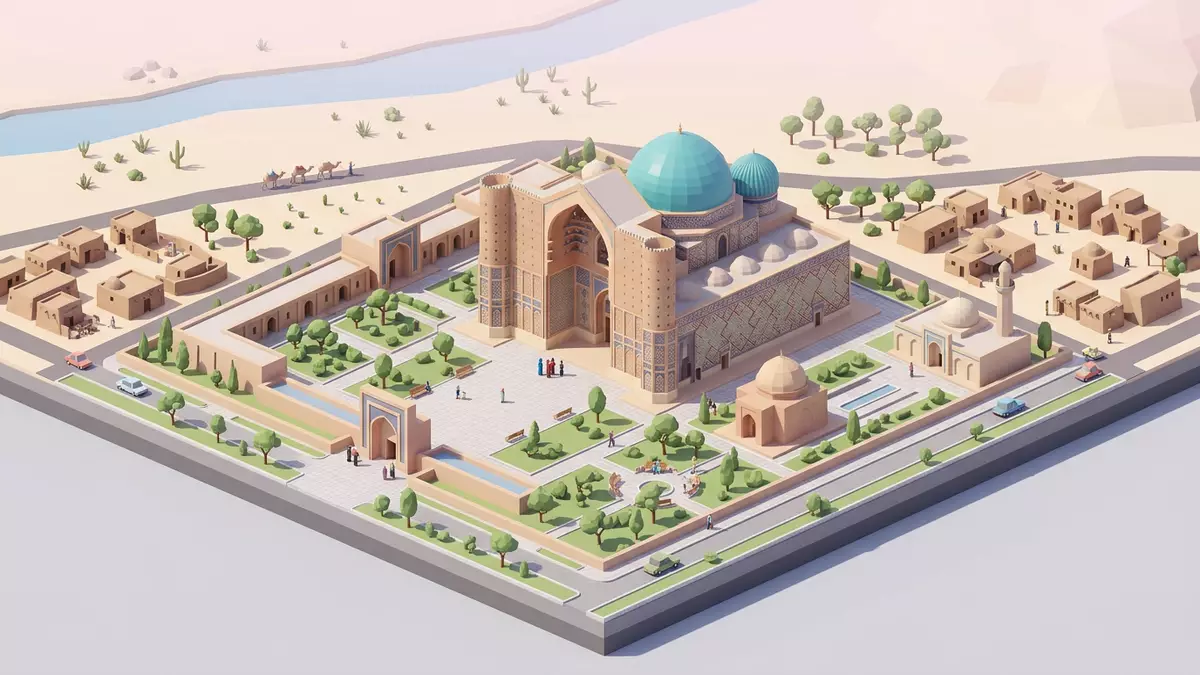
Khoja Ahmed Yasawi Keshenesi in Turkistan, Kazakhstan, is a monumental Timurid-era mausoleum complex where brick walls, soaring domes and sacred halls form a single vast structure around the tomb of the Sufi poet Khoja Ahmed Yasawi, whose life in the twelfth century anchors the site’s enduring religious significance.
A Timurid mausoleum raised over a Sufi master’s tomb
The building known as Khoja Ahmed Yasawi Keshenesi is the mausoleum of Khoja Ahmed Yasawi, a Turkic Sufi teacher and poet who died in the twelfth century and was buried on the northern edge of the town historically called Yasi, now Turkistan in southern Kazakhstan.twelfth century Sufi master His grave became the centre of a small earlier tomb complex before the Mongol-era ruler Timur, known in Western Europe as Tamerlane, ordered a much larger mausoleum above it in the late fourteenth century.
Construction of the present mausoleum began in 1389 and continued into the early fifteenth century, during Timur’s rule over a Central Asian empire centred on Samarkand.began in 1389 and continued to 1405 The complex now stands as a dominant brick mass in the north-eastern part of Turkistan, its outline visible from afar across the flat steppe that surrounds the city.north-eastern part of Turkistan
Brick, domes and Timurid architectural experiment
Khoja Ahmed Yasawi Keshenesi is built largely of fired brick, with walls and vaults organised around a central ceremonial hall known as the Kazandyk, where a great bronze cauldron occupies the centre under a dominant dome.Kazandyk hall and bronze cauldron The Kazandyk’s brick dome has a diameter of around 18.2 m (59.7 ft), and is among the largest masonry domes built in Central Asia during the Timurid period.brick dome with 18.2 m diameter
The mausoleum’s overall layout brings together prayer spaces, burial chambers and service rooms in a single multi-purpose structure that functions as both shrine and mosque.multi-purpose structure as mosque and shrine Persian master builders used the project to test architectural and structural solutions, including large-scale domes and monumental portals, that later appeared in Timurid buildings in Samarkand and other cities.architectural and structural experiment The brickwork, glazed tile panels and bands of calligraphy visible on the facades reflect techniques that became characteristic of Timurid architecture across Central Asia.
UNESCO World Heritage and the heart of historic Turkistan
The mausoleum of Khoja Ahmed Yasawi is recognised as a cultural World Heritage Site on the UNESCO list, inscribed in 2003 for its architectural value and its importance to the history of Sufism and Central Asian urban centres.UNESCO World Heritage inscription in 2003 The designation covers the main building and parts of its immediate surroundings, where historic burial grounds and ancillary structures emphasise the site’s long role as a focus of religious life in southern Kazakhstan.
Within Turkistan, Khoja Ahmed Yasawi Keshenesi occupies a prominent position in the historic core, and its mass of brick, tile and domes has become the city’s defining landmark from many viewpoints.landmark in the city of Turkistan Interior rooms house displays linked to the mausoleum’s function as a museum as well as a place of worship, and burials of Kazakh khans and other figures underline its status as a dynastic and spiritual centre over several centuries.burials of leading Kazakh khans
Visiting Khoja Ahmed Yasawi Keshenesi: what travellers from Western Europe should know
- Khoja Ahmed Yasawi Keshenesi stands in southern Kazakhstan in the city of Turkistan, with the mausoleum complex forming a large brick landmark in the north-eastern part of the urban area.
- The complex covers an extensive area with interior corridors, stairways and halls, and the main entrance portal leads into a sequence of vaulted spaces where stone or brick floors require steady footing.
- Turkistan lies on the steppe of southern Kazakhstan, where summers can be very hot and winters cold, so the exposed approach to the mausoleum and the open areas around it reflect a continental climate.
- The official language is Kazakh, and the currency is the Kazakhstani tenge.
- Entry requirements depend on your nationality; UK travellers can check the FCDO travel advice at gov.uk/foreign-travel-advice, Irish travellers the Department of Foreign Affairs at ireland.ie.
Searching for Khoja Ahmed Yasawi Keshenesi on social platforms
These links open searches for Khoja Ahmed Yasawi Keshenesi on each platform.
Frequently asked questions about Khoja Ahmed Yasawi Keshenesi
Where is Khoja Ahmed Yasawi Keshenesi located?
Khoja Ahmed Yasawi Keshenesi stands in the city of Turkistan in southern Kazakhstan, on the site historically known as Yasi in the north-eastern part of the town.
What can visitors expect when they enter the mausoleum complex?
Visitors encounter a sequence of brick-built halls, including the Kazandyk with its large dome and bronze cauldron, alongside prayer spaces, burial rooms and museum displays.
What makes Khoja Ahmed Yasawi Keshenesi distinctive among mausoleums?
Its combination of a massive Timurid brick structure, one of Central Asia’s largest masonry domes, and a UNESCO-recognised role as shrine, mosque and dynastic burial place makes it distinctive.


