
Khao Phing Kan and the limestone towers of Phang Nga
Published on 08/31/2026 at 06:10 | Editorial responsibility: Rafael Müller, Editor-in-Chief AD HOC NEWS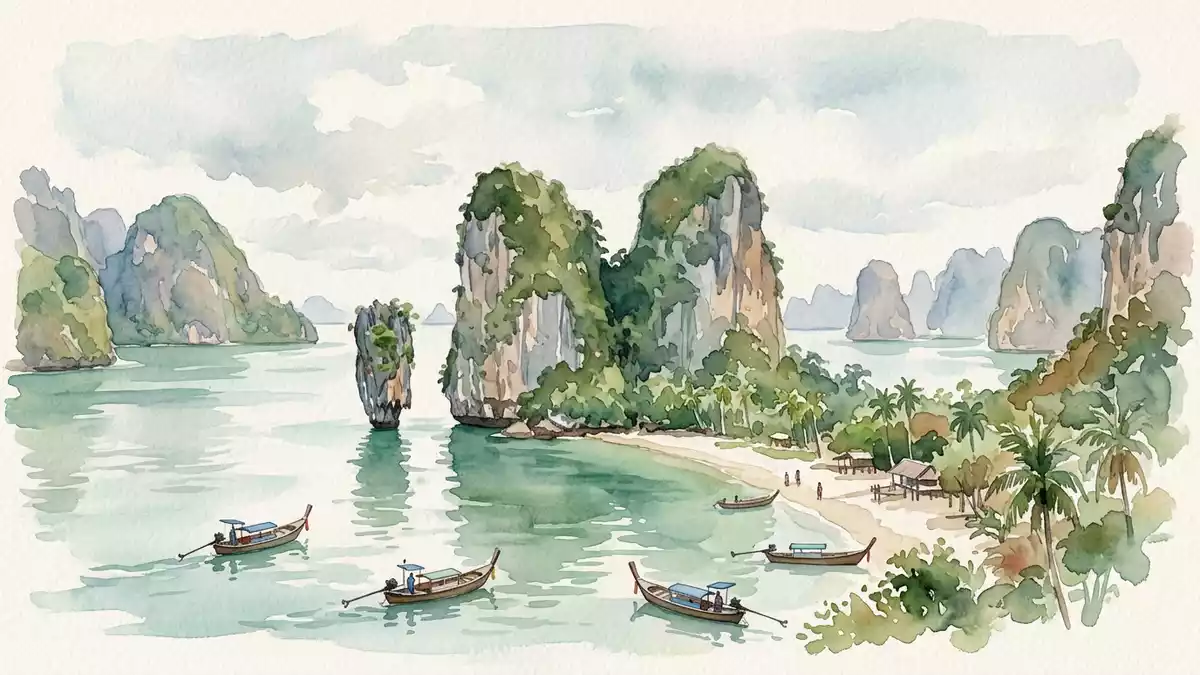
Khao Phing Kan in Phang Nga Bay is a pair of limestone islands with steep green cliffs and a small beach between them. It is better known in English as James Bond Island, a name tied to the 1974 film The Man with the Golden Gun.
Khao Phing Kan and the bay around it
The islands lie in southern Thailand, within Phang Nga Bay, northeast of Phuket. They form part of the Ao Phang Nga National Park, which places them in a karst landscape of cliffs, sea stacks and sheltered water.
The setting is easy to read from the shore: folded rock faces, narrow stretches of sand and the separate limestone needle of Ko Tapu offshore. Khao Phing Kan and Ko Tapu are the names most closely linked with the place, and both matter to its identity.
The limestone forms that define the view
Khao Phing Kan is a compact island pair rather than a broad landmass. Its cliffs rise sharply, and the rock faces carry the weathered look typical of Phang Nga Bay’s limestone formations.
The most familiar outline is the contrast between the island’s low sandy edge and the vertical rock behind it. Ko Tapu stands nearby as a slender stack, giving the bay one of its most recognisable coastal scenes.
That relationship between beach, cliff and sea stack is the place’s strongest visual feature. The limestone towers sit in open water, close enough for the eye to take in as one composition.
Khao Phing Kan in cultural memory
The island’s English-language fame rests on its appearance in The Man with the Golden Gun. That association brought a cinema title into everyday travel language, while Khao Phing Kan remains the local name for the island.
The place is also a useful example of how a film location can outgrow its original screen role. Visitors encounter the bay’s rock forms first, then the film reference that has attached itself to them over the years.
The name Khao Phing Kan refers to leaning hills, a phrase that suits the island’s tilted limestone walls. The shape is visible before any story is told about it.
Visiting Khao Phing Kan: what travellers from Western Europe should know
- The island lies in Phang Nga Bay, between Phuket and the mainland of Phang Nga province. Access is by boat across the bay.
- The ground combines a small sandy area with steep limestone rock. The cliffs and the beach form the main terrain contrast on site.
- Ko Tapu stands offshore as a separate limestone stack. It belongs to the same bay scene as Khao Phing Kan.
- The official language is Thai and the currency is the Thai baht.
- Entry requirements depend on your nationality; UK travellers can check the FCDO travel advice at gov.uk/foreign-travel-advice, Irish travellers the Department of Foreign Affairs at ireland.ie.
Searching for Khao Phing Kan on social platforms
These links open searches for Khao Phing Kan on each platform.
Frequently asked questions about Khao Phing Kan
Where is Khao Phing Kan?
Khao Phing Kan lies in Phang Nga Bay in southern Thailand. It sits northeast of Phuket and within Ao Phang Nga National Park.
What does a visit involve?
The approach is by boat, and the setting is a small island with a beach, steep limestone cliffs and the offshore stack of Ko Tapu. The landscape is compact and clearly defined.
What makes it distinctive?
The island’s profile is distinctive because the rock faces lean above the sand, while Ko Tapu stands separately in the water. The film association adds another layer to an already memorable limestone scene.


