Keukenhof’s spring mosaic of bulbs and landscape history
Published on 09/07/2026 at 11:17 | Editorial responsibility: Rafael Müller, Editor-in-Chief AD HOC NEWS
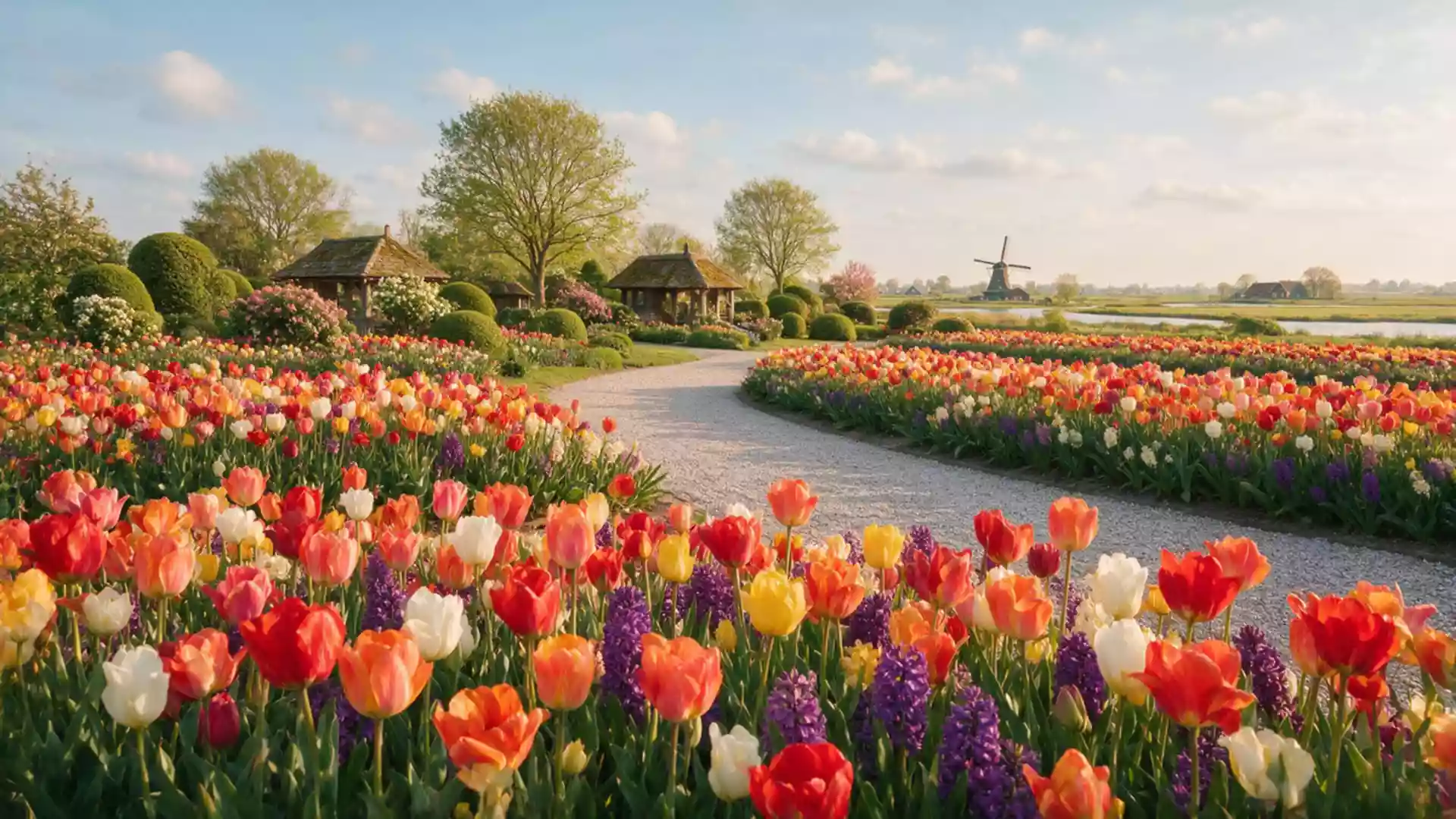
Keukenhof in Lisse, in the western Netherlands, is a spring garden laid across a historic estate where landscape design and bulb cultivation meet in carefully planned displays of tulips and other flowers. The park, in its present form as a public flower garden, dates to 1950, yet its grounds trace back to medieval hunting land and a seventeenth-century country house that still anchors the site.
From kitchen dunes to a country estate
The name Keukenhof refers to a “kitchen garden” and reflects the area’s origin as a resource landscape for nearby Teylingen Castle in the fifteenth century. Countess Jacoba van Beieren, known in English as Jacqueline of Bavaria, used the dunes south of Lisse as hunting grounds and for gathering herbs and produce for the castle household, giving the land its practical character long before formal gardens were laid out.Countess Jacoba van Beieren In the seventeenth century the character of the site shifted when the merchant and administrator Adriaen Maertensz Block bought the land and, in 1641, commissioned a country house that took the name Keukenhof, turning the working landscape into a stately estate focused on residence as well as supply.country house Keukenhof was built in 1641
That house, now known as Castle Keukenhof, stands within an estate that grew over time to cover more than 200 hectares, with woodland, water and meadows forming a varied setting for later gardens.the estate grew to encompass an area of over 200 hectares In the nineteenth century Baron and Baroness Van Pallandt, then owners of the estate, invited landscape architect Jan David Zocher and his son Louis Paul Zocher to redesign the grounds around the house in the English landscape style, with sweeping lawns, curving paths and informal tree groups that remain the underlying structure of the park visitors walk through today.redesigned in 1857 by Jan David Zocher and Louis Paul Zocher
Keukenhof as a spring flower park
Keukenhof’s identity as a garden dedicated to spring-flowering bulbs dates to the mid-twentieth century, when growers and exporters in the bulb region around Lisse turned the estate into a showcase for their plants. In 1949 a group of flower bulb specialists proposed using the castle grounds as an exhibition landscape for tulips and related bulbs, and the spring park opened to visitors in 1950, transforming the private estate into a seasonal garden centred on colour and pattern across lawns and beds.the park opened its gates to the public in 1950 The idea tied the traditional bulb trade of the region to a carefully designed visitor experience, with winding paths, water features and wooded sections giving rhythm to the planted areas.
The flower park occupies around 32 hectares within the broader estate, with beds and borders arranged along the existing landscape framework set by the nineteenth-century design.the park is 32 hectares in size Every spring millions of bulbs are planted in sweeping drifts and smaller patterns, mixing tulips with hyacinths, daffodils and other species to create bands of colour that change as different varieties come into flower.over seven million bulbs are planted every autumn Pavilions on the grounds host indoor flower shows, while long paths weave through trees and alongside water, giving visitors views across planted areas and back towards the historic house.
Layout, planting and the wider bulb landscape
Keukenhof’s layout reflects its dual identity as historic estate and modern exhibition garden. Visitors follow curving paths through woodland and past water, with open lawns used as canvases for bulb displays that are replanted each year. The English landscape style introduced by the Zocher family means the garden avoids rigid geometry; instead, trees frame views of flower beds, and gentle rises in the terrain give changing perspectives on the colours spread across the ground.designed in the 1800s by landscaper Jan David Zocher and his son Paths extend for many kilometres, so moving through the garden involves steady walking rather than short hops between fixed points.the paths at Keukenhof measure 15 km in total
The garden sits within the Bollenstreek, the bulb-growing region south-west of Amsterdam, and fields of tulips and other flowers spread around Lisse in season, linking the park to its agricultural setting.Keukenhof is at Stationsweg 166a in the Bollenstreek flower region Within the estate more than 2,500 trees from over a hundred species form the green structure into which the bulbs are planted, and watercourses and ponds add further texture to the landscape.over 2,500 trees at Keukenhof The presence of Castle Keukenhof as a backdrop, alongside listed buildings scattered on the grounds, reinforces the sense that the spring gardens are one layer in a longer story of land use and design on this patch of Dutch countryside.
Visiting Keukenhof: what travellers from Western Europe should know
- Keukenhof lies near the town of Lisse in South Holland, south-west of Amsterdam, and the park’s entrance is on Stationsweg, a road well signposted in the bulb-growing region.
- The terrain inside the garden combines level paths with gentle slopes, and visiting generally involves walking along long paved routes between planted areas and through wooded sections.
- Large planted lawns, water features and wooded corners mean distances between highlights are covered on foot, so comfortable walking shoes suit the experience on the paths.
- Fields of bulbs surround the garden in season, and viewpoints within Keukenhof give sightlines towards the wider agricultural landscape as well as back to Castle Keukenhof.
- The official language is Dutch and the currency is the euro.
Searching for Keukenhof on social platforms
These links open searches for Keukenhof on each platform.
Frequently asked questions about Keukenhof
Where is Keukenhof and what kind of place is it?
Keukenhof is a spring flower garden on the historic Keukenhof estate near Lisse in South Holland, the Netherlands, combining a country house setting with landscaped bulb displays.
What can visitors expect during a walk through Keukenhof?
Visitors follow long paths through woodland, past water and across lawns planted with tulips and other bulbs, with views towards Castle Keukenhof and the surrounding bulb fields.
What makes Keukenhof distinctive among gardens?
Keukenhof stands out for its combination of an English-style nineteenth-century landscape design and a mid-twentieth-century bulb exhibition, set within a larger historic estate where millions of bulbs are replanted each spring.