
Keukenhof in Lisse, a spring garden rooted in centuries of landscape history
Published on 09/18/2026 at 11:33 | Editorial responsibility: Rafael Müller, Editor-in-Chief AD HOC NEWS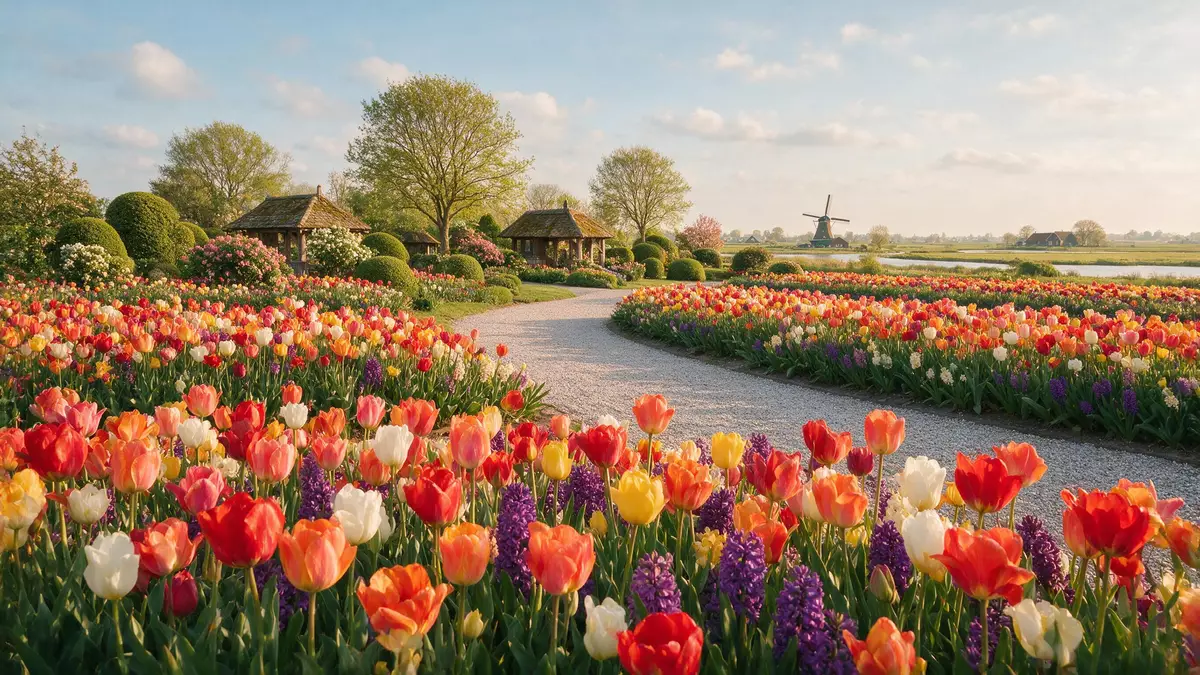
Keukenhof near Lisse in the Netherlands is a spring garden laid out within an older country estate, where broad beds of bulbs sit among mature trees and water from nineteenth-century parkland. Its modern role as a seasonal flower exhibition dates to 1949, yet the grounds reach back to medieval hunting land and a castle kitchen garden in the fifteenth century.
From kitchen garden to country estate
The name Keukenhof derives from the Dutch words for “kitchen” and “garden”, reflecting an origin as land supplying herbs and produce to a castle kitchen in the fifteenth century.name Keukenhof In that period the grounds formed part of the hunting lands attached to Slot Teylingen, and Countess Jacoba van Beieren, born in 1401 and deceased in 1436, is closely associated with the early estate.Countess Jacoba van Beieren Her connection bridges the practical origin of the land as a source of kitchen plants with its later development into a designed landscape.
In the seventeenth century the estate shifted towards a country house landscape. Adriaen Maertensz Block, a captain and governor within the Dutch East India Company, acquired land here in 1638 and had a manor house constructed in 1641.Castle Keukenhof built in 1641 That house evolved into what is now known as Keukenhof Castle, anchoring the estate and giving the surrounding ground a new role as ornamental parkland rather than purely functional farmland.Keukenhof Castle around 1642
Nineteenth-century landscape design and the park framework
The structure visitors recognise in the trees, lawns and water at Keukenhof traces back to an English landscape-style redesign in the nineteenth century. In 1857 Baron and Baroness Van Pallandt, owners of the estate at that time, commissioned landscape architect Jan David Zocher and his son Louis Paul Zocher to reshape the park around the castle.Zocher redesign in 1857 Their work, comparable to their design for Amsterdam’s Vondelpark, introduced sweeping lawns, curving bodies of water and informal groupings of trees that still underpin the garden’s layout.
This nineteenth-century parkland forms the framework into which the bulb plantings are fitted. The estate today covers well over 200 hectares, with the spring exhibition occupying 32 hectares of that area.32 ha exhibition within 240 ha estate Footpaths extend for many kilometres through the grounds, crossing bridges over canals and ponds and looping between grass, trees and flower beds.15 km of footpaths The fact that the bulb fields sit within a mature park, rather than on open farmland, gives Keukenhof its distinct character as a combination of historic estate and temporary floral show.
Keukenhof as a spring flower exhibition
The idea of using Keukenhof as an open-air exhibition of spring bulbs emerged in the aftermath of the Second World War. In 1949 a group of Dutch bulb growers and flower exporters planned a show on the estate to present their varieties and support the Netherlands’ export trade, working with local authorities in Lisse.flower exhibition created in 1949 The first public season of the garden followed in 1950, turning the estate’s parkland into a landscape of designed bulb beds for visitors.
The exhibition has grown into a large spring garden within the Bollenstreek, the wider bulb-growing region of the Netherlands.flower exhibition in Bollenstreek Paths run beside and between extensive beds planted with tulips, daffodils, hyacinths and other bulbs, set against the backdrop of the nineteenth-century trees and water features. Around the historic castle and across the wider estate, sculptures and pavilions add further layers to the experience, but the core idea remains the same: spring-flowering bulbs arranged in a concentrated garden season on centuries-old land.
Visiting Keukenhof: what travellers from Western Europe should know
- Keukenhof lies on an estate near Lisse in the province of South Holland, reached by road from surrounding Dutch cities and by public transport links serving the bulb-growing region.
- The exhibition area is largely level parkland with extensive footpaths; visiting involves walking on paved and gravel paths between lawns, water and planting.
- Lisse is in the Netherlands, where the official language is Dutch and the currency is the euro.
Searching for Keukenhof on social platforms
These links open searches for Keukenhof on each platform.
Frequently asked questions about Keukenhof
Where is Keukenhof?
Keukenhof is a spring garden and historic estate near the town of Lisse in South Holland, within the bulb-growing region of the western Netherlands.
What should visitors expect on a visit?
Visitors walk through extensive parkland planted with spring-flowering bulbs, following footpaths past lawns, trees, canals, pavilions and the historic Keukenhof Castle.
What makes Keukenhof distinctive among gardens?
Keukenhof combines a twentieth-century bulb exhibition with an estate whose roots reach back to a fifteenth-century kitchen garden and a nineteenth-century English landscape-style park.


