
Keukenhof in Lisse: a historic spring park of bulbs and landscape design
Published on 09/19/2026 at 14:36 | Editorial responsibility: Rafael Müller, Editor-in-Chief AD HOC NEWS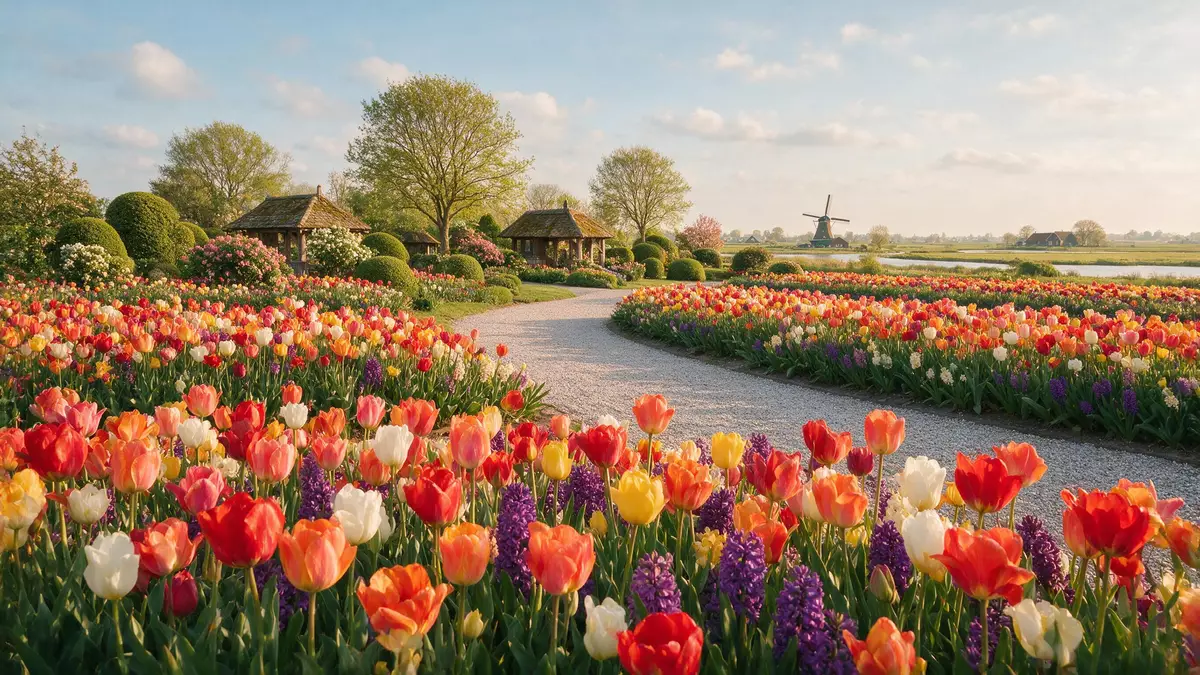
Keukenhof in Lisse in the Netherlands is a spring park laid out across the grounds of a historic estate, where an English-style landscape garden and a large open-air bulb exhibition share the same terrain. The site links a 17th-century manor, landscaped parkland from the nineteenth century and extensive plantings of tulips and other bulbs into one continuous experience.
From kitchen garden to Keukenhof estate
The land that now forms Keukenhof belonged in the fifteenth century to the estate of Castle Teylingen, a noble property in the coastal region south of Haarlem and west of Leiden.Castle Teylingen estate In that period the grounds were used as hunting land and as a source of produce for the castle’s kitchen, which gave the area its name as a kitchen garden, or “Keukenhof”. Countess Jacoba van Beieren, also known as Jacqueline of Bavaria, held the estate in the early fifteenth century and is closely associated with this origin story of hunting grounds and herb plots.Countess Jacoba van Beieren
In the seventeenth century the estate passed to Adriaen Maertensz Block, a merchant and governor linked to the Dutch East India Company, who commissioned a manor house that became Keukenhof Castle.Keukenhof Castle The manor, constructed in 1641, anchors the estate and still stands beside the later park. Around the middle of the nineteenth century Baron and Baroness Van Pallandt, then owners of the estate, engaged landscape architect Jan David Zocher and his son Louis Paul Zocher, known for Amsterdam’s Vondelpark, to redesign the grounds in the English landscape style.English landscape garden by Zocher Their sweeping lawns, curved paths and framed views still form the underlying structure of Keukenhof’s parkland.
The creation of the spring flower park
Keukenhof’s identity as a spring park dedicated to bulbs dates to the middle of the twentieth century, when leading growers and exporters began to use the estate as an open-air showcase for their stock.group of bulb growers In 1949 a consortium of growers and exporters agreed to organise a bulb exhibition in the castle gardens, drawing on the estate’s established landscape and its position in the traditional bulb-growing region of South Holland. The park opened to visitors in 1950 as a dedicated spring garden centred on blooming bulbs, and has kept that seasonal character ever since.opening to the public in 1950
The spring park itself occupies around 32 hectares (79 acres) within a larger estate that extends across roughly 240 to 250 hectares and includes the castle and several listed buildings.32-hectare exhibition area Paths lead through lawns edged with bulb borders, past water features and into themed garden areas, while the historic house forms a backdrop to the park. The combination of formal exhibition beds and the more natural English landscape layout gives Keukenhof a layered character: it is both a commercial showcase for the bulb trade and a pleasure garden built on nineteenth-century design principles.
Landscape, themed gardens and bulbs
Within the park, bulbs are planted across lawns, beds and woodland edges, creating dense swathes of colour in spring. Tulips hold a central place among these plantings, reflecting the long association between the Netherlands and the flower, which dates back to the arrival of tulips in the country in the late sixteenth century through the botanist Carolus Clusius.Carolus Clusius and tulips Other spring-flowering bulbs, including daffodils and hyacinths, appear in mixed plantings that make use of height and flowering time to extend the visual rhythm of the borders.
Keukenhof’s layout includes watercourses, bridges and pavilions that punctuate the walking routes, as well as themed gardens that explore different styles of planting within the broader English landscape framework.paths, water features and pavilions Broad paths pass through open lawns before narrowing in woodland sections, creating shifts in scale between wide, open views and more intimate garden rooms. The historic castle nearby gives the park a clear architectural focal point, while the surrounding bulb fields of the Lisse area link the estate to the wider agricultural landscape.
Visiting Keukenhof: what travellers from Western Europe should know
- Keukenhof lies in Lisse in South Holland, between Haarlem and Leiden. It is reached by road from the main Dutch motorway network and sits within the bulb-growing area around the town.
- The park consists of gently rolling lawns, long walking paths and sections of woodland. Visitors cover significant ground on foot, with some routes crossing bridges and small rises in the landscape.
- The castle and various pavilions stand within or beside the park, so built structures and garden areas lie close together, with water features and open lawns linking them.
- The official language is Dutch and the national currency is the euro.
Searching for Keukenhof on social platforms
These links open searches for Keukenhof on each platform.Frequently asked questions about Keukenhof
Where is Keukenhof located?
Keukenhof is situated on an historic estate in Lisse in South Holland in the Netherlands, within the traditional bulb-growing region south of Haarlem and west of Leiden.
What can visitors expect on a visit to Keukenhof?
Visitors walk through an English-style landscape park planted with large numbers of spring-flowering bulbs, moving between lawns, woodland edges, water features, themed gardens and pavilions.
What makes Keukenhof distinctive among gardens?
Keukenhof combines a seventeenth-century manor and nineteenth-century landscape design with a twentieth-century spring bulb exhibition on a large scale within an established bulb-growing area.


