
Keukenhof and the landscape garden behind the flowers
Published on 09/23/2026 at 03:24 | Editorial responsibility: Rafael Müller, Editor-in-Chief AD HOC NEWS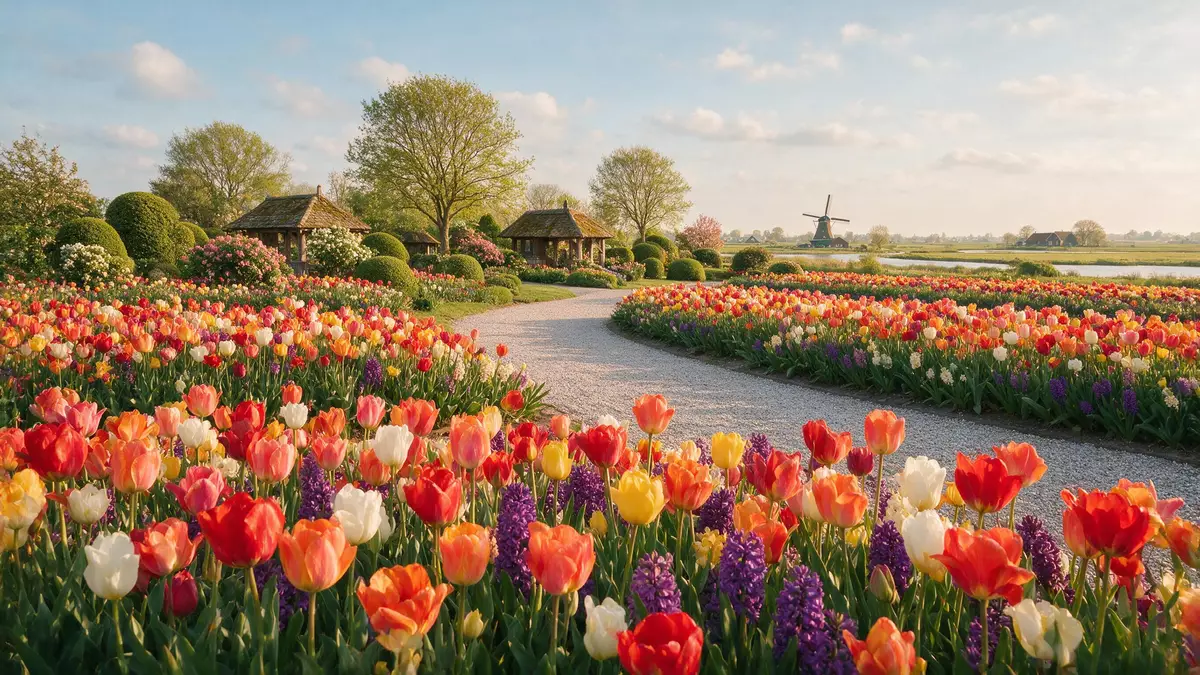
Keukenhof is a spring garden in Lisse where colourful bulb beds sit within a nineteenth-century landscape garden. Its public flower exhibition began in 1949, while the estate’s history reaches back to the fifteenth century. The result is a place where tulips, woodland paths, water and historic buildings share one designed landscape.
Keukenhof grew from a castle estate
The name Keukenhof means “kitchen garden”. In the fifteenth century, Jacoba van Beieren used part of the estate for herbs, fruit and vegetables connected with the castle kitchen. The grounds belonged to a wider medieval estate associated with Slot Teylingen.
Keukenhof Castle dates from 1642. In 1857, Jan David Zocher and his son Louis Paul Zocher reshaped the park around the castle as an English landscape garden. Their work established the curving paths, planted areas and water features that remain part of the estate’s visual character. The Zochers also worked on Amsterdam’s Vondelpark.
From estate park to spring flower exhibition
The public Keukenhof began with a group of Dutch bulb growers and flower exporters. In 1949, they planned a spring exhibition on the estate, creating a new use for the landscaped grounds. The park opened to the public in 1950.
Its central subject is the cultivated bulb. Tulips dominate the visual language, joined by daffodils, hyacinths and other spring flowers. Planting beds are arranged through lawns, woodland, ponds and avenues, while pavilions provide additional exhibition spaces. The result is not a single formal garden, but a sequence of garden rooms with different colours, textures and views.
Bulbs, trees and water in a designed landscape
Keukenhof covers 32 hectares, and its paths extend through an estate planted with more than 2,500 trees representing over 100 species. The scale gives the flower displays a setting beyond the individual bed. Tulips appear beside mature trees, along water, near sculptures and around buildings.
The park’s planting changes across the grounds. Some areas use broad blocks of colour, while others place bulbs among grass, shrubs and woodland planting. Flower beds sit beside ponds and streams, and bridges connect parts of the garden. The surrounding estate includes Keukenhof Castle, listed buildings and the historic landscape shaped by the Zocher family.
Keukenhof’s modern identity rests on the meeting of two layers: a castle estate with medieval associations and a public exhibition created in 1949. The flowers provide the seasonal surface, while the paths, trees, water and buildings give the garden its permanent framework.
Visiting Keukenhof: what travellers from Western Europe should know
- Keukenhof is at Stationsweg 166A in Lisse, in the bulb-growing region of South Holland. It is reached by road and by dedicated bus services from transport hubs including Schiphol Airport.
- The garden is a walking landscape with planted paths, lawns, ponds, bridges and woodland sections. Comfortable footwear suits the varied surfaces and the broad grounds.
- Lisse lies between Amsterdam and The Hague. Keukenhof Castle is part of the same historic estate and stands beside the public flower garden.
- The official language is Dutch and the currency is the euro.
Searching for Keukenhof on social platforms
These links open searches for Keukenhof on each platform.Frequently asked questions about Keukenhof
Where is Keukenhof?
Keukenhof is in Lisse, in South Holland, Netherlands. The garden lies within a historic estate near Keukenhof Castle.
What can visitors expect?
The grounds contain bulb beds, mature trees, ponds, bridges, pavilions, sculptures and walking paths. Tulips share the garden with daffodils, hyacinths and other spring flowers.
What makes Keukenhof distinctive?
Keukenhof combines a public flower exhibition founded in 1949 with a landscape garden created by Jan David Zocher and Louis Paul Zocher in 1857.


