
Kazanski Kreml: stone citadel above the rivers of Kasan
Published on 09/18/2026 at 13:23 | Editorial responsibility: Rafael Müller, Editor-in-Chief AD HOC NEWS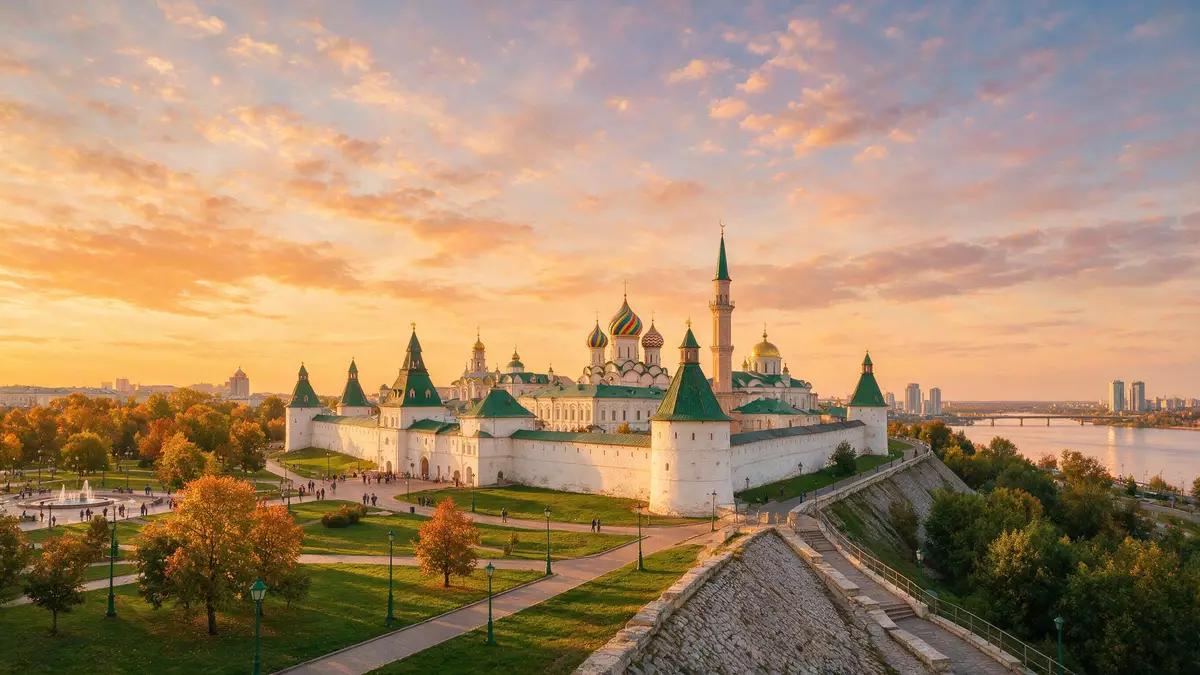
Kazanski Kreml is the historic citadel of Kasan, rising on an elevated terrace above the river Kazanka where it meets the Volga in Russia. This fortified hilltop, known formally as the Historic and Architectural Complex of the Kazan Kremlin, brings together Tatar, Russian and earlier Bulgar layers in one walled ensemble that was reshaped after Tsar Ivan IV, known as Ivan the Terrible, conquered Kazan in 1552.
Fortress on the high cape above the Kazanka
The core of Kazanski Kreml occupies a pronounced cape on the left bank of the Kazanka, with the land falling away towards the river and the wider Volga valley. The kremlin’s inner space follows a regular plan laid out across the hilltop, enclosed by fortification walls whose length and height mark it as a substantial stronghold; the fortifications define a compact plateau that can be walked end to end without leaving the defensive perimeter.The Kremlin is situated in the central part of Kazan, on the cape of an elevated terrace of the left bank of the river Kazanka
Fortified occupation of this hill dates back many centuries, with archaeological and structural remains from the tenth to the sixteenth century embedded in the present complex. Earlier phases include fortified settlements associated with Volga Bulgaria, later structures tied to the Golden Horde and, in the fifteenth and sixteenth centuries, the Kazan Khanate, which made the hill its seat of power. The current kremlin, rebuilt in white stone after the conquest of Kazan by Ivan IV in 1552, overlays these earlier fortresses while preserving elements of them within its fabric.????? ?????? ?????? ?????? ??????? ? 1552 ???? ?? ??? ??????? ???? ????????? ????? ???????? ?? ?????? ?????
Layers of Tatar and Russian power inside the walls
Within the walls of Kazanski Kreml stand buildings dating from the sixteenth to the nineteenth centuries, arranged along streets and squares that reflect its long role as an administrative centre.the Kazan Kremlin consists of an outstanding group of historic buildings dating from the 16th to 19th centuries, integrating remains of earlier structures of the 10th to 16th centuries Orthodox Christian structures such as the Annunciation Cathedral from the 1560s stand alongside the leaning Suyumbike Tower, a brick tower traditionally dated to the mid seventeenth century, and later palatial buildings from the eighteenth and nineteenth centuries. Together they show how the hilltop evolved from a Tatar khanate centre into a Russian provincial capital and, more recently, the seat of the president of the Republic of Tatarstan.It includes unique objects of cultural heritage, such as Walls and Towers, 1555-1568, Annunciation Cathedral, 1562, Tower of Suyumbike, mid XVII century, Palace Church, early XVIII century, Governor’s Palace, mid XIX century
Religious and civic functions share the same enclosure. The Annunciation Cathedral and other churches, the Kul Sharif Mosque built in the late twentieth and early twenty-first century in memory of a historic mosque destroyed after the conquest, and the presidential residence of Tatarstan stand within sight of one another. This juxtaposition gives visitors a direct view of how Kazanski Kreml expresses both Tatar identity and Russian state power inside the same fortification, with white-stone walls encircling minarets, domes, towers and offices on one hill.
UNESCO World Heritage and a compact historic ensemble
Kazanski Kreml is recognised internationally as a cultural site of outstanding value. In 2000 it was inscribed on the UNESCO World Heritage List as the Historic and Architectural Complex of the Kazan Kremlin, under cultural criteria that emphasise the synthesis of artistic styles and the way the site reflects successive historical epochs from Bulgar through Golden Horde and Tatar to Russian periods.The historical and architectural complex of the Kazan Kremlin was included in the World Heritage List in 2000 As the only surviving Tatar fortress in Russia, it concentrates the architectural heritage of an entire region within one accessible ensemble.The only surviving Tatar fortress in Russia and an important place of pilgrimage, the Kazan Kremlin consists of an outstanding group of historic buildings
The kremlin covers a clearly defined area on the hill, enclosed by walls whose height and thickness underline its original defensive purpose. Within that space, visitors encounter streets lined with historic façades, open squares looking out towards the rivers and vantage points across Kasan. The ensemble stands at the centre of the city, linked by major streets such as Ulitsa Kremlyovskaya and surrounded by modern districts, yet within the walls the focus is on stone architecture, towers and plazas that preserve the layout of a fortress adapted over several centuries.The Kazan Kremlin is located in the centre of Kazan on a high peninsular sticking out into the Kazanka and Volga Rivers
Visiting Kazanski Kreml: what travellers from Western Europe should know
- Kazanski Kreml stands in central Kasan on the high ground between the Kazanka and the Volga, reached by city streets such as Ulitsa Kremlyovskaya and adjacent squares.
- The terrain within the kremlin is a hilltop plateau enclosed by fortification walls, with streets, squares and some stairways linking different levels between the riverside and the upper citadel.
- Kasan lies in the Republic of Tatarstan in Russia; the official languages are Russian and Tatar and the currency is the Russian rouble.
- Entry requirements depend on your nationality; UK travellers can check the FCDO travel advice at gov.uk/foreign-travel-advice, Irish travellers the Department of Foreign Affairs at ireland.ie.
Searching for Kazanski Kreml on social platforms
These links open searches for Kazanski Kreml on each platform.
Frequently asked questions about Kazanski Kreml
Where is Kazanski Kreml located within Kasan?
Kazanski Kreml stands in the centre of Kasan on a high cape between the Kazanka and the Volga rivers, forming the city’s historic hilltop citadel.
What should visitors expect when entering the kremlin?
Visitors enter through the fortification walls into a compact hilltop ensemble of streets, squares, churches, mosques, towers and official buildings within the historic fortress.
What makes Kazanski Kreml distinctive among Russian fortresses?
Kazanski Kreml combines Tatar and Russian heritage as the only surviving Tatar fortress in Russia, with buildings from the sixteenth to nineteenth centuries and earlier remains in one UNESCO-listed complex.


