
Kazanski Kreml as a meeting place of Tatar and Russian traditions
Published on 08/27/2026 at 13:14 | Editorial responsibility: Rafael Müller, Editor-in-Chief AD HOC NEWS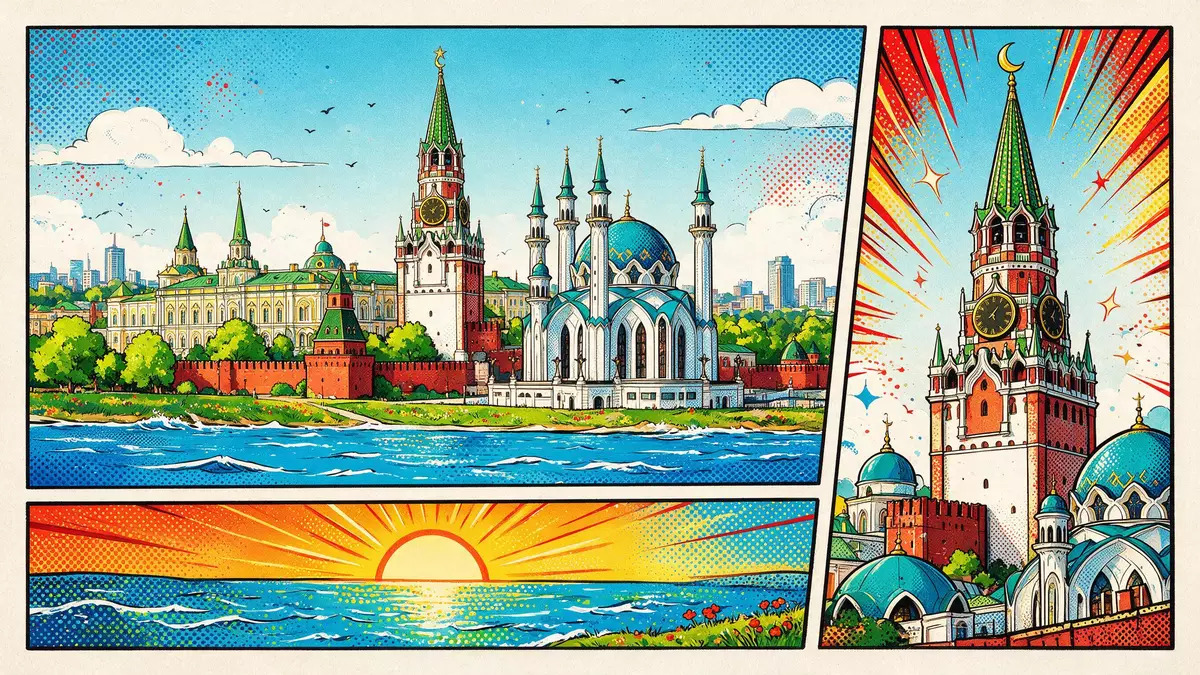
Kazanski Kreml crowns a high terrace above the river in Kasan, a walled citadel where Tatar and Russian traditions share the same enclosed hilltop. The historic and architectural complex was inscribed on the UNESCO World Heritage List in 2000 and sets a stone frame for the city’s skyline with its towers, palaces and sacred buildings.
Stone walls on a Tatar hilltop
The name Kazanski Kreml refers to the historic citadel of Kasan, capital of the Republic of Tatarstan in the middle Volga region of Russia. The fortress occupies a prominent headland above the Kazanka River, close to where it meets the broader Volga plain, and forms the oldest urban core of the city.Historic and Architectural Complex
The defensive circuit of Kazanski Kreml is formed by pale stone walls punctuated by towers from the sixteenth century and later. Their profile follows the edge of the plateau, enclosing a compound that still functions as an administrative and ceremonial centre for Tatarstan.walls and towers, 1555-1568 Within these walls lie layers of construction from the sixteenth to the nineteenth centuries, integrating earlier archaeological remains from as early as the tenth century.
A citadel of two faiths
Kazanski Kreml is closely associated with Ivan IV, known in English as Ivan the Terrible, who ordered a new stone fortress here in the sixteenth century after the conquest of the Kazan Khanate.built at the behest of Ivan the Terrible The ensemble that grew on this site illustrates how Orthodox Christian and Islamic traditions meet: an Orthodox cathedral and an important mosque stand within the same fortified perimeter.
The white Annunciation Cathedral, completed in the sixteenth century, is one of the dominant church buildings of the citadel, with multiple domes rising above its masonry walls.Annunciation Cathedral, 1562 Nearby, a more recent mosque with high minarets and a spacious prayer hall brings Tatar Islamic architecture visibly into the same courtyard system. Together they underline the mixed cultural history of Tatarstan and the long coexistence of Islam and Orthodox Christianity within the city.
Towers, palaces and views across the rivers
Among the towers of Kazanski Kreml, the leaning silhouette of the Suyumbike Tower is one of the most recognisable. Rising in several diminishing tiers, this brick tower dates from the seventeenth century and stands close to the edge of the plateau, where it overlooks the rivers and the expanding city below.Suyumbike Tower, mid seventeenth century
Across the inner courtyards stand administrative and residential buildings from the eighteenth and nineteenth centuries, including the Governor’s Palace, which continues the stone architecture in a more classical style.Governor’s Palace, mid nineteenth century From the open spaces inside the walls there are broad views across the Kazanka towards the modern quarters of Kasan, while within the fortification the combination of towers, churches, mosques and palaces forms a compact outline of the region’s history.
Visiting Kazanski Kreml: what travellers from Western Europe should know
- Kazanski Kreml stands in the historic centre of Kasan, on a headland above the Kazanka River, and is reached by city streets and public transport lines that converge on the citadel.
- The terrain within the fortress includes sloping cobbled courtyards and stairways, so moving between the different levels and towers involves some walking on uneven surfaces.
- The official language is Russian and the currency is the rouble.
- Entry requirements depend on your nationality; UK travellers can check the FCDO travel advice at gov.uk/foreign-travel-advice, Irish travellers the Department of Foreign Affairs at ireland.ie.
Searching for Kazanski Kreml on social platforms
These links open searches for Kazanski Kreml on each platform.
Frequently asked questions about Kazanski Kreml
Where is Kazanski Kreml located?
Kazanski Kreml stands in Kasan, capital of the Republic of Tatarstan in Russia, on a high terrace above the Kazanka River near its confluence with the Volga basin.
What can visitors expect inside the walls?
Visitors encounter stone walls, towers, an Orthodox cathedral, a major mosque, administrative palaces and open courtyards that together illustrate several centuries of Tatar and Russian architecture.
What makes Kazanski Kreml distinctive among fortress complexes?
The combination of Tatar fortress origins, association with Ivan the Terrible and the coexistence of major Islamic and Orthodox monuments within one citadel gives Kazanski Kreml a particular character.


