
Kazanski Kreml and the white walls above Kazan
Published on 08/30/2026 at 12:37 | Editorial responsibility: Rafael Müller, Editor-in-Chief AD HOC NEWS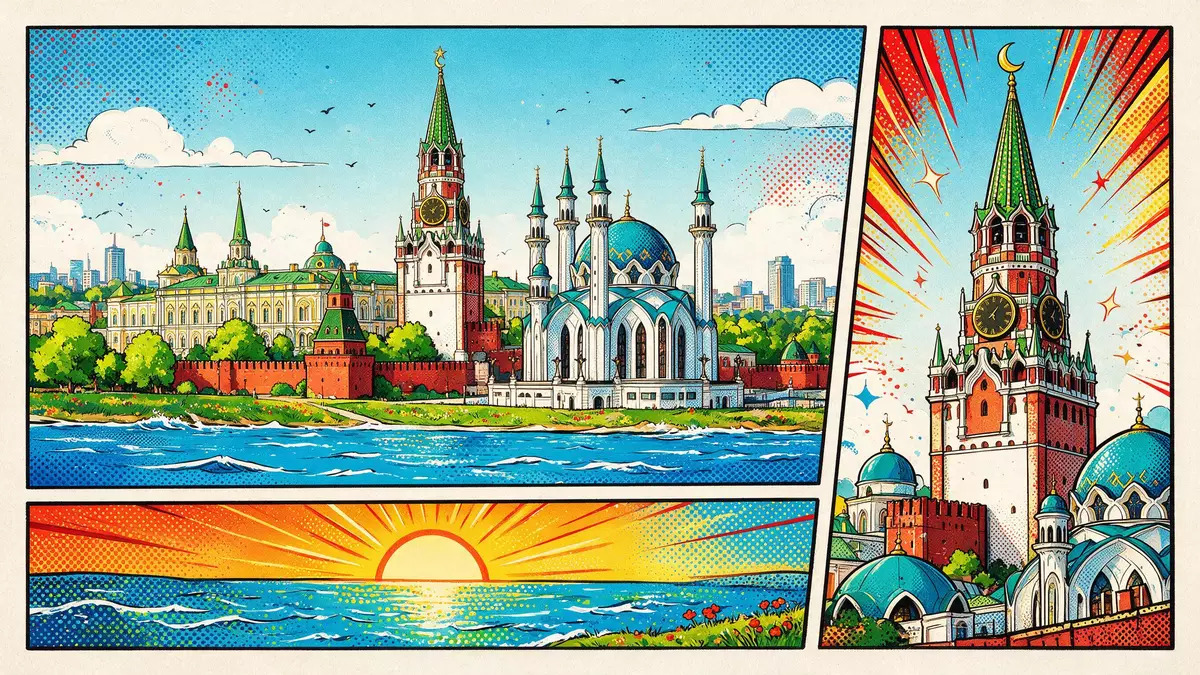
Kazanski Kreml rises above Kasan in white walls, towers and domes, with the Kazanka river below. The Historic and Architectural Complex of the Kazan Kremlin was inscribed on the UNESCO World Heritage List in 2000.
Kazanski Kreml and the layered citadel above the Kazanka
The complex combines fortifications, palaces, cathedrals and administrative buildings inside a single citadel. UNESCO describes it as the only surviving Tatar fortress in Russia, with buildings from the sixteenth to nineteenth centuries and traces of earlier structures.
The setting is part of its character. The Kremlin stands on an elevated terrace above the Kazanka, and the hill gives the enclosure an irregular outline that follows the ground beneath it.
The best-known monuments include the Annunciation Cathedral, the Governor’s Palace, Syuyumbeki’s Tower and the Kul Sharif Mosque. Their different forms make the Kremlin read as both a fortress and a civic quarter.
World Heritage List and the historic core of Kazan place the ensemble among Russia’s defining urban landmarks. The name Kazanski Kreml belongs to a site where military walls, sacred buildings and state space sit inside one perimeter.
Stone, faith and power in one enclosure
The Kremlin’s buildings reflect several historical layers rather than a single architectural moment. Some structures belong to the Tatar khanate period, while others date from the Russian imperial period and later additions.
That mixture is visible in the skyline. A mosque, Orthodox cathedrals, a tower and government buildings stand within the same defensive line, giving the site a dense and compact profile.
Kazanski Kreml also remains tied to the political life of Tatarstan. The Governor’s Palace and other administrative buildings sit alongside monuments that represent the city’s religious history.
UNESCO Russia page and the wider Kremlin precinct both reinforce that status. The enclosure is not a ruin field; it is a living ensemble of walls, towers and institutional buildings.
A citadel built across several centuries
The historic core includes material from the tenth to nineteenth centuries, with the strongest visible fabric belonging to the sixteenth century and after. That long span is part of what gives the place its layered appearance.
Within the walls, individual monuments present different traditions side by side. Russian Orthodox architecture, Tatar forms and later civic architecture all appear in a compact historic landscape.
The Kremlin’s profile is shaped by stone walls, pale façades and golden domes. The ensemble reads as a fortified height rather than a single building, and the irregular plan follows the hill.
World Heritage decision records the site’s criteria and its synthesis of Tatar and Russian influences. The result is an urban citadel where architecture from different periods sits inside one historic boundary.
Visiting Kazanski Kreml: what travellers from Western Europe should know
- Kazanski Kreml stands in central Kasan near the Kazanka river. City streets lead to the fortress gates, and the ensemble is part of the historic core.
- The terrain is a hill with an uneven outline. Paths, walls and towers follow the slope, and the site rewards attention to levels as well as façades.
- The official language is Russian and the currency is the Russian ruble.
- Entry requirements depend on your nationality; UK travellers can check the FCDO travel advice at gov.uk/foreign-travel-advice, Irish travellers the Department of Foreign Affairs at ireland.ie.
Searching for Kazanski Kreml on social platforms
These links open searches for Kazanski Kreml on each platform.
Frequently asked questions about Kazanski Kreml
Where is Kazanski Kreml?
It stands in Kasan, on a hill above the Kazanka river. The Kremlin forms the historic core of the city.
What does a visit reveal?
It reveals a fortified enclosure with walls, towers, cathedrals, a mosque and administrative buildings. The mix of forms makes the complex readable from several angles.
What makes it distinctive?
The site combines Tatar and Russian architectural traditions inside one UNESCO-listed citadel. Its long historical span runs from early structures to the nineteenth century.


