
Kazanski Kreml and the layered citadel of Kasan
Published on 08/28/2026 at 06:52 | Editorial responsibility: Rafael Müller, Editor-in-Chief AD HOC NEWS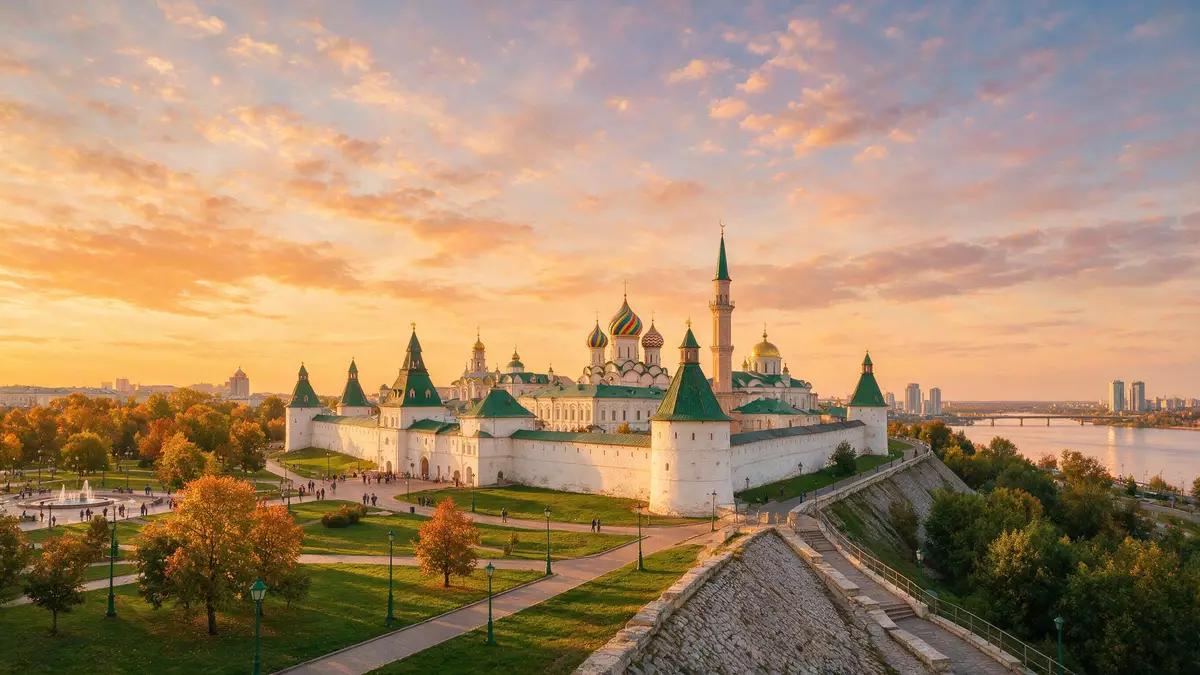
Kazanski Kreml in Kasan is a fortified ensemble whose walls, towers and churches make its layered history visible at a glance. The complex is the Historic and Architectural Complex of the Kazan Kremlin and a UNESCO World Heritage site.
Kazanski Kreml as a citadel of walls and towers
The Kremlin’s outline is defined by white masonry walls and several towers, with the Söyembikä Tower giving the skyline a distinct vertical counterpoint. The ensemble is linked with the era of Ivan the Terrible, the sixteenth century, and the architectural work of Pskov masters such as Postnik Yakovlev and Ivan Shiryay.
Its buildings span the sixteenth to nineteenth centuries, while older traces from the tenth to sixteenth centuries are integrated within the present complex. That long sequence gives Kazanski Kreml its layered character, with fortification, church architecture and civic buildings sharing one enclosed setting.
Orthodox churches and Tatar memory
Inside the walls, the Annunciation Cathedral and Qol Sharif Mosque stand as the clearest statements of the site’s mixed heritage. The cathedral was built in 1561–1562, and the mosque is the later rebuilding of a structure associated with Kazan’s pre-Russian past.
That combination places Orthodox and Muslim monuments within the same historic citadel. UNESCO describes the complex as the only surviving Tatar fortress in Russia, and that designation fits the way different epochs remain legible in stone, brick and domes.
Why the Kremlin reads as one place
The power of Kazanski Kreml lies in the fact that it does not present one period alone. The walls, towers, cathedral and mosque belong to different moments, yet they are arranged within a single walled compound.
Ivan the Terrible, Postnik Yakovlev and the wider architectural tradition of the Kazan Kremlin all belong to that story. The result is a citadel where military form, religious buildings and a museum landscape remain in close conversation.
Visiting Kazanski Kreml: what travellers from Western Europe should know
- The Kremlin stands in central Kasan, in the Republic of Tatarstan. It can be approached through the city streets and entered on foot within the historic core.
- The site includes walls, towers and uneven routes across a large enclosed complex. Some viewpoints and upper levels involve steps and changing levels.
- English is not the official language; the official language is Russian and the currency is the Russian ruble.
- Entry requirements depend on your nationality; UK travellers can check the FCDO travel advice at gov.uk/foreign-travel-advice, Irish travellers the Department of Foreign Affairs at ireland.ie.
Searching for Kazanski Kreml on social platforms
These links open searches for Kazanski Kreml on each platform.
Frequently asked questions about Kazanski Kreml
Where is Kazanski Kreml?
It stands in Kasan, in the Republic of Tatarstan, Russia, on the city’s historic high ground. The complex overlooks the urban centre and remains the main citadel of the city.
What does a visit involve?
The site combines walls, towers, a cathedral, a mosque and museum buildings within one enclosed complex. The visitor walks through a historic fortress landscape rather than a single monument.
What makes it distinctive?
The strongest feature is the meeting of Tatar, Orthodox and Russian layers in one fortified ensemble. Its UNESCO status and its long building history give that mixture a clear historical frame.


