
Kazanski Kreml: a hilltop citadel of stone and faith in Kasan
Published on 09/10/2026 at 16:26 | Editorial responsibility: Rafael Müller, Editor-in-Chief AD HOC NEWS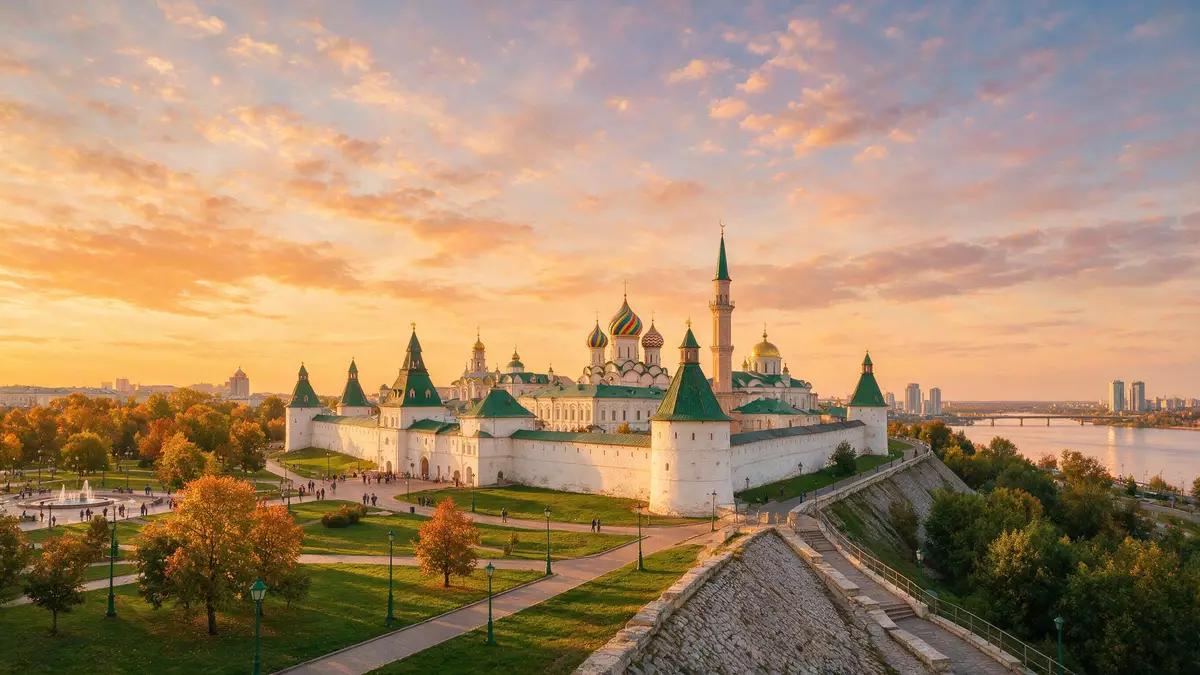
Kazanski Kreml rises above Kasan as a walled hilltop citadel, a historic core where state power, Orthodox Christianity and Islam share the same compact plateau. Its ensemble of towers, churches, mosques and civic buildings reflects centuries of rule from medieval Volga Bulgaria through the Kazan Khanate to the Russian Empire, before gaining recognition as a UNESCO World Heritage Site in 2000.
A historic fortress on the Volga terrace
The Kazanski Kreml occupies a high terrace on the left bank of the Kazanka River at the point where the river bends through the centre of Kasan. Within its white defensive walls stand a group of historic buildings from the sixteenth to the nineteenth centuries that incorporate traces of earlier structures reaching back to the tenth century, forming the core of what UNESCO calls the Historic and Architectural Complex of the Kazan Kremlin.Historic and Architectural Complex
The present stone walls date to the decades after the conquest of Kazan by Ivan IV, better known as Ivan the Terrible, in 1552. Wooden fortifications from the Kazan Khanate period were largely destroyed during that campaign, and new masonry ramparts and towers were erected as a fortress for the expanding Russian state in the second half of the sixteenth century.walls and towers Over later centuries the Kremlin also took on the role of administrative centre for the Middle Volga region and, within the Russian Empire, for the Kazan district.
Layers of power: from Bulgar stronghold to Tatarstan’s presidency
Long before it became a Russian fortress, the site of Kazanski Kreml had served successive regimes as their seat of authority. In the pre-Mongol era from the tenth to the mid-thirteenth century it developed from an unfortified settlement into a fort marking the northern boundary of Volga Bulgaria, already functioning as a military and commercial hub by the twelfth century.northern boundary of Volga Bulgaria
From the later thirteenth century until the first half of the fifteenth century the Kremlin formed part of the Golden Horde, then became the governmental and military base of the Kazan Khanate between 1438 and 1552.Kazan Khanate between 1438 and 1552 After Ivan IV’s forces seized Kazan, the fortress was converted into the administrative and military centre of the annexed Middle Volga territories, a role it retained into the eighteenth century. In the Russian Federation it became the official residence of the Head of the Republic of Tatarstan, and today the Kremlin still houses the presidential residence alongside museums and religious buildings.official residence of the Head of the Republic of Tatarstan
Stone, brick and faith: the Kremlin’s inner ensemble
Inside the walls, Kazanski Kreml presents an ensemble where Orthodox Christian and Islamic architecture stand side by side. One of its landmarks is the Annunciation Cathedral, an Orthodox church whose origins lie in the sixteenth century and whose pale masonry and domes recall the period when Russian builders reshaped the fortress under Ivan IV.Annunciation Cathedral
The Kul Sharif Mosque, completed in the early twenty-first century, brings a set of tall minarets and a generous prayer hall into the Kremlin’s skyline, echoing traditions of Tatar religious architecture within the historic fortress.Kul Sharif Mosque Nearby stand civic buildings such as the Governor’s Palace, which serves as the presidential residence, and museum complexes arranged in former administrative quarters. Together they form a state historical, architectural and artistic museum preserve recognised on the UNESCO World Heritage List in 2000.state historical, architectural and artistic museum preserve
Visiting Kazanski Kreml: what travellers from Western Europe should know
- Kazanski Kreml stands in the centre of Kasan on a bluff above the Kazanka River, reached by city streets and public transport including the metro station named for the Kremlin.
- Within the walls, the terrain rises and falls over the terrace, and access between levels often involves outdoor stairways and paved slopes rather than long, flat walks.
- The complex lies close to the meeting point of the Volga and Kazanka rivers, so viewpoints on the ramparts and squares look out over broad water and the modern city districts beyond.
- The official language is Russian and the currency is the rouble.
- Entry requirements depend on your nationality; UK travellers can check the FCDO travel advice at gov.uk/foreign-travel-advice, Irish travellers the Department of Foreign Affairs at ireland.ie.
Searching for Kazanski Kreml on social platforms
These links open searches for Kazanski Kreml on each platform.
Frequently asked questions about Kazanski Kreml
Where is Kazanski Kreml and what kind of place is it?
Kazanski Kreml is a fortified historic citadel on a high terrace beside the Kazanka River in Kasan, a city in Russia.
What should visitors expect when entering the Kremlin complex?
Visitors enter through historic gates into enclosed squares and streets lined with religious buildings, museums and administrative structures set among walls, towers and viewpoints.
What makes Kazanski Kreml distinctive among Russian historic sites?
The Kremlin’s combination of Tatar and Russian heritage, with an Orthodox cathedral and a mosque within the same fortified complex and the presidential residence of Tatarstan, gives it a distinctive character.


