
Kawah Ijen and the chemistry of a turquoise crater lake
Published on 09/24/2026 at 00:16 | Editorial responsibility: Rafael Müller, Editor-in-Chief AD HOC NEWS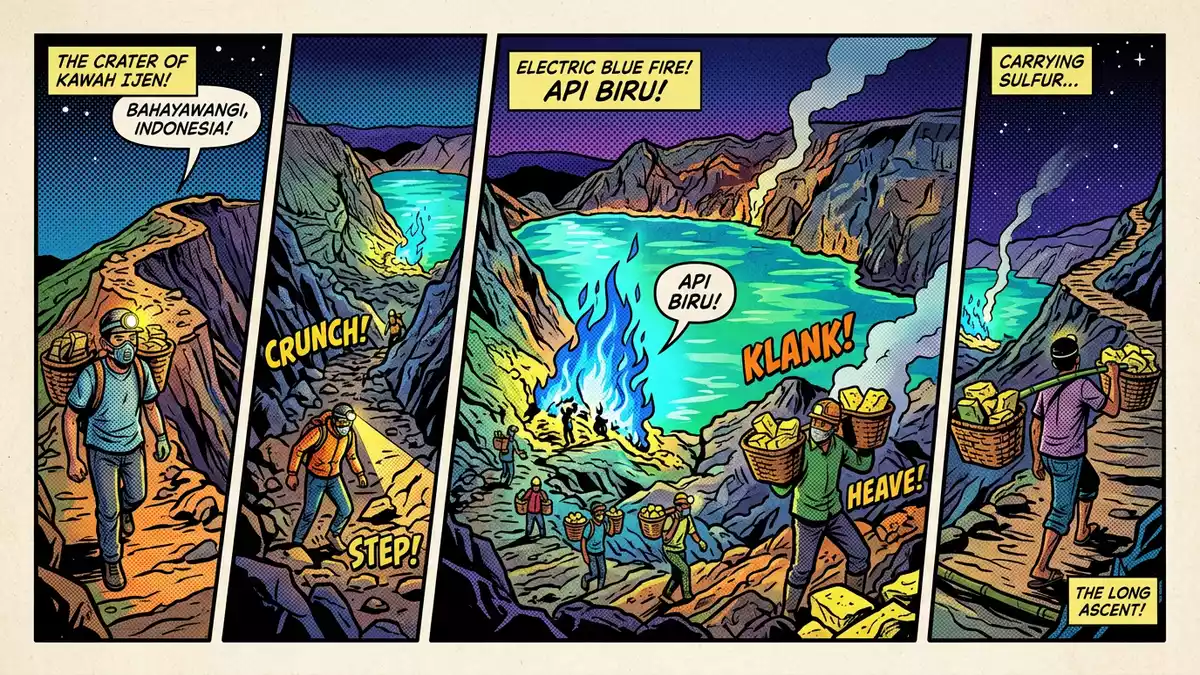
Kawah Ijen is a volcanic crater in eastern Java, above Banyuwangi, with a turquoise lake enclosed by dark walls. Sulphur vents, mining paths and night-time blue flames occupy the same dramatic volcanic landscape.
Kawah Ijen’s lake inside the Ijen caldera
Kawah Ijen belongs to the Ijen volcanic complex, a group of cones and craters within a caldera on Java’s eastern end. The wider caldera measures about 20 km across, while the active crater contains a lake nearly 1 km wide.
The lake surface lies at about 2,200 m, beneath a crater rim associated with the Kawah Ijen cone. The wider volcanic complex reaches 2,769 m at Gunung Merapi, a neighbouring summit on the caldera’s eastern side. Ijen’s volcanic profile records the complex’s stratovolcanic form and elevation.
The lake is an intensely acidic body of water, with a measured depth of about 200 m in geological descriptions. Its colour comes from the mineral-rich chemistry of a crater lake connected with an active hydrothermal system.
Blue fire, sulphur and the crater’s working landscape
Kawah Ijen’s blue flames are produced by sulphur-bearing gases that ignite after emerging from fumaroles. The flames appear blue in darkness, while daylight obscures the colour against the surrounding crater.
The visible fire is not blue lava. It is burning volcanic gas, associated with temperatures exceeding 360°C in the sulphur-rich vent area. The Ijen geopark landscape includes the volcano, its crater lake and the blue-fire phenomenon.
Sulphur also gives Kawah Ijen a human working landscape. Miners break solid sulphur from deposits near the fumaroles and carry it in baskets across the steep crater terrain. The yellow mineral appears beside grey volcanic rock, white gases and the lake’s green-blue surface.
The mining tradition forms part of the place’s cultural identity, but the physical work remains demanding. The crater combines steep paths, volcanic gases, unstable ground and a lake with highly corrosive water.
A volcanic record from Java’s eastern edge
The Ijen caldera formed through major volcanic activity, followed by the growth of smaller cones and craters within its broad depression. Kawah Ijen is one of those post-caldera volcanic centres.
Historical records describe eruptive activity from 1796, with further eruptions recorded in 1817, 1917, 1936, 1952, 1993, 1994 and 1999. The activity has included phreatic explosions, which occur when heated water and volcanic gases disrupt the crater system.
The eruption of 1817 is associated with destructive mudflows in the surrounding landscape. Kawah Ijen’s history therefore includes both a striking lake and a volcanic system with documented hazards.
In 2023, the wider Ijen area received UNESCO Global Geopark designation. The geopark connects volcanic landforms with forests, coffee-growing areas, cultural traditions and coastal geology across eastern Java.
Its geological story extends beyond the crater rim. Volcanic cones, lava flows, altered rocks and hydrothermal deposits appear across the region. The Banyu Pahit river carries acidic water away from the crater system.
Visiting Kawah Ijen: what travellers from Western Europe should know
- Kawah Ijen lies in eastern Java, above Banyuwangi. Access from the Banyuwangi side leads towards the Paltuding area and the mountain route.
- The approach is a high-altitude walk over steep volcanic terrain. The route reaches the crater rim, with further descent associated with the sulphur-mining area.
- The crater contains acidic water, fumaroles and volcanic gases. The blue flames belong to the dark hours, while the turquoise lake is a daylight landscape.
- The official language is Indonesian and the currency is the Indonesian rupiah.
- Conditions on the mountain change with the seasons; the local cable-car operators and alpine clubs provide information.
Searching for Kawah Ijen on social platforms
These links open searches for Kawah Ijen on each platform.
Frequently asked questions about Kawah Ijen
Where is Kawah Ijen?
Kawah Ijen is in eastern Java, Indonesia, in the volcanic highlands above Banyuwangi. It lies within the Ijen caldera, near Java’s eastern end.
What can visitors expect at Kawah Ijen?
The landscape combines a steep mountain approach, a turquoise acidic lake, fumaroles, sulphur deposits and a working mining area. Blue flames belong to the sulphur gases visible in darkness.
What makes Kawah Ijen distinctive?
Kawah Ijen brings together a highly acidic crater lake, active sulphur deposits and blue-burning volcanic gases. The site also forms part of the Ijen UNESCO Global Geopark, designated in 2023.


