
Kato Mili windmills on the ridge above Little Venice
Published on 09/16/2026 at 11:09 | Editorial responsibility: Rafael Müller, Editor-in-Chief AD HOC NEWS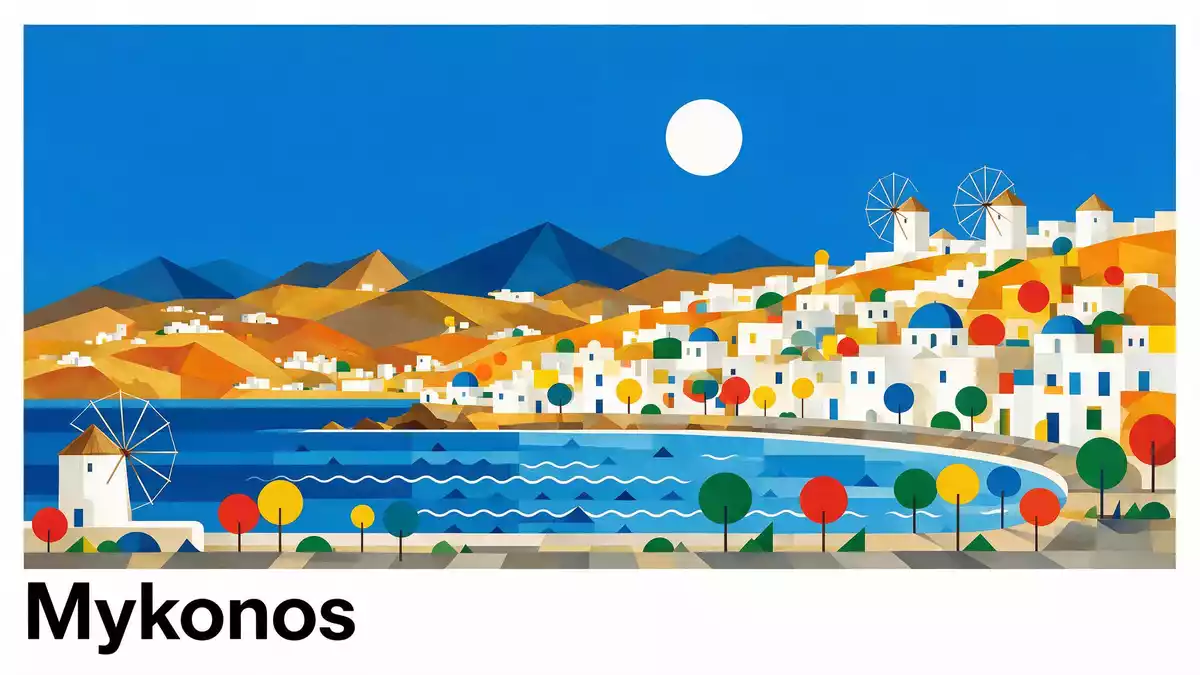
Kato Mili is the name given to the row of whitewashed windmills that stand on a low hill above Little Venice in Mykonos Town on the island of Mykonos in Greece. The hilltop ridge carries several cylindrical stone mills dating to the sixteenth century, when Mykonos lay under Venetian influence and grain milling formed a central part of the island’s economy.
A ridge of white mills above the Aegean
The Kato Mili windmills rise on a small hill at the southern edge of Mykonos Town, between the harbour quarter of Alefkandra and the neighbourhood known as Neochori, overlooking the Aegean Sea and the waterfront houses of Little Venice below.Situated on a small hill overlooking the sea The ridge forms a kind of natural balcony over the harbour, and from the slope the view reaches across the old port and out towards the wider townscape of Chora, as locals call the main settlement.
Seven cylindrical windmill structures are preserved in the Kato Mili cluster, forming a line along the crest above the sea and the tavern-lined lanes below.Seven cylindrical windmill structures are preserved Each mill is built as a heavy multi-storey stone construction, rendered in white plaster with small windows and a simple cap, a form that stands out against the deep blue of sea and sky.Heavy multi-storey constructions made of stone
From Venetian-era grain to heritage landmark
Most of the windmills around Chora, including the Kato Mili group, were constructed during the sixteenth century, a period when the island’s economy depended strongly on grain production and flour.Most of the windmills were constructed by the Venetians in the sixteenth century Venetian interests on Mykonos used the strong Meltemi winds of the central Aegean to drive the sails and internal machinery of the mills, grinding wheat and barley for local consumption and for ships calling at the harbour.Harnessing wind to grind wheat and barley
By the end of the eighteenth century and through the nineteenth century, several dozen windmills operated across Mykonos, with ten forming the original Kato Mili complex near Alefkandra.Ten mills formed the Kato Mili complex near Alefkandra Wealthy landowners, merchants, sailors and monasteries such as Panagia Tourliani held many of these mills, which supplied passing vessels with rusk and provided a significant source of income for island residents.Windmills contributed to the economic prosperity of the island
Architecture, layout and the meaning of “lower mills”
The architecture of the Kato Mili windmills follows a clear pattern: round plan, thick stone walls rendered in white, small openings and a timber cap carrying the sails.Round shape, white finish and pointed roof Inside, the mills are organised over several levels, with grain stored near the base and processed flour kept on upper floors, connected by internal stairways and machinery linked to the rotating sails.Three levels inside the mills for grain and flour
The name Kato Mili translates from Greek as “lower mills”, distinguishing this seafront row from other mills located higher on the island’s hills and ridges.The name Kato Mili literally means lower mills Ten mills once stood in this particular complex, and although fewer survive intact, the preserved row along the ridge above Little Venice has become closely associated with the identity of Mykonos as a whole.Ten of the 28 island windmills were located in the Kato Mili complex
Visiting Kato Mili: what travellers from Western Europe should know
- The Kato Mili windmills stand on a low hill just above the waterfront quarter called Little Venice, at the southern side of Mykonos Town on the island of Mykonos, Greece. The hill lies between the harbour area of Alefkandra and the Neochori neighbourhood.
- The terrain on the ridge is stony and gently sloping, with short paved approaches from the town and uneven ground immediately around the bases of the mills. Access from the waterfront involves an uphill walk on streets and paths.
- In summer the exposed hill can be bright and windy, with little shade around the windmills themselves. In winter the same exposure brings cooler coastal weather, with the Aegean visible in most directions.
- Mykonos lies in the Cyclades island group in Greece, where the official language is Greek and the currency is the euro (EUR).
Searching for Kato Mili on social platforms
These links open searches for Kato Mili on each platform.
Frequently asked questions about Kato Mili
Where is Kato Mili located on Mykonos?
Kato Mili stands on a small hill at the southern edge of Mykonos Town, between Alefkandra and Neochori, overlooking the waterfront district known as Little Venice.
What can visitors expect when walking up to the windmills?
Visitors find a cluster of whitewashed cylindrical windmills on exposed coastal ground, with short uphill approaches on paved streets and wide views across the harbour and the Aegean.
What makes Kato Mili distinctive among Greek island landmarks?
Kato Mili combines sixteenth-century stone windmill architecture with a linear ridge layout above the sea, forming a clearly recognisable silhouette linked closely to Mykonos.


