
Kathmandu Durbar Square and the palaces that shaped a valley
Published on 09/15/2026 at 10:34 | Editorial responsibility: Rafael Müller, Editor-in-Chief AD HOC NEWS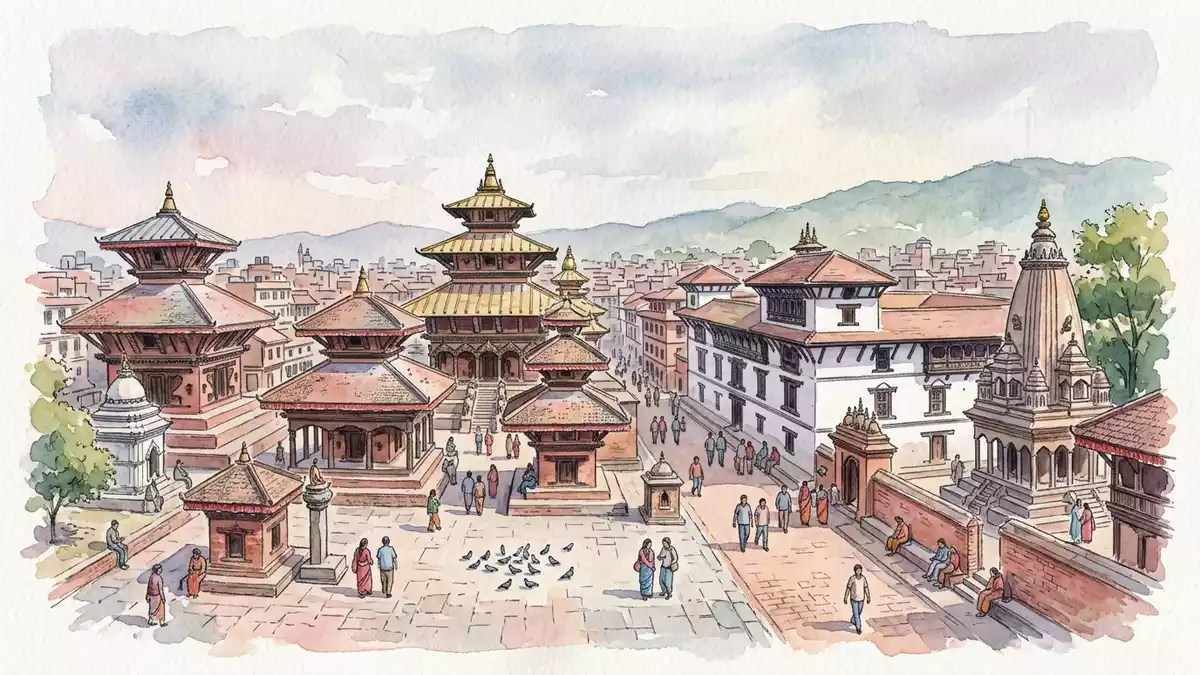
Kathmandu Durbar Square is the historic royal heart of Kathmandu, a dense ensemble of palaces, courtyards and temples that chart Nepal’s political and artistic history across many centuries. In the centre stands the Hanuman Dhoka Palace complex, where Malla and later Shah kings ruled the city before power shifted to newer residences in the nineteenth century.
Royal palaces in brick, timber and stone
The core of Kathmandu Durbar Square is the Hanuman Dhoka Palace, a sprawling complex that once served as the main royal residence for the Malla rulers and, after 1769, for the Shah dynasty.Hanumandhoka Palace complex The palace grew over centuries, with structures and wings added between the fifteenth and twentieth centuries as successive kings extended, repaired and reshaped their seat of power.built between the fifteenth and twentieth centuries Within the complex, courtyards such as Mul Chowk date to the sixteenth century, forming enclosed ceremonial spaces ringed by finely carved wooden galleries.Mul Chowk built in 1564
The palace faces onto a series of squares filled with timber and brick structures whose facades belong to the Newar architectural tradition, the dominant style of the Kathmandu Valley.Newar architecture Rooflines step upwards in tiers, shrines sit above colonnaded platforms, and projecting windows carry dense bands of latticework and figurative carving. At the main entrance to the palace, an image of the Hindu deity Hanuman installed by King Pratap Malla in 1672 gives the complex its name and asserts the religious dimension of royal power.idol of Hanuman installed by Pratap Malla
Temples, courtyards and the living city
Surrounding the palace are temples that mark the square as both a courtly and a sacred landscape. During the sixteenth century, under Mahendra Malla, a series of important shrines was added, including the Jagannath Temple, Mahendreswara and the large Taleju Temple, which rises above the surrounding roofs.temples commissioned by Mahendra Malla These structures, together with other pagoda-style temples from the same era, frame processional routes and small squares where religious rituals take place.
Kathmandu Durbar Square also carries traces of earlier periods. The origins of the palace site reach back to the Licchavi era, and the square gained importance as Kathmandu emerged as a centre of power between the fourth and ninth centuries.origins in the Licchavi period Later Malla additions layered further courtyards, audience halls and shrines onto this base, creating a compact urban fabric in which palace walls sit beside temple plinths and narrow lanes thread between them.developed under the Malla dynasty
World Heritage status and Kathmandu’s dynasties
Kathmandu Durbar Square forms part of the Kathmandu Valley monument zone inscribed on the UNESCO World Heritage List in 1979, a recognition centred on the royal squares of Kathmandu, Patan and Bhaktapur and their ensembles of palaces and temples.Kathmandu Valley monument zone The designation reflects both the density of historic structures in the square and its role in state ceremonies, including coronations for monarchs of the Shah line. The Nautalle Durbar, a nine-storey palace built by Prithvi Narayan Shah, stands as a marker of Nepal’s unification under his rule in the eighteenth century.Nautalle Durbar built by Prithvi Narayan Shah
From Ratna Malla in the late fifteenth century through to Prithvi Bir Bikram Shah in the early twentieth century, rulers added wings, halls and decorative elements to Hanuman Dhoka, each extension leaving its own architectural signature.from Ratna Malla to Prithivi Bir Bikram Shah The result is a palace complex where different periods meet: older brick courtyards sit alongside later plastered facades, and Newar-style structures coexist with features introduced under rulers who were engaging with changing tastes and political conditions in the wider region.
Visiting Kathmandu Durbar Square: what travellers from Western Europe should know
- Kathmandu Durbar Square lies in the old city in central Kathmandu, south of the commercial districts around Thamel and New Road, and is reached on foot or by road vehicles.
- The site consists of paved squares, stepped temple plinths and palace courtyards, with many stairways and uneven stone surfaces that require steady footing.
- The square sits at the elevation of the Kathmandu Valley floor, so approaches from surrounding neighbourhoods involve modest gradients rather than sustained climbs.
- English is widely used in visitor information, but the official language is Nepali and the currency is the Nepalese rupee.
- Entry requirements depend on your nationality; UK travellers can check the FCDO travel advice at gov.uk/foreign-travel-advice, Irish travellers the Department of Foreign Affairs at ireland.ie.
Searching for Kathmandu Durbar Square on social platforms
These links open searches for Kathmandu Durbar Square on each platform.
Frequently asked questions about Kathmandu Durbar Square
Where is Kathmandu Durbar Square located within Kathmandu?
Kathmandu Durbar Square sits in the historic core of Kathmandu, near the junction of old market streets and administrative quarters south of the Thamel area.
What should visitors expect when exploring the square?
Visitors encounter palace courtyards, temples and stepped platforms set close together, with intricate Newar woodcarving and brickwork visible across many facades.
What makes Kathmandu Durbar Square distinctive among Nepal’s historic sites?
The square combines the Hanuman Dhoka royal palace complex with major temples such as the Taleju Temple and the Nautalle Durbar, and holds UNESCO World Heritage status.


