
Kathmandu Durbar Square and the layered palace city
Published on 09/09/2026 at 15:14 | Editorial responsibility: Rafael Müller, Editor-in-Chief AD HOC NEWS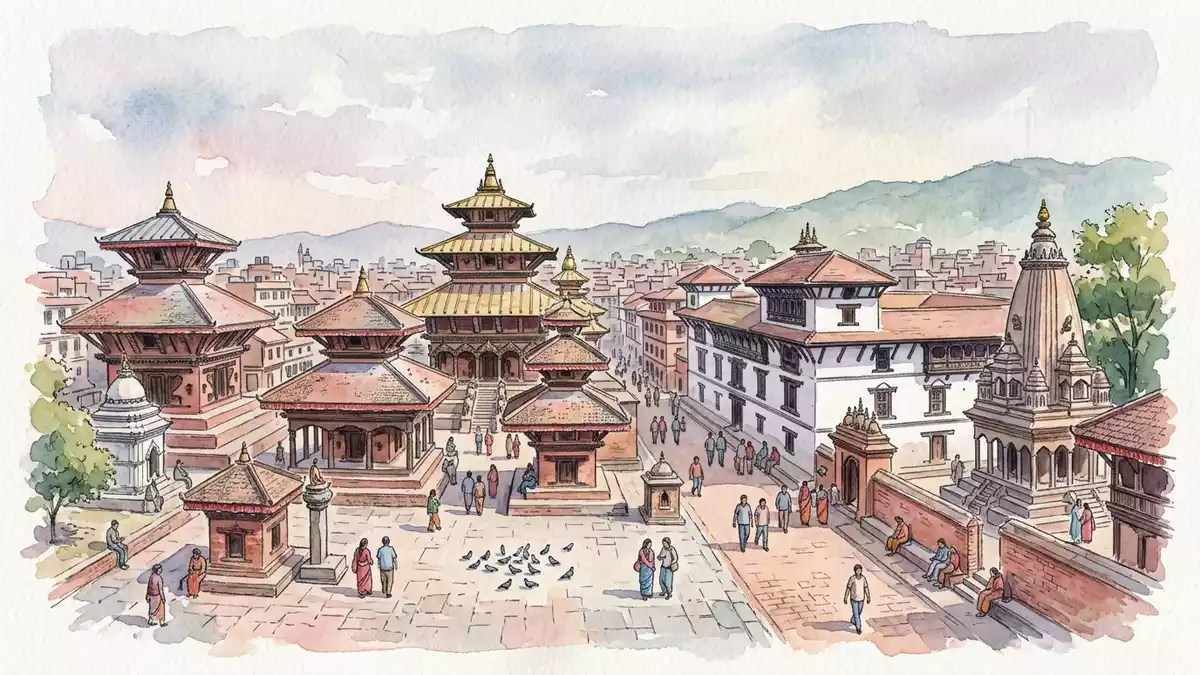
Kathmandu Durbar Square is the historic palace centre of Kathmandu, and its layered courtyards, temples and towers make the site read as a compact royal city. It forms part of the Kathmandu Valley UNESCO World Heritage property, inscribed in 1979, and it is closely tied to the Malla and Shah dynasties.
Palace courtyards and temple fronts in Kathmandu
The best-known core of the square is Hanuman Dhoka, the palace complex at the west side of the open precinct. Kathmandu Valley World Heritage links the square to the wider monument ensemble that makes Kathmandu distinctive within the valley.
Within the square, the eye moves between brick surfaces, timber galleries and pagoda roofs. The buildings show the Newar vocabulary of carved struts, courtyards and shrine fronts that defines much of historic Kathmandu.
Hanuman Dhoka and the Malla court
Hanuman Dhoka takes its name from the stone figure of Hanuman near the main entryway, and the complex grew under the Malla kings and the Shah dynasty. Its palace buildings preserve the memory of court life in central Kathmandu, where ceremonial space and domestic space sit side by side.
Pratap Malla is one of the names most closely associated with the complex, and the palace fabric reflects that long period of royal use. The square’s layered history is visible in its courtyards, gates and roofs rather than in a single unified plan.
Newar workmanship in wood, brick and stone
The place is strongest when seen as a material ensemble. Fired brick, timber beams and stone sculptures appear together across the precinct, and the carved wooden details give the square much of its character.
fired brick and timber are among the materials named in the World Heritage description, and they remain central to the square’s identity. That combination places Kathmandu Durbar Square within the broader Newar architectural tradition of the valley.
Visiting Kathmandu Durbar Square: what travellers from Western Europe should know
- The square lies in central Kathmandu, within the old urban core. It is reached on foot from nearby streets and by road traffic in the city centre.
- The precinct is made up of courtyards, steps, gateways and uneven surfaces. The ground-level transitions between spaces are part of the site’s historic layout.
- The official language is Nepali and the currency is the Nepalese rupee.
- Entry requirements depend on your nationality; UK travellers can check the FCDO travel advice at gov.uk/foreign-travel-advice, Irish travellers the Department of Foreign Affairs at ireland.ie.
Searching for Kathmandu Durbar Square on social platforms
These links open searches for Kathmandu Durbar Square on each platform.
Frequently asked questions about Kathmandu Durbar Square
Where is Kathmandu Durbar Square?
It is in central Kathmandu, inside the historic core of the city. The square belongs to the Kathmandu Valley heritage ensemble.
What does a visit to Kathmandu Durbar Square show?
It shows palace courtyards, temple fronts, carved timber and brick buildings in one compact urban setting. Hanuman Dhoka is the main palace complex associated with the square.
What makes Kathmandu Durbar Square distinctive?
Its combination of royal architecture, Newar craftsmanship and World Heritage status gives the square its character. The name Hanuman Dhoka and the association with Pratap Malla and the Malla court are central to that identity.


