
Katara’s waterfront village of culture and architecture in Doha
Published on 09/07/2026 at 13:59 | Editorial responsibility: Rafael Müller, Editor-in-Chief AD HOC NEWS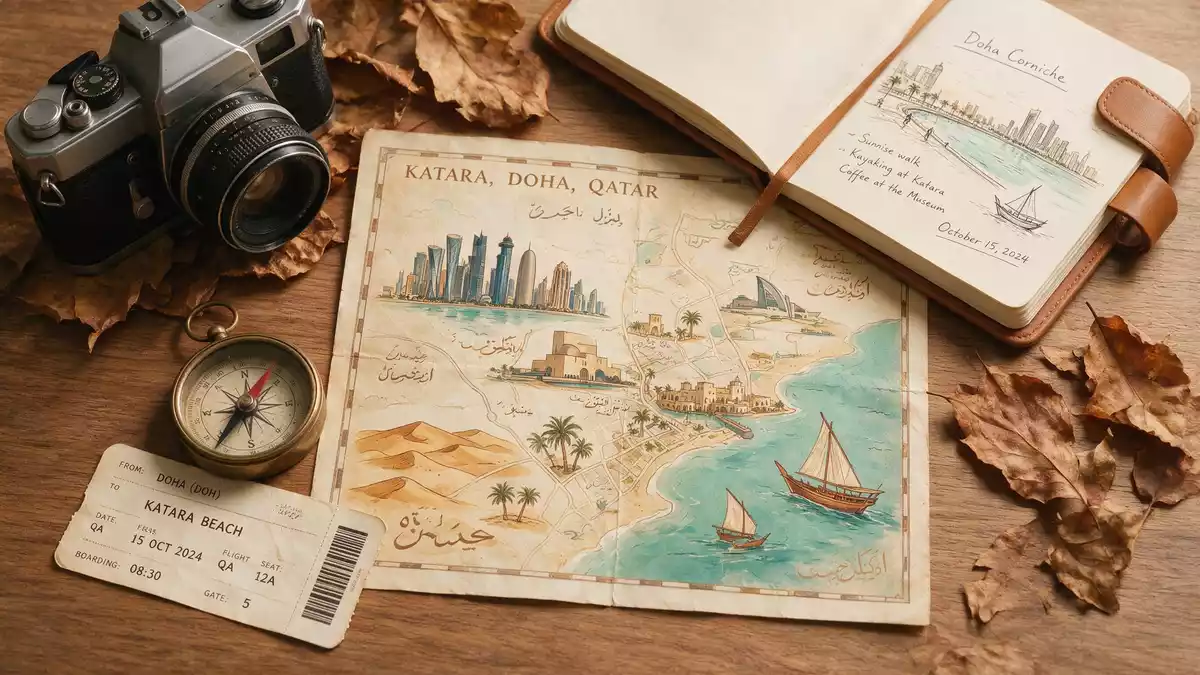
Katara in Doha is a purpose-built cultural village where Islamic-inspired architecture, arts venues and public spaces line a waterfront between the city’s West Bay district and The Pearl.Katara Cultural Village was established in 2010 on reclaimed land along the Arabian Gulf, and has developed into a compact district of mosques, theatres, galleries and a beach dedicated to culture and leisure.Katara is described as Doha’s go-to destination for art, culture and cuisine
Waterfront setting between West Bay and The Pearl
Katara occupies a stretch of Doha’s eastern coastline, framed by the Arabian Gulf on one side and the twin Katara Hills on the other.The village lies between West Bay and The Pearl, giving visitors views across modern high-rise towers and offshore residential developments from its promenades and open plazas.Katara sits along the turquoise waters of the Arabian Gulf and is bordered by a broad beach that hosts recreation as well as cultural events.
The village is laid out as a network of paved streets, courtyards and passages that recall the dense fabric of a traditional Middle Eastern town, while accommodating large public buildings and landscaped spaces.Descriptions emphasise cobblestone pathways and alleys reminiscent of a souq. The Katara Hills rise behind these streets as shaped landforms with paths and planting, forming a green backdrop to the seafront and giving elevated views back over mosques, theatres and the coastline.
Architectural highlights: amphitheatre, mosques and cultural venues
The most striking single structure in Katara is its open-air amphitheatre, a large stepped performance space facing the sea.The amphitheatre balances the classical Greek theatre concept with Islamic architectural features, combining stone seating tiers, arcades and decorative detailing in a form that can host sizable audiences. It occupies a central position within the village, with its stage and seating open to the sky and the waterfront beyond.
Religious architecture is another defining element. The Katara Mosque, also known as the Great Katara Mosque and the Blue Mosque, stands within the village as an elaborately decorated place of worship.The Katara Mosque is widely referred to as the Blue Mosque, and sources note its rich ornamentation and coloured surfaces.It is situated within Katara on Al Moasses Street in Doha. Nearby, the village includes pigeon towers, galleries, a drama theatre, an opera house associated with the Qatar Philharmonic Orchestra, and other venues that make cultural programming part of the everyday built environment.Katara houses galleries, an opera house, a drama theatre and an open amphitheatre
A contemporary hub for Qatari and global arts
Katara was conceived as a centre for culture and the arts, and its institutions reflect that role.Accounts describe Katara as constructed on reclaimed land along Doha’s coastline as a centre for culture and the arts. Organisations based in the village include societies for fine arts, visual arts and photography, alongside a music academy.Qatar Fine Arts Society, Visual Arts Centre, Qatar Photographic Society and the Music Academy all have headquarters in Katara. Exhibitions, performances and workshops occupy the halls and galleries, while outdoor plazas host installations and events in the open air.
A beach along the waterfront forms part of the village, laid out as a purpose-built strip for water-based activities and relaxation.Sources mention a 1.5 km beach inside the village, and the seafront is lined with cafes, restaurants and spaces for strolling beside the water.Katara is presented as a destination for culture and cuisine, with dining options integrated among the cultural buildings. Taken together, the streets, hills, mosques, theatres and beach create a district where everyday public life and formal cultural programming share the same waterfront setting.
Visiting Katara: what travellers from Western Europe should know
- Katara lies on Doha’s eastern shoreline between West Bay and The Pearl, reached by road and by the Doha Metro’s Red Line, which serves Katara Station.
- The village consists of paved streets, plazas and hills, and exploring its mosques, amphitheatre and waterfront involves walking on gradients, stairways and broad promenades.
- The official language is Arabic and the currency is the Qatari riyal.
- Entry requirements depend on your nationality; UK travellers can check the FCDO travel advice at gov.uk/foreign-travel-advice, Irish travellers the Department of Foreign Affairs at ireland.ie.
Searching for Katara on social platforms
These links open searches for Katara on each platform.Frequently asked questions about Katara
Where is Katara and what kind of place is it?
Katara is a cultural village on Doha’s eastern waterfront in Qatar, situated between the West Bay district and The Pearl and laid out as a compact urban quarter.
What can visitors expect when walking through Katara?
Visitors encounter mosques, theatres, galleries, pigeon towers, hills and a beach arranged along paved streets and plazas, with views over the Arabian Gulf and the city skyline.
What makes Katara distinctive compared with other parts of Doha?
Its combination of Islamic-inspired architecture, an open-air amphitheatre, cultural institutions and a purpose-built beach within one waterfront village distinguishes Katara within Doha.


