

Katara in Doha: sand-coloured streets between amphitheatre and sea
Published on 08/30/2026 at 12:44 | Editorial responsibility: Rafael Müller, Editor-in-Chief AD HOC NEWS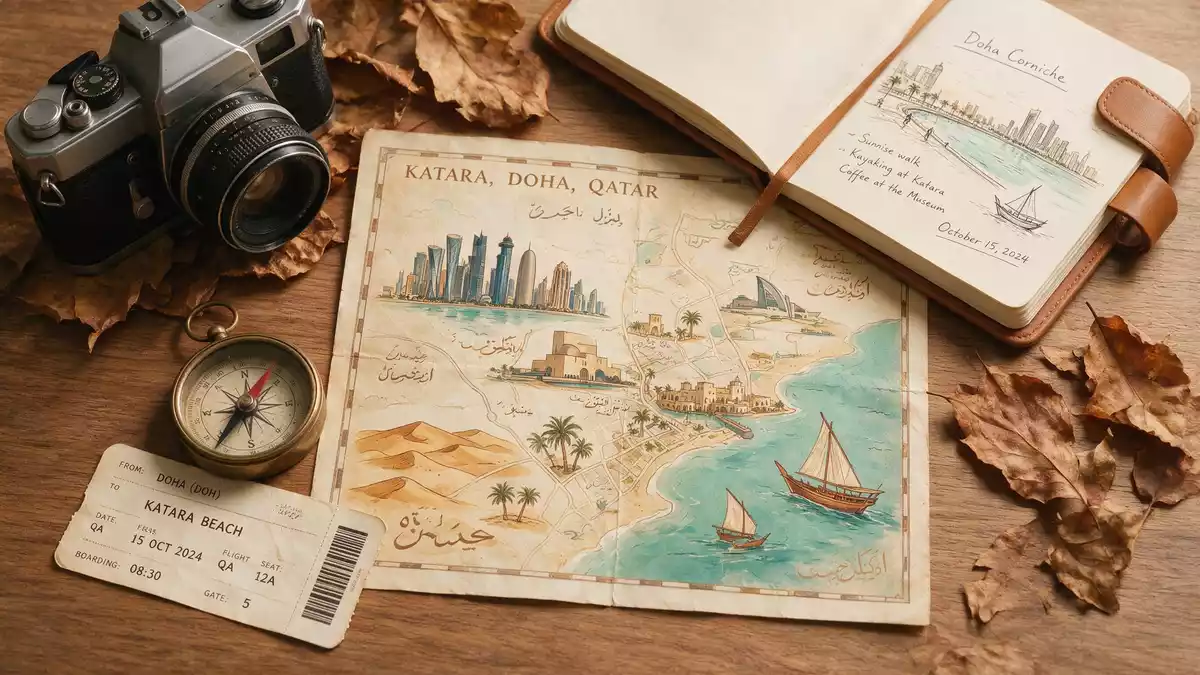
Katara in Doha is a purpose-built cultural village on Qatar’s eastern waterfront, laid out as a cluster of sand-coloured streets and courtyards between West Bay and the Pearl. Opened in 2010, it gathers theatres, galleries, mosques and promenades into a single district where architecture and public space frame views towards the Gulf.
Sand-coloured lanes and a coastal setting
Katara occupies reclaimed land on the coast of Doha, forming a narrow strip between the water and the city’s West Bay high-rises. Its plan reads as a compact town, with low-rise buildings in beige and sand tones arranged around plazas, passages and stairways, and a beach forming the seaward edge of the site.a cultural village on Qatar's eastern waterfront Within this fabric stand cultural venues, including theatres and exhibition spaces, alongside cafés and restaurants that open onto shaded colonnades and squares.
The architecture combines forms associated with traditional Qatari and wider Islamic design with elements drawn from classical Mediterranean models. Many façades carry arcades, niches and decorative bands, while domes and minarets rise above the roofline at certain points. The village sits close to Lusail Street and the West Bay district, giving it a location within Doha that is both coastal and connected to one of the city’s main business areas.Katara sits on the waterfront along Lusail Street
A marble amphitheatre facing the Gulf
At the heart of Katara stands a large marble amphitheatre, one of the village’s most recognisable structures and a focal point for performances. The building combines the stepped seating and semi-circular plan associated with ancient Greek theatres with arches and geometric motifs linked to Islamic architecture.Spread over 3,275 sqm, this classical Greek style amphitheatre reflects Islamic influences Its terraces are clad in pale stone, rising around a central stage that opens towards views of the sea and the wider cultural village.
The amphitheatre’s capacity is around 5,000 spectators, giving it scale for concerts, ceremonies and open-air screenings.seating for 5,000 spectators The structure was completed before Katara’s official inauguration, with sources noting building work in 2008 and an opening event for the theatre in December 2011.Completed in 2008, this 3,275 sq m landmark Stepped approaches lead down towards the stage, while open sides and balustrades frame the amphitheatre against the Gulf and the rest of the village.
Mosques, pigeon towers and cultural venues
Among Katara’s most striking landmarks is the Katara Mosque, sometimes referred to as the Blue Mosque, designed by Turkish architect Zeynep Fad?ll?o?lu.Designed by Turkey’s Zeynep Fadilloglu The mosque’s surfaces carry Persian and Turkish tile and enamel work in shades of blue and gold, set against the neutral tones of surrounding buildings.Iranian and Turkish tiling and enameling in shades of blue and gold Its dome, minaret and prayer niche draw inspiration from well-known mosques and palaces in Istanbul and elsewhere in the Muslim world.
A smaller Golden Mosque stands within the village, clad in gold-coloured tiles and reflecting Ottoman stylistic influences.the Golden Masjid is inlaid with tiny golden chips, representing the Ottoman style Nearby, distinctive pigeon towers rise as tall, perforated structures providing nesting space for birds, their forms echoing vernacular constructions across the region.unmistakable pigeon towers – oblong structures with holes and perches Elsewhere in Katara, visitors encounter a drama theatre, an opera house and exhibition buildings, as well as facilities such as Al Thuraya Planetarium and retail streets like 21 High Street.the Government Communications Office highlights a 5,000-seat amphitheatre, Al Thuraya Planetarium, 21 High Street shopping
Visiting Katara: what travellers from Western Europe should know
- Katara lies between Doha’s West Bay district and the artificial island development known as the Pearl, reached by road along Lusail Street and other coastal routes.
- The village is laid out as a network of pedestrian streets and plazas; moving between venues involves walking over paved surfaces, with steps and gentle ramps in some sections.
- The beachfront at Katara extends along the eastern side of the site, with sandy shore backed by promenade structures and beach facilities set against the Gulf.
- The official language is Arabic and the currency is the Qatari riyal.
- Entry requirements depend on your nationality; UK travellers can check the FCDO travel advice at gov.uk/foreign-travel-advice, Irish travellers the Department of Foreign Affairs at ireland.ie.
Searching for Katara on social platforms
These links open searches for Katara on each platform.
Frequently asked questions about Katara
Where is Katara within Doha?
Katara is on Doha’s eastern waterfront between West Bay and the Pearl, reached along major coastal roads including Lusail Street.
What can visitors expect on a visit to Katara?
Visitors encounter sand-coloured streets lined with cultural venues, mosques, an amphitheatre and cafés, with a beach and promenade along the Gulf.
What makes Katara distinctive among Doha’s districts?
Katara stands out for its combination of a large marble amphitheatre, landmark mosques with elaborate tilework and a purpose-built layout focused on arts and heritage.


