

Karnak’s stone forest in Luxor’s ancient temple city
Published on 08/19/2026 at 17:19 | Editorial responsibility: Rafael Müller, Editor-in-Chief AD HOC NEWS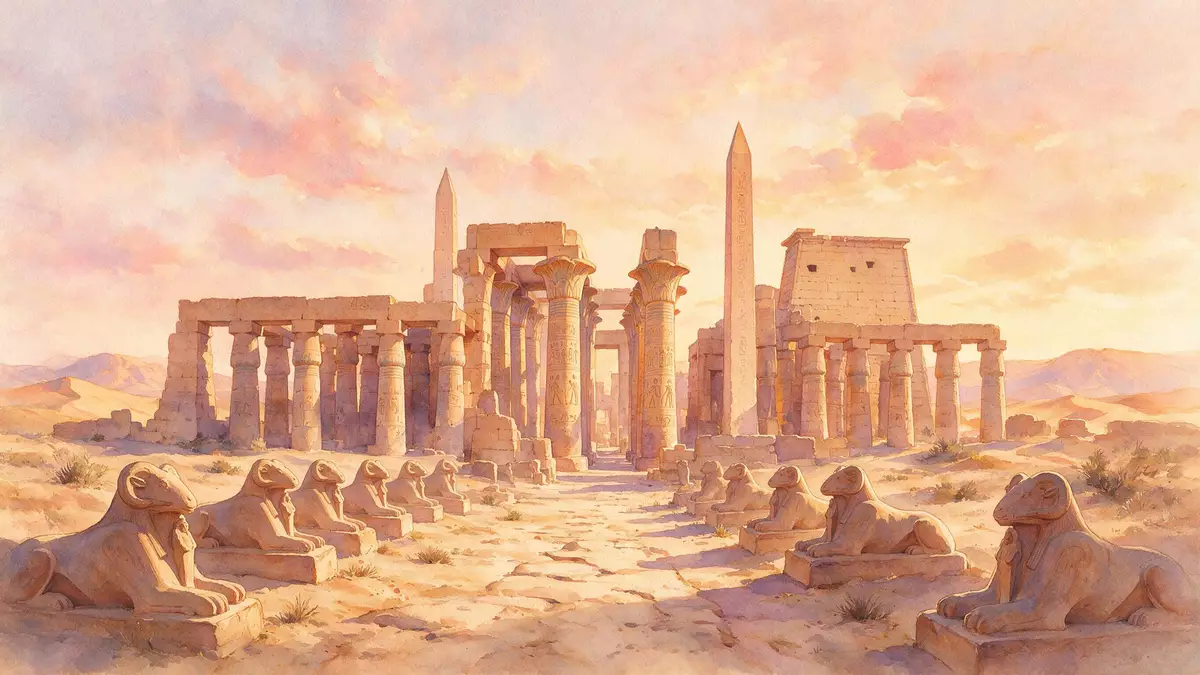
Karnak in Luxor is a vast temple complex where rows of monumental stone columns, pylons and courtyards form an open-air record of ancient Egypt’s religious power. Rising on the east bank of the Nile in Egypt, it developed over many centuries from the Middle Kingdom into the Ptolemaic period and became the principal cult centre of Amun and the Theban Triad.
A temple city built over millennia
Karnak is not a single sanctuary but a complex of temples, chapels, pylons and other structures that grew over roughly 1,500 years of ancient Egyptian history.vast religious complex Construction began in the Middle Kingdom, particularly under the Twelfth Dynasty pharaoh Senusret I, and continued with successive rulers down to the Ptolemaic period.Middle Kingdom origins under Senusret I
Most of the standing architecture belongs to the New Kingdom, when Thebes was a political capital and Karnak became a ceremonial focus for the empire.New Kingdom expansion at Karnak The principal axis is the Precinct of Amun-Re, fronted by a sequence of massive stone gateways known as pylons that once framed processional routes between different parts of the complex and towards Luxor Temple further south along the river.location in Luxor on the Nile’s east bank
Amun and the sacred architecture of Thebes
The ancient name of Karnak was Ipet-Isut, often translated as “The Most Selected of Places”, reflecting its status as the holiest sanctuary of ancient Thebes.Ipet-Isut meaning “The Most Selected of Places” The complex was primarily dedicated to Amun-Re, worshipped together with his consort Mut and their son Khonsu as the Theban Triad, and over time accrued additional shrines and precincts for these deities.cult temple of Amun, Mut and Khonsu
Within the walls of the Amun precinct stand obelisks, colossal statues and a sacred lake that formed part of ritual life at the temple city.obelisks, statues and sacred lake Other sectors include the Precinct of Mut and the Precinct of Montu, each with their own temples but linked to the wider ceremonial landscape of Thebes and to the processional routes that connected Karnak with neighbouring sanctuaries along the Nile.Mut and Montu precincts at Karnak
The Great Hypostyle Hall: Karnak’s stone forest
The most striking space within Karnak is the Great Hypostyle Hall, a vast interior filled with ranks of stone columns that once carried a high roof. This hall lies within the central axis of the Amun precinct and covers about 5,000 m² (around 1.2 acres), enclosed between the second and third pylons.Great Hypostyle Hall dimensions
There are 134 columns arranged in 16 rows, including twelve taller columns in the central nave that rise about 24 m (79 ft) with papyrus-flower capitals, and more than a hundred somewhat lower columns around them with closed-bud capitals.134 columns in 16 rows Work on the hall belongs mainly to the reigns of Nineteenth Dynasty pharaohs Seti I and Ramesses II, whose names and reliefs appear on the column shafts and walls.construction under Seti I and Ramesses II
Visiting Karnak: what travellers from Western Europe should know
- Karnak stands on the east bank of the Nile in Luxor, Egypt, with its main entrances reached from city streets that run inland from the river embankment.
- Within the complex, movement between courtyards and through pylons involves long, level stone surfaces punctuated by occasional ramps and flights of steps.
- The temple city lies close to Luxor Temple along the Nile, and the broader archaeological zone includes other major sites on both the east and west banks.
- The official language is Arabic and the currency is the Egyptian pound.
- Entry requirements depend on your nationality; UK travellers can check the FCDO travel advice at gov.uk/foreign-travel-advice, Irish travellers the Department of Foreign Affairs at ireland.ie.
Searching for Karnak on social platforms
These links open searches for Karnak on each platform.
Frequently asked questions about Karnak
Where is Karnak located?
Karnak stands on the east bank of the Nile in Luxor in southern Egypt, occupying a large archaeological zone within the modern city.
What should visitors expect at Karnak?
Visitors encounter a sprawling complex of stone temples, pylons, columned halls and open courtyards, dominated by the Great Hypostyle Hall and the main Amun-Re precinct.
What makes Karnak distinctive among Egyptian temples?
Karnak is distinctive for its long development from the Middle Kingdom onward, its role as the chief cult centre of Amun-Re and its monumental forest of 134 columns in the Great Hypostyle Hall.


