

Karnak’s forest of stone: walking through ancient Luxor
Published on 08/23/2026 at 12:37 | Editorial responsibility: Rafael Müller, Editor-in-Chief AD HOC NEWS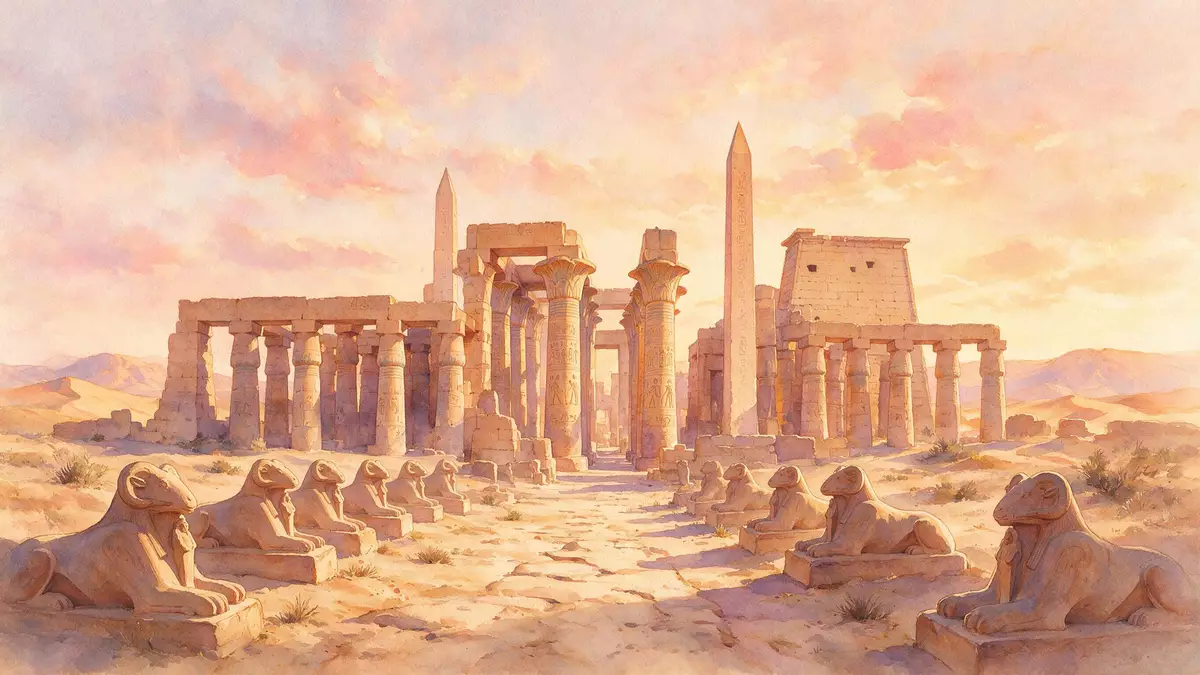
Karnak in Luxor is a vast temple complex on the east bank of the Nile, where stone pylons, obelisks and colonnades record more than a thousand years of ancient Egyptian building. Centred on the cult of Amun in the New Kingdom, it grew into a monumental religious precinct during the eighteenth to twentieth dynasties.
A temple city built over centuries
Karnak formed part of ancient Thebes and developed as the principal sanctuary of the Theban triad, with Amun at its head and Mut and Khonsu beside him.Principal sanctuary of the Theban triad Construction began in the Middle Kingdom under Senusret I in the twentieth century BC and continued through the New Kingdom into the Ptolemaic period.Construction from Middle Kingdom to Ptolemaic period
The complex covers a large area with several distinct precincts, the most prominent being the Precinct of Amun-Re, accompanied by those of Mut and Montu.Precincts of Amun, Mut and Montu Over generations, successive pharaohs added pylons, courts, sanctuaries and processional routes, turning Karnak into an architectural record of dynasties from Senusret I to the Ptolemies.
The Great Hypostyle Hall and sacred landscape
At the heart of the Amun precinct stands the Great Hypostyle Hall, an immense columned space covering about 5,000 m² (1.2 acres).Great Hypostyle Hall area Its 134 sandstone columns rise in tightly packed rows, the tallest reaching around 24 m (79 ft) with massive capitals that once supported a high central section of roof.
Reliefs and hieroglyphs run across the column shafts and architraves, recording royal names, offerings and scenes of ritual. Light filters into the hall from above where the higher central roof once stood above the side aisles, giving the forest of stone a varied pattern of brightness and shadow.Architecture of the Hypostyle Hall Nearby, the Sacred Lake forms part of the ritual landscape, cut into the ground within the precinct of Amun and bordered by stone quays.Sacred Lake within the Amun precinct
Pylons, obelisks and processional ways
Visitors approach Karnak through a sequence of monumental stone gateways, or pylons, that mark successive building phases across the New Kingdom and later periods.Series of pylons at Karnak Between these pylons lie open courts, colonnaded halls and smaller chapels that once housed processional barques and cult statues.
Granite obelisks rise within the Amun precinct, including examples associated with Hatshepsut and Thutmose I.Obelisks of Hatshepsut and Thutmose I Outside the main enclosure, an avenue lined with sphinxes links Karnak with Luxor Temple along a processional route that once connected the two great sanctuaries of Thebes.Avenue of sphinxes between Karnak and Luxor Temple
Visiting Karnak: what travellers from Western Europe should know
- Karnak stands on the east bank of the Nile in Luxor, in southern Egypt, a short distance north of Luxor Temple within the modern city.
- The core of the complex is largely level but built in stone, with wide open courts, high gateways and extensive walking between precincts on hard surfaces.
- The official language is Arabic and the currency is the Egyptian pound. Entry requirements depend on your nationality; UK travellers can check the FCDO travel advice at gov.uk/foreign-travel-advice, Irish travellers the Department of Foreign Affairs at ireland.ie.
Searching for Karnak on social platforms
These links open searches for Karnak on each platform.
Frequently asked questions about Karnak
Where is Karnak and what kind of place is it?
Karnak is a large ancient Egyptian temple complex in Luxor, on the east bank of the Nile in southern Egypt, forming part of the remains of Thebes.
What can visitors expect when exploring Karnak?
Visitors walk through stone gateways, open courts, colonnaded halls and the Great Hypostyle Hall, with carved reliefs, statues, obelisks and the Sacred Lake spread across the site.
What makes Karnak distinctive among ancient Egyptian sites?
Karnak is distinctive for its long building history from the Middle Kingdom to the Ptolemaic period, its multiple precincts and the monumental scale of the Great Hypostyle Hall.


