

Karnak in Luxor: a stone forest of ancient power
Published on 09/14/2026 at 13:09 | Editorial responsibility: Rafael Müller, Editor-in-Chief AD HOC NEWS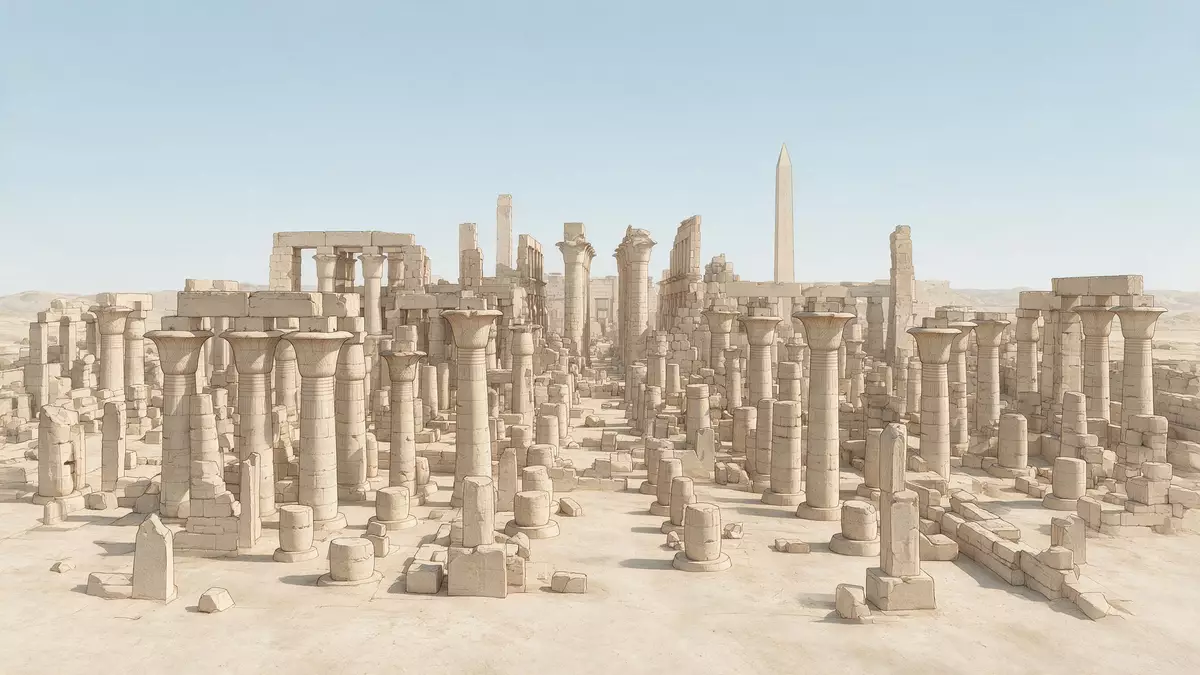
Karnak in Luxor is not a single temple but a sprawling complex of sanctuaries, pylons and processional ways, with the Great Hypostyle Hall forming its most striking stone “forest”. Set on the east bank of the Nile in Upper Egypt, the site grew over more than two thousand years as pharaohs added new structures, enclosed older ones and inscribed their achievements on walls and columns.
A vast temple city on the Nile’s east bank
Karnak stands on the east bank of the Nile at ancient Thebes, the area known today as Luxor in Upper Egypt, where the river bends between cultivated land and desert plateau.Located on the east bank of Thebes The complex occupies a broad strip of ground north of Luxor Temple, with its main entrance aligned towards the city and the river.
Rather than a single enclosure, Karnak consists of several distinct precincts. The largest is the Precinct of Amun-Re, dedicated to the Theban god Amun and forming the core of what most travellers recognise as Karnak.Karnak was in reality a complex of temples To its south lies the Precinct of Mut, to the north the Precinct of Montu, and to the east the remains of a temple dedicated to Aten from the reign of Akhenaten.
The Great Hypostyle Hall: Karnak’s stone forest
At the heart of the Amun-Re precinct, just behind the second pylon, spreads the Great Hypostyle Hall, a roofed space whose floor area has been measured at about 5,000 m² (1.2 acres).The Great Hypostyle Hall covers an area of 5,000 m² The hall is filled with sandstone columns arranged in regular rows, rising to different heights and carrying a roof whose upper level once admitted filtered daylight through stone grilles.
The hall in its present form belongs to the nineteenth dynasty of the New Kingdom, around 1290–1224 BC, when Seti I and his son Ramesses II oversaw its construction and decoration.The structure was built around the 19th Egyptian Dynasty Reliefs on the exterior walls record military campaigns: scenes on the north wall relate to Seti I’s expeditions, while those on the south wall carry Ramesses II’s account of the Battle of Kadesh.The exterior walls portray the military actions of Ramesses II and Seti I
Layers of history in the Precinct of Amun-Re
The Precinct of Amun-Re preserves construction and inscription work that spans many centuries, from Middle Kingdom origins through the height of the New Kingdom into later periods.Karnak Temple dates from around 2055 BC to around 100 AD Successive rulers, including Horemheb, Amenhotep III, Seti I and Ramesses II, modified the main axis with pylons, courts and columned halls, leaving cartouches and narrative scenes carved in stone.
A defining feature of the precinct is its double orientation. The temple of Amun-Re has an east–west axis running inland from the river, and, exceptionally, a north–south axis that connects it with Luxor Temple further downriver.It also possesses a north–south axis orienting it towards Luxor Temple Processional routes once linked these sanctuaries, passing through gates and courts that framed the movement of cult statues during major festivals.
Visiting Karnak: what travellers from Western Europe should know
- Karnak lies on the east bank of the Nile at Luxor in Upper Egypt, north of Luxor Temple and reached over level ground from the city’s riverside streets.
- Inside the Amun-Re precinct, paved avenues and broad courts alternate with narrower passageways and areas of uneven stone underfoot, and approaches to viewpoints may involve long flights of steps.
- The official language is Arabic and the currency is the Egyptian pound.
- Entry requirements depend on your nationality; UK travellers can check the FCDO travel advice at gov.uk/foreign-travel-advice, Irish travellers the Department of Foreign Affairs at ireland.ie.
Searching for Karnak on social platforms
These links open searches for Karnak on each platform.
Frequently asked questions about Karnak
Where is Karnak and what kind of place is it?
Karnak is a multi-precinct temple complex on the east bank of the Nile at Luxor in Upper Egypt, centred on the great sanctuary of Amun-Re.
What should a visitor expect when exploring Karnak?
Visitors move between pylons, open courts and roofed halls, including the Great Hypostyle Hall, with extensive reliefs, statues and monumental sandstone architecture throughout.
What makes Karnak distinctive among Egyptian temple sites?
The combination of its size, multi-axial layout and the monumental Great Hypostyle Hall built under Seti I and Ramesses II gives Karnak a scale unmatched at other Egyptian temple complexes.


