
Karnak in Luxor, a stone forest of ancient power
Published on 08/31/2026 at 13:58 | Editorial responsibility: Rafael Müller, Editor-in-Chief AD HOC NEWS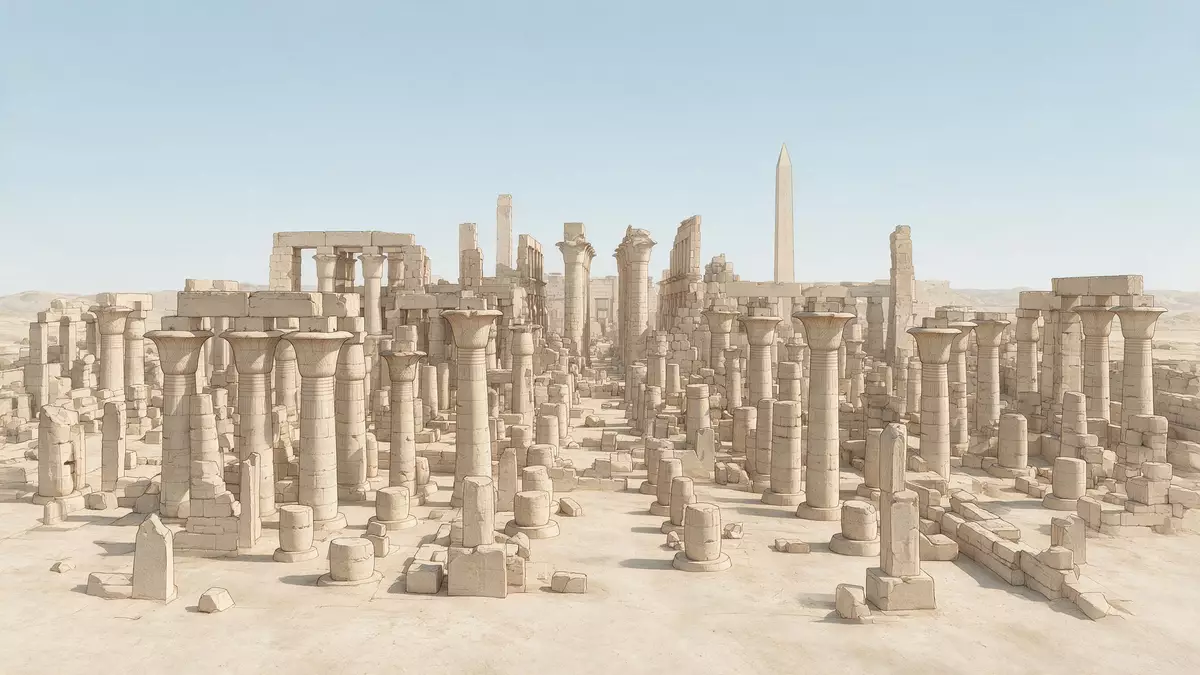
Karnak in Luxor is a vast temple precinct on the east bank of the Nile, where colossal stone architecture charts more than two millennia of ancient Egyptian religious power. The complex grew from Middle Kingdom beginnings into a layered sanctuary of Amun and the Theban Triad, with construction spanning dynasties from Senusret I in the twentieth century BC through the Ptolemaic period.
A city of temples raised over two thousand years
Karnak occupies part of the ruins of ancient Thebes in Upper Egypt, a landscape of pylons, courts and sanctuaries aligned along the river plain. Its ancient name, Ipet-isut, is translated as “the most select of places”, a phrase that reflects its status as the principal sanctuary of Amun-Ra at Thebes.The ancient name Ipet-isut The earliest surviving temple structures at Karnak date to the Middle Kingdom, around the twentieth century BC, and building continued into the Ptolemaic period, leaving a chronological span of roughly two thousand years in stone.Construction over two millennia
Successive pharaohs expanded Karnak into what is widely recognised as one of the largest religious complexes of the ancient world, covering hundreds of acres on the Nile’s east bank. Across that expanse rise monumental gateways, columned halls, obelisks and subsidiary chapels, forming interlocking precincts dedicated primarily to Amun, his consort Mut and their son Khonsu, known together as the Theban Triad.Precincts of Amun, Mut and Khonsu The main sanctuary of Amun, with its sequence of pylons and enclosed courts, anchors the complex, while neighbouring precincts devoted to Mut and Khonsu extend the sacred city southwards and westwards.
The Great Hypostyle Hall: Karnak’s stone forest
At the heart of the Amun precinct lies the Great Hypostyle Hall, a monumental space whose dense grid of stone columns has become Karnak’s most distinctive interior. The hall was built during the nineteenth dynasty in the thirteenth century BC, with work traditionally associated with Seti I and his son Ramesses II.Nineteenth-dynasty hypostyle hall Measuring roughly 103 m across and 52 m deep, it occupies about 5,000 m² (1.2 acres), filling the processional axis between earlier and later pylons with masonry on a monumental scale.Area and scale of the hall
Inside the hall stand 134 columns arranged in rows, with a central zone of taller shafts carrying a raised section of roof and lower side aisles spreading out on either side.Rows of monumental columns The twelve central columns rise to around 21–24 m (69–79 ft) and are capped with large capitals shaped in papyrus forms, while the surrounding one hundred and twenty-two columns are slightly shorter. Together they create an environment of stone that once supported a complex roofing system, with clerestory openings above the central aisle admitting light into the forest of carved surfaces.
Processional routes, sacred water and living archaeology
Karnak is not a single building but a network of temples, courts and corridors linked by processional routes that extended beyond the precinct walls. A monumental avenue lined with ram-headed sphinxes connected Karnak with Luxor Temple to the south, forming a ceremonial axis along which religious processions moved between the two sanctuaries.Avenue of sphinxes between Karnak and Luxor Within Karnak itself, further avenues and gateways structure movement between the Amun precinct and the smaller temples of Mut and Khonsu.
On the western side of the Amun precinct lies a large sacred lake, an artificial basin set within the temple enclosure. The lake formed part of ritual practice, its still water reflecting the surrounding walls, columns and obelisks.Sacred lake within the precinct Across the complex, carved reliefs on pylons, column drums and walls record offerings, festivals and royal building programmes, creating a dense archive of religious and political imagery that Egyptology has studied for generations. Karnak forms part of the UNESCO World Heritage Site “Ancient Thebes with its Necropolis”, a designation that links the temple precinct with Luxor Temple and the royal tombs across the river in the desert cliffs.World Heritage status within Ancient Thebes
Visiting Karnak: what travellers from Western Europe should know
- Karnak stands on the east bank of the Nile in Luxor in southern Egypt, reached from the modern city by road along the river and by local transport from Luxor’s airport and railway station.
- The temple precinct covers a large area with long axial routes, broad courts and extensive ruins; walking between the main pylons, the Great Hypostyle Hall and the sacred lake involves spending extended time on uneven stone surfaces.
- Many parts of Karnak retain ancient stone paving, steps and worn thresholds, and some interiors are roofed at height; visitors encounter changes in light levels and need to navigate low reliefs and carved elements at eye level.
- The official language is Arabic and the currency is the Egyptian pound. Entry requirements depend on your nationality; UK travellers can check the FCDO travel advice at gov.uk/foreign-travel-advice, Irish travellers the Department of Foreign Affairs at ireland.ie.
Searching for Karnak on social platforms
These links open searches for Karnak on each platform.
Frequently asked questions about Karnak
Where is Karnak and what kind of place is it?
Karnak is a temple precinct on the east bank of the Nile at Luxor in Upper Egypt, forming part of the ruins of ancient Thebes and centred on the sanctuary of Amun-Ra.
What should visitors expect when exploring Karnak?
Visitors encounter a large archaeological site with monumental pylons, the Great Hypostyle Hall, processional avenues and a sacred lake, all set within extensive temple precinct walls.
What makes Karnak distinctive among Egyptian temple sites?
Karnak is distinctive for its scale as a layered city of temples built over roughly two thousand years and for the Great Hypostyle Hall, whose forest of 134 papyrus-form columns creates one of the most monumental interiors of ancient Egypt.


