

Kapellbrucke in Luzern, a painted wooden bridge over the Reuss
Published on 09/14/2026 at 10:47 | Editorial responsibility: Rafael Müller, Editor-in-Chief AD HOC NEWS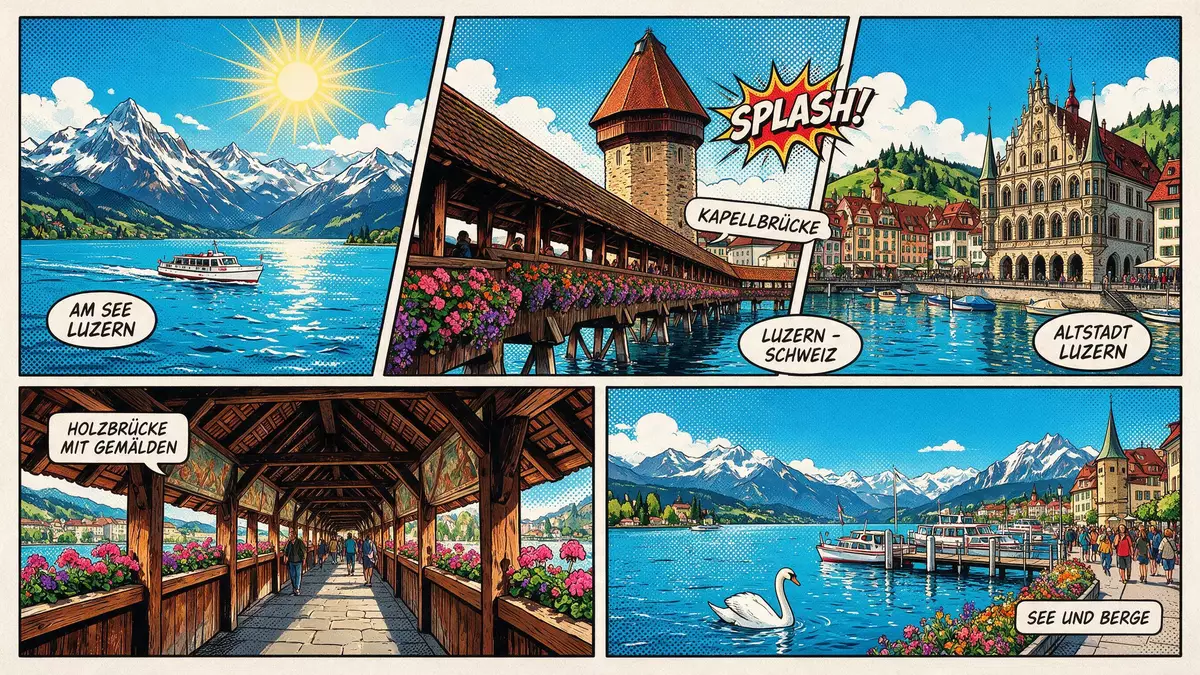
Kapellbrucke in Luzern is a long, covered wooden bridge crossing the Reuss River, combining timber construction, painted roof panels and a stone tower into one of Switzerland’s best-known historic cityscapes.
A medieval wooden bridge crossing the Reuss
Kapellbrucke is a covered wooden pedestrian bridge spanning the Reuss between the historic quarters of Luzern on either bank. It forms a zig-zag line across the river, bending around the stone mass of the Wasserturm that rises directly out of the water beside it.The Chapel Bridge runs as a zig-zag rather than straight across, which makes its junction with the tower a distinct visual hinge within the city centre skyline.
The bridge belongs to the group of medieval wooden bridges constructed in central Europe during the fourteenth century and is associated with dates around the 1360s. Several historical and technical studies place its original construction in the middle of that century, while its first written mention appears in records from 1367.The Chapel Bridge was probably constructed around 1360, with a first recorded mention in 1367, placing it firmly within the late medieval phase of Luzern’s growth.
Fortifications, paintings and the Wasserturm
Kapellbrucke was integrated into Luzern’s medieval fortification system and not merely conceived as a convenient river crossing. Historical summaries from the city and tourism authorities describe it as part of the defensive ring around Luzern, physically linking ramparts and protecting the lakeside approach to the town.The bridge is described as a former Wehrgang, an elevated defensive walkway, and the lakeside wall of the structure is higher than the inner side, which once made it easier for soldiers to rest weapons and shield the town.
Inside the Kapellbrucke, a series of painted panels hangs under the roof, forming a sequence of triangular images that accompany travellers along the walkway. These paintings present episodes from Swiss and local history, as well as scenes tied to patron saints and civic identity. Research on the bridge’s art attributes the concept for this series to Renward Cysat, a municipal clerk and scholar active in the first quarter of the seventeenth century.The panel cycle was created in the early seventeenth century under Renward Cysat, giving the medieval structure an added narrative layer from a later era.
Length, age and the stone water tower
The present Kapellbrucke stretches for just over 200 m (about 670 ft) along its diagonal path over the Reuss, supported on stone piers beneath the river’s surface.Studies of the bridge’s structure give a present length of roughly 205 m, while historical reconstructions show that earlier versions extended further along the river before nineteenth-century embankment works shortened it. This considerable span, combined with its survival in some form since the fourteenth century, underpins descriptions of Kapellbrucke as one of the oldest covered wooden bridges in Europe and one of the continent’s longest surviving examples of a timber truss bridge.
The most striking neighbour of the bridge is the Wasserturm, an octagonal stone tower standing in the river beside Kapellbrucke. Architectural and historical investigations date its timber roof structure to 1339 and indicate that the stone shaft itself likely originates in the thirteenth century.The Wasserturm’s oldest examined timbers date to 1339, with the tower regarded as a thirteenth-century work, meaning it predates the bridge. Over the centuries the tower served various functions, including use as a watchtower, prison, treasury and archive, and its compact, massive form anchors the lighter timber construction of Kapellbrucke beside it.
Visiting Kapellbrucke: what travellers from Western Europe should know
- Kapellbrucke crosses the Reuss in the historic centre of Luzern, linking the southern bank near Luzerner Theater with the northern side by St Peter’s Chapel and Rathausquai.
- The walkway is roofed and set above the river on stone piers, approached via ramps and short flights of steps at each end, with a gentle gradient along most of its length.
- Luzern lies in central Switzerland, where the official language is German and the currency is the Swiss franc.
- Entry requirements depend on your nationality; UK travellers can check the FCDO travel advice at gov.uk/foreign-travel-advice, Irish travellers the Department of Foreign Affairs at ireland.ie.
Searching for Kapellbrucke on social platforms
These links open searches for Kapellbrucke on each platform.
Frequently asked questions about Kapellbrucke
Where is Kapellbrucke in Luzern?
Kapellbrucke spans the Reuss River in Luzern’s historic centre, between the southern bank near Luzerner Theater and the northern side by St Peter’s Chapel.
What can travellers expect when crossing Kapellbrucke?
Travellers walk along a covered timber deck supported on stone piers, passing beneath a sequence of historic painted panels and alongside the stone Wasserturm in the river.
What makes Kapellbrucke distinctive compared with other bridges?
Kapellbrucke combines a fourteenth-century covered wooden truss bridge with seventeenth-century roof paintings and a medieval stone water tower, forming a rare layered ensemble over the Reuss.


