
Kapellbrucke in Luzern, a painted medieval wooden crossing
Published on 09/16/2026 at 14:01 | Editorial responsibility: Rafael Müller, Editor-in-Chief AD HOC NEWS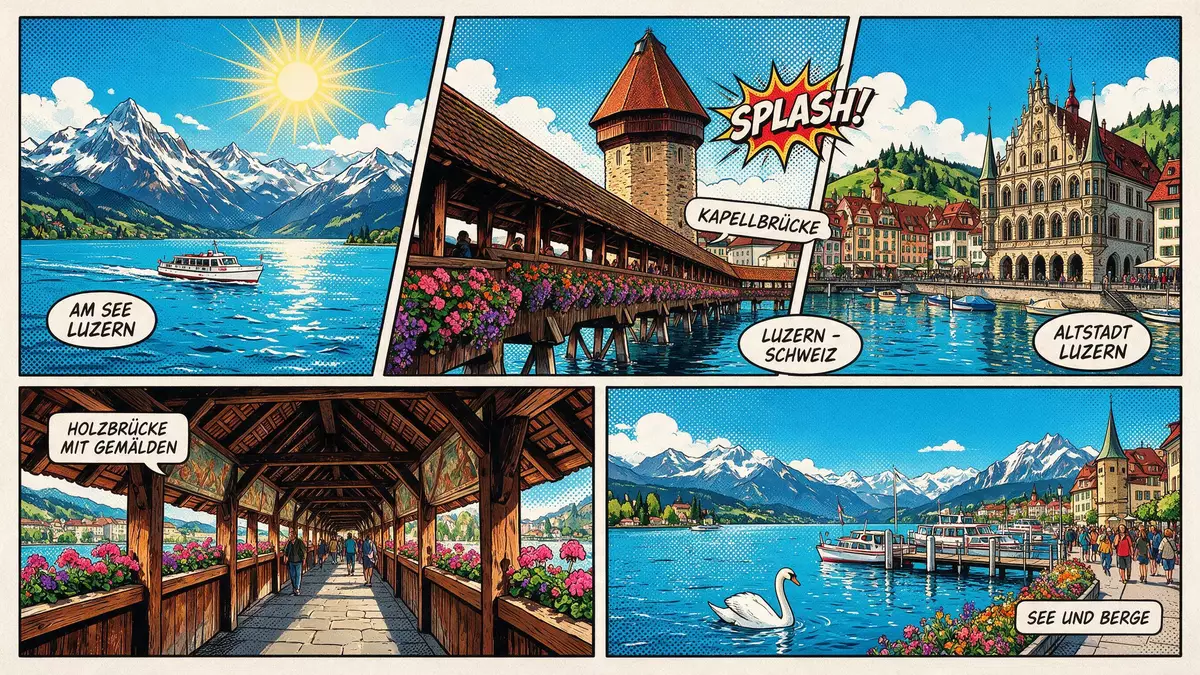
Kapellbrucke in Luzern is a covered wooden footbridge crossing the Reuss, combining medieval timber engineering with a long roof lined by seventeenth-century paintings. Built in the fourteenth century as part of the city’s fortifications, it has become a distinctive element of Luzern’s riverside panorama and a compact corridor of local history in wood and paint.
A diagonal bridge tied to the river and the tower
Kapellbrucke runs diagonally across the Reuss, linking the southern bank near the Luzerner Theater with the northern bank at St Peter’s Chapel on Rathausquai.The Chapel Bridge runs from the Luzerner Theater The bridge’s line is not straight: it bends at the stone Water Tower, or Wasserturm, an older octagonal structure that rises from the river and anchors the crossing visually and structurally.the bridge now totals only 204.7 metres
The present length of Kapellbrucke is just over 200 m (around 670 ft), supported on stone columns beneath the river’s surface.rests on stone columns beneath the river’s surface In its medieval form it was significantly longer, but nineteenth-century embankment works and shortening on the lakeside reduced the span. The bridge takes its name from nearby St Peter’s Chapel, which stands on the right bank of the Reuss and gives the crossing its link to local religious life.The Chapel Bridge takes its name from St Peter’s Chapel
Fourteenth-century fortification in timber
Kapellbrucke dates to the middle of the fourteenth century, with documentary mentions from 1367 and dendrochronological analysis indicating construction in the decades around 1360.dendrochronological analysis indicate that it was built no earlier than 1356 In that period Luzern’s position on Lake Lucerne and north–south trade routes made control of the river crucial, and the bridge formed part of a defensive system linking fortifications on both banks. The structure was designed as a covered timber walkway, connected with city walls and other bridges to form a protective line along the Reuss.In combination with the city walls and the Court Bridge, it formed an impressive line of defense
One visible reminder of this military role is the higher wall on the lakeside edge of Kapellbrucke, which contrasts with the lower inner side facing the town.the bridge’s lakeside wall is higher than the other side The raised outer parapet once provided better cover for armed guards moving along the bridge, while the covered roof shielded them from weather as they crossed between the fortified sectors. In this way Kapellbrucke functioned simultaneously as part of everyday circulation across the river and as a component of Luzern’s defensive perimeter.
A seventeenth-century painted history under the roof
Inside Kapellbrucke, the most striking feature is the sequence of triangular painted panels mounted beneath the roof trusses. The cycle was created in the first quarter of the seventeenth century, making the bridge a timber gallery of civic imagery as well as a crossing.The series of works decorating the Chapel Bridge was created in the first quarter of the 17th century The concept was developed by Renward Cysat, a municipal clerk and scholar in Luzern, who drew on his research into early Swiss and Christian history.concept for the pictorial decoration was developed by Renward Cysat
The paintings themselves were executed by artist Hans Heinrich Wägmann, with accompanying explanatory texts written by councilman Hans Rudolf von Sonnenberg.Artist Hans Heinrich Wägmann painted the pictures and councilman Hans Rudolf von Sonnenberg wrote the accompanying text The scenes show episodes from the history of Luzern and the Swiss Confederation, together with legends about patron saints such as Mauritius and Leodegar.depicts the history of the Swiss Confederation as well as the patron saints Although some panels were lost when a fire damaged large sections of the bridge and its decoration in 1993, many works remain in place after restoration, continuing the sequence of images along much of the crossing.many of them were destroyed along with a larger part of the centuries-old bridge in a 1993 fire
Visiting Kapellbrucke: what travellers from Western Europe should know
- Kapellbrucke crosses the Reuss in central Luzern, linking the southern bank near Luzerner Theater with the northern riverside at St Peter’s Chapel, within the historic city centre.
- The bridge’s timber deck is covered and gently sloped, with wooden planks underfoot and low parapets on the town side; the route includes a bend around the stone Water Tower.
- The surrounding streets of the old town are paved and compact, with narrow lanes and short approaches on foot from nearby squares and riverfront promenades.
- Luzern lies in central Switzerland, where the official language is German and the currency is the Swiss franc.
Searching for Kapellbrucke on social platforms
These links open searches for Kapellbrucke on each platform.
Frequently asked questions about Kapellbrucke
Where is Kapellbrucke located in Luzern?
Kapellbrucke spans the Reuss in central Luzern, connecting the southern bank by Luzerner Theater with the northern riverside at St Peter’s Chapel in the historic centre.
What can visitors expect when crossing Kapellbrucke?
Visitors walk along a covered timber deck that bends around the octagonal Water Tower, passing beneath a line of seventeenth-century painted panels suspended under the roof.
What makes Kapellbrucke distinctive among bridges?
Kapellbrucke combines a fourteenth-century defensive function with a seventeenth-century cycle of historical paintings, creating a rare mix of fortification, wooden engineering and civic art in a single river crossing.


