
Kapadokya’s rock landscape around Göreme
Published on 09/04/2026 at 16:11 | Editorial responsibility: Rafael Müller, Editor-in-Chief AD HOC NEWS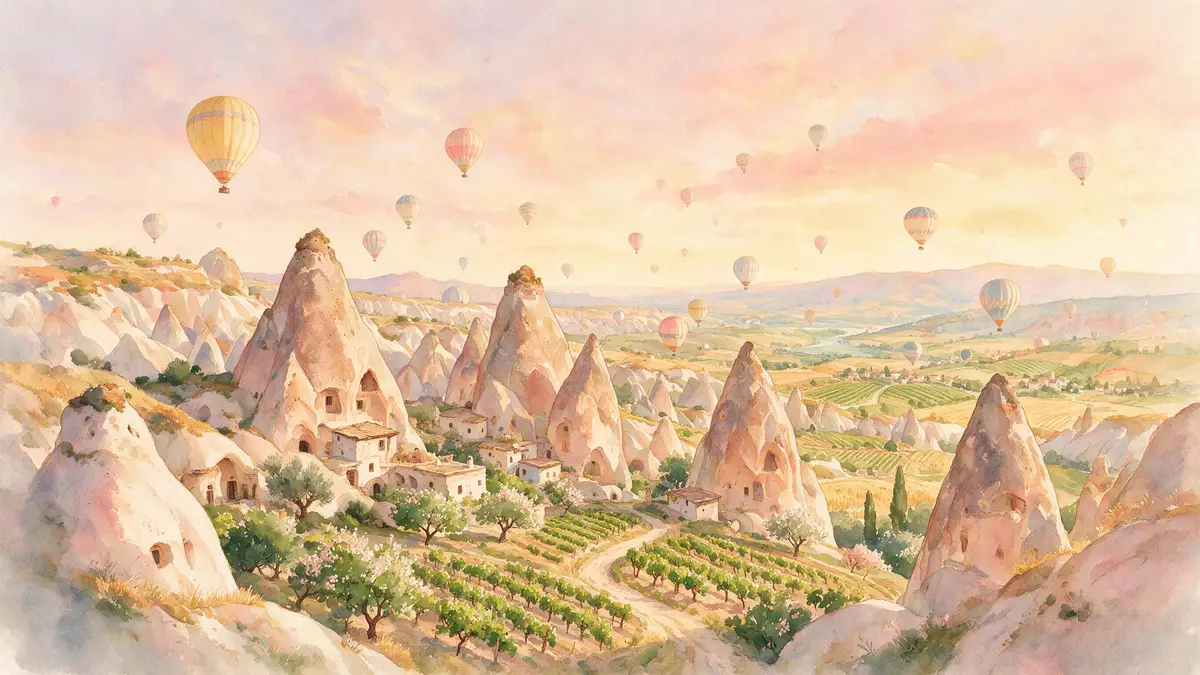
Kapadokya around Göreme is a landscape of volcanic rock, erosion and carved stone. Göreme National Park and the Rock Sites of Cappadocia were placed on the World Heritage List in 1985, and the region contains the forms that made that inscription possible.
Fairy chimneys, valleys and carved stone
The most striking feature is the rough skyline of pinnacles and ridges known as fairy chimneys. They rise from valleys cut into soft volcanic deposits and harder caps, giving Kapadokya a surface that looks eroded and sculpted at once.
The UNESCO description places the landscape on the central Anatolia plateau and names the broad area between Nev?ehir, Ürgüp and Avanos. That wider setting matters because Göreme sits inside a named cultural and geological region rather than beside a single monument.
Göreme’s monastic rock sites
Göreme is closely associated with rock-cut churches and monastic spaces. The best-known cluster lies in the Göreme Open Air Museum, where Byzantine carving meets painted interiors and the rock itself becomes the building material.
The churches and chapels are part of the same carved world as the valleys around them. The setting links settlement, worship and geology in one visible form, with tuff walls, recessed spaces and painted surfaces carrying the site’s history.
Google Arts & Culture identifies the museum as a UNESCO World Heritage Site in Göreme and describes a cluster of rock-cut churches, chapels and monasteries. That combination of built space and excavated space is central to the character of Kapadokya.
A plateau shaped by volcanic rock
Kapadokya belongs to Central Anatolia, where volcanic deposits created the soft material that erosion later cut into valleys, spires and basins. The region’s geology is part of the reason the landscape reads so clearly from a distance and in close-up.
The surface is not a single uniform mass. It alternates between softer rock and more resistant layers, so the land holds towers, cuttings and wall-like forms in the same frame.
Live Science describes the fairy chimneys as spires formed in volcanic rock over millions of years, and the basic sequence matches what is visible across the plateau. The result is a place where geology is not background but the main architectural material.
Visiting Kapadokya: what travellers from Western Europe should know
- Göreme lies in central Turkey, in the Cappadocia region of Nev?ehir Province. It is reached by road from the surrounding towns, with the rock sites spread across the wider landscape.
- The terrain is uneven, with valleys, carved slopes and rock-cut steps in some places. Many routes follow bare volcanic ground rather than paved urban streets.
- Several parts of the area are open rock sites rather than enclosed buildings. The most legible experience comes from moving between the valleys, the museum complex and the town itself.
- The official language is Turkish and the currency is the Turkish lira. Entry requirements depend on your nationality; UK travellers can check the FCDO travel advice at gov.uk/foreign-travel-advice, Irish travellers the Department of Foreign Affairs at ireland.ie.
Searching for Kapadokya on social platforms
These links open searches for Kapadokya on each platform.
Frequently asked questions about Kapadokya
Where is Kapadokya?
Kapadokya lies in central Anatolia in Turkey, around Göreme and the wider Cappadocia region. The landscape extends across valleys, rock sites and nearby towns in Nev?ehir Province.
What does a visit involve?
Expect rock-cut churches, open valleys and carved stone formations rather than a single enclosed monument. The place is best understood as a region of linked sites.
What makes Kapadokya distinctive?
Its distinction lies in the combination of volcanic landscape, eroded rock forms and carved religious spaces. Göreme ties those elements together in one World Heritage landscape.


