
Kapadokya’s rock landscape around Göreme
Published on 08/30/2026 at 11:34 | Editorial responsibility: Rafael Müller, Editor-in-Chief AD HOC NEWS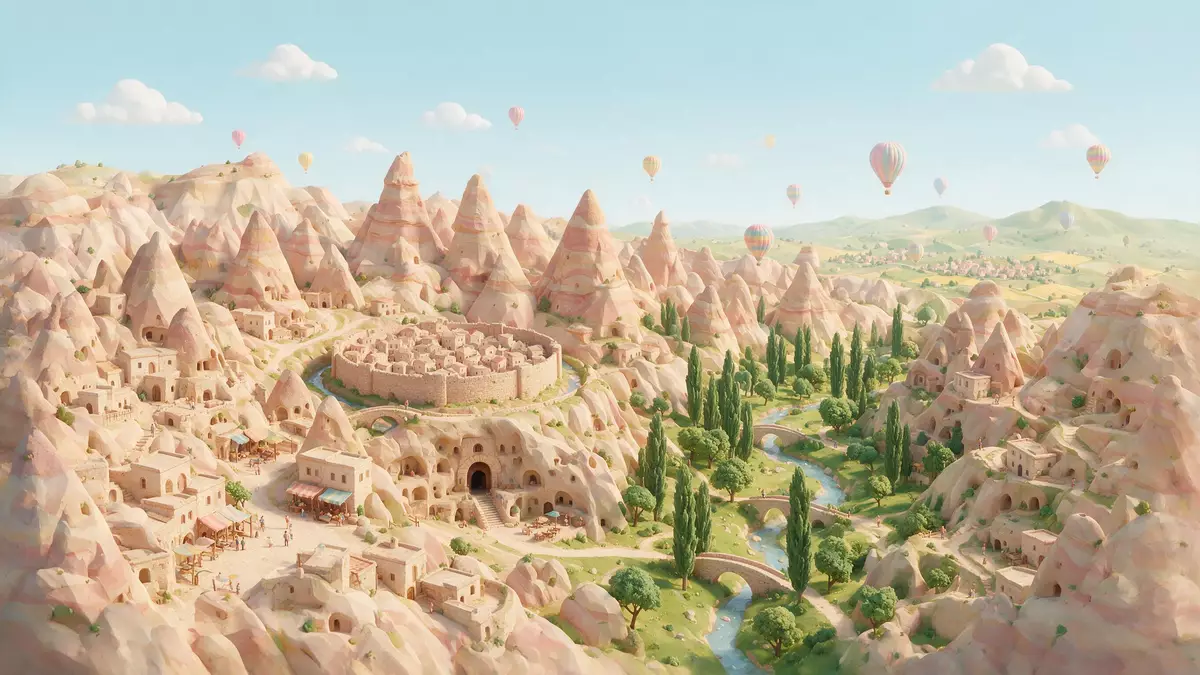
Kapadokya around Göreme is a landscape of pale volcanic rock, carved valleys and cone-shaped formations. Göreme National Park and the Rock Sites of Cappadocia were inscribed on the UNESCO World Heritage List in 1985, and the designation links the scenery to a long cultural history.
Volcanic rock and carved valleys
The ground here is built from volcanic tuff, a soft rock that erosion has cut into ridges, gullies and tall pinnacles. The resulting formations include the hoodoos known locally as fairy chimneys, a name that has become tied to the terrain of central Anatolia. The valley and its surroundings contain both the eroded landforms and the rock-hewn sanctuaries that make Kapadokya around Göreme distinctive.
The area reaches across the plateau between Nev?ehir, Ürgüp and Avanos. That wider setting matters because the rock landscape does not stop at a single valley edge; it continues through a region of linked sites, underground cities and carved slopes.
Churches, shelters and underground spaces
Kapadokya is known for churches cut directly into the rock, along with dwellings, stables and subterranean settlements. The best-known religious spaces around Göreme preserve Byzantine wall paintings, and the region’s carved interiors show how architecture and stone merge into a single surface. rock-hewn sanctuaries provide evidence of Byzantine art in the post-iconoclastic period.
That carved tradition reaches beyond a single monument. The wider UNESCO property includes the subterranean cities of Kaymakl? and Derinkuyu, as well as rock sites at Karain, Karl?k, Ye?ilöz and So?anl?, which places Göreme within a broader network of settlements and sacred spaces.
Kapadokya’s long historical layer
The region has been settled since antiquity, and the surviving landscape reflects repeated use rather than one isolated building phase. Kapadokya region has been a continuous settlement area since the Chalcolithic period, and its later Christian monuments belong to the Byzantine world of the early medieval centuries.
The result is a place where stone, devotion and shelter remain visible in the same terrain. Göreme is not just a point on a map but part of a cultural landscape that survived because people kept cutting, living and worshipping in the rock over generations.
Visiting Kapadokya: what travellers from Western Europe should know
- Göreme lies in central Anatolia, in Turkey, within the wider Cappadocia region. The area is reached through Nev?ehir and the surrounding road network, with the rock sites spread across valleys and plateaus.
- The terrain is uneven and the rock faces are cut with paths, steps and carved entrances. Many parts of the landscape involve slopes, rough ground and narrow passages between formations.
- The region includes underground cities such as Kaymakl? and Derinkuyu. These places add depth to the visit, both geographically and historically.
- English is not an official language here; the official language is Turkish and the currency is the Turkish lira.
Searching for Kapadokya on social platforms
These links open searches for Kapadokya on each platform.
Frequently asked questions about Kapadokya
Where is Kapadokya?
Kapadokya is in central Anatolia, in Turkey, with Göreme at the heart of the best-known rock landscape. The UNESCO-listed area covers valleys, ridges and subterranean sites across the wider region.
What does a visit involve?
The place combines open valleys, carved churches and underground spaces. Paths and rock-cut entrances make the terrain physically varied, with much of the interest spread across several sites rather than one building.
What makes Kapadokya distinctive?
The landscape joins geology and human use in one setting. Volcanic tuff, rock-hewn sanctuaries and Byzantine art all belong to the same carved terrain around Göreme.


