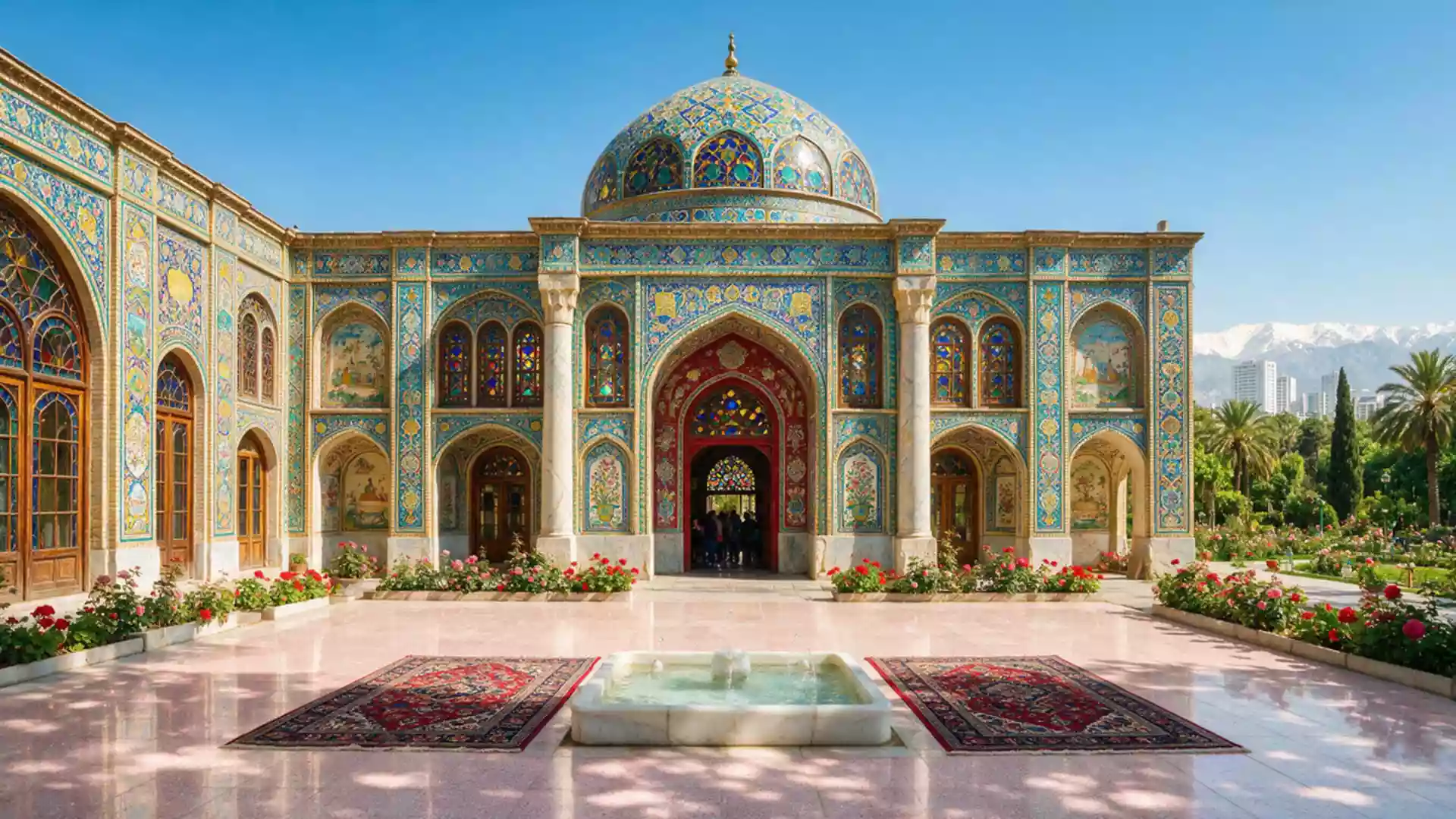
Kakh-e Golestan: a Qajar-era palace garden in Teheran
Published on 09/14/2026 at 21:07 | Editorial responsibility: Rafael Müller, Editor-in-Chief AD HOC NEWS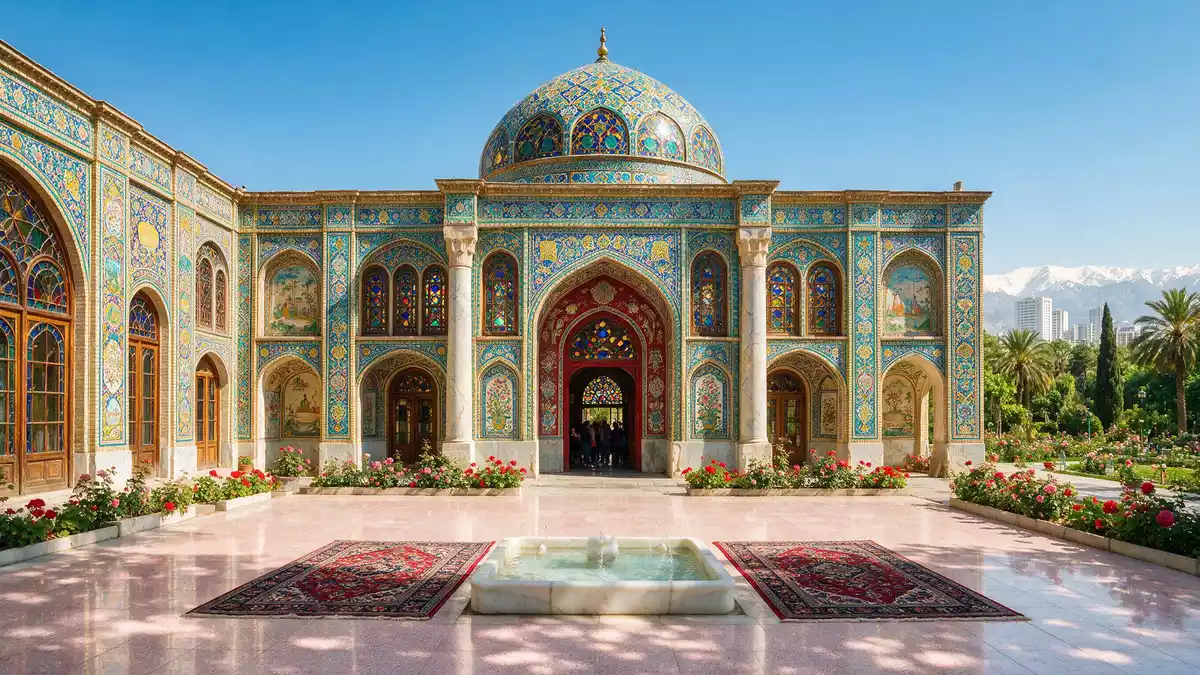
Kakh-e Golestan, known in English as Golestan Palace, is a historic royal complex in Teheran where ornate Qajar-era buildings gather around an enclosed garden court. Built on foundations laid in the Safavid period and reshaped in the nineteenth century, it became the seat of the Qajar ruling family and is now recognised as a UNESCO World Heritage site for its blend of Persian and European-influenced architecture.
A royal complex at the heart of Teheran
Kakh-e Golestan stands in the historic core of Teheran, within the area once enclosed by the city’s citadel walls. The complex developed from earlier Safavid-period structures and took on its characteristic form in the nineteenth century, when the Qajar dynasty selected it as their principal residence and centre of power.located in the historic core of Tehran The palace ensemble occupies a substantial plot with an arrangement of palatial buildings set around gardens and courtyards, contained within an outer wall with formal gates.
The World Heritage listing describes Golestan Palace as one of the oldest palace complexes in Teheran, with the core fabric originating in the Safavid dynasty and later additions reflecting Qajar tastes.one of the oldest complexes in Tehran Within the walls, the complex includes key palace structures and open garden space, forming a self-contained royal precinct in what is now a dense urban district. This layered history is physically legible in the juxtaposition of earlier brickwork with nineteenth-century decorative surfaces and newer museum arrangements.
Qajar-era architecture and decoration
The form in which visitors encounter Kakh-e Golestan today largely dates from the nineteenth century, when the Qajar rulers reorganised and embellished the complex. The ensemble includes several palace buildings and ceremonial halls, where richly decorated façades face onto the garden. Within these structures, interiors feature mirror decoration, tiled surfaces and ornamental plasterwork associated with high-status Qajar design.collections of Iranian crafts and European presents
Golestan Palace is noted for integrating long-established Persian architectural crafts with motifs drawn from Europe, particularly in the nineteenth-century phase.integration of Persian crafts and architecture with Western influences Tiled panels show figurative and floral designs, while mirror-work and stucco ornament catch and scatter light across interior spaces. In several buildings, display rooms and halls house objects that include Iranian artworks and diplomatic gifts, underscoring the palace’s former role in court ceremony and international representation.royal buildings and collections
Garden, museums and UNESCO recognition
At the centre of Kakh-e Golestan lies the palace garden, a green space enclosed by the surrounding buildings and outer wall. Paths and planting create a courtyard-like landscape, with the palace façades forming a continuous architectural frame around the open ground. This arrangement of garden and built fabric reflects a Persian tradition of integrating greenery and water with residential and ceremonial structures.
The complex is formally inscribed on the UNESCO World Heritage List under cultural criteria, highlighting its value as a Qajar-era ensemble and its testimony to changing architectural practice in nineteenth-century Iran.inscribed 2013 as a World Heritage Site The palace buildings are largely used as museums, presenting elements of court life, decorative arts and historical artefacts, while the garden serves as a shared centre for the complex.key palace structures mostly used as museums Together, the architecture, collections and garden layout convey the evolution of royal representation from Safavid beginnings through Qajar reconfiguration.
Visiting Kakh-e Golestan: what travellers from Western Europe should know
- Kakh-e Golestan stands in central Teheran, close to major thoroughfares and historic commercial districts. It is reached by city streets that lead towards Arg Square, where palace walls and gates mark the edge of the complex.
- Within the complex, movement between palace buildings and the garden involves walking on paved surfaces and navigating interior staircases. Some historic halls are reached by steps, reflecting the multi-level arrangement of the royal structures.
- The city of Teheran lies at altitude on the Iranian plateau, and Kakh-e Golestan shares this general elevation. Visitors encounter an enclosed garden court surrounded by substantial masonry walls and façades.
- The official language is Persian and the currency is the Iranian rial.
- Entry requirements depend on your nationality; UK travellers can check the FCDO travel advice at gov.uk/foreign-travel-advice, Irish travellers the Department of Foreign Affairs at ireland.ie.
Searching for Kakh-e Golestan on social platforms
These links open searches for Kakh-e Golestan on each platform.
Frequently asked questions about Kakh-e Golestan
Where is Kakh-e Golestan located?
Kakh-e Golestan is in central Teheran, within the historic core of the city where the former citadel once stood.
What should visitors expect on a visit?
Visitors encounter palace buildings arranged around an enclosed garden, with museum interiors displaying decorative arts and royal artefacts.
What makes Kakh-e Golestan distinctive?
The complex is distinctive for its Qajar-era architecture, its enclosed palace garden and its recognised status as a UNESCO World Heritage site.