
Kakadu National Park’s vast living landscape around Jabiru
Published on 09/19/2026 at 20:42 | Editorial responsibility: Rafael Müller, Editor-in-Chief AD HOC NEWS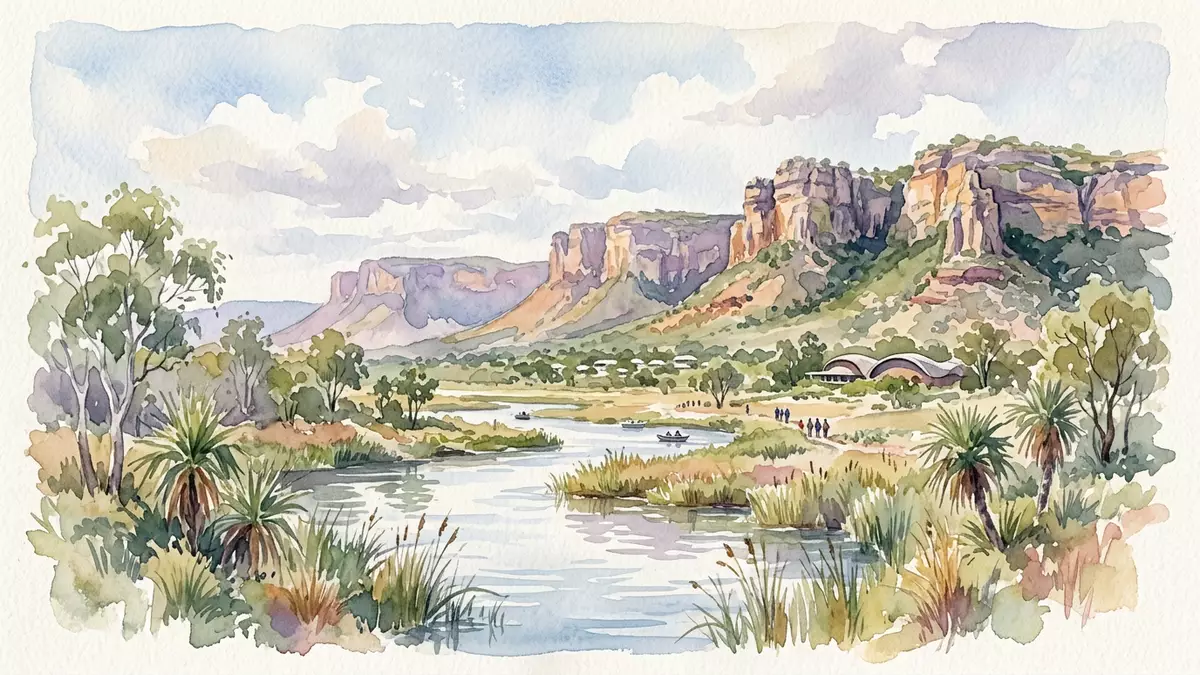
Kakadu National Park stretches around Jabiru in Australia’s Northern Territory as a vast protected landscape of wetlands, sandstone plateaux and woodlands shaped by monsoonal climate and long human presence. It is recognised as a mixed World Heritage site for both its outstanding natural environments and its deep Aboriginal cultural heritage.mixed World Heritage site
Landforms, scale and monsoon country
Kakadu National Park covers an area of about 19,804 square kilometres (7,647 sq mi), making it one of Australia’s largest terrestrial national parks.19,804 square kilometres The park extends for roughly 200 km (124 mi) from north to south and more than 100 km (62 mi) from east to west, from coastal flats and estuaries in the north to southern hills and basins inland.extends from the coast in the north
Within this scale, Kakadu forms a mosaic of landforms that are easy to sense on a journey from Jabiru outward. Savannah woodlands, sometimes referred to as the lowlands, occupy most of the park’s area as gently undulating country of grasses and scattered trees.savanna woodlands Rising above them, sandstone “stone country” of the Arnhem Land Plateau and escarpment complex reaches elevations around 330 m (1,083 ft), with cliffs and outliers framing the wetlands below.Arnhem Land Plateau
Wetlands, coasts and biodiversity
Between the plateau and the lowlands lie extensive floodplains that drain the catchments of the Alligator Rivers and the Wildman River, forming seasonal wetlands linked to the region’s monsoonal climate.catchment of a tropical monsoonal river system These floodplains sit alongside permanent billabongs and channels, and towards the north they meet tidal flats, mangrove-lined estuaries and coastal areas where the park reaches the sea.coastal and estuarine areas
This range of wetlands, woodlands, stone country, tidal flats and coast supports a high diversity of plants and animals, including habitats for rare and endangered species and endemic flora and fauna recognised in conservation assessments.wide range of environmental gradients The park’s landscapes are also protected under the Ramsar Convention as internationally significant wetlands, reflecting the importance of its floodplains and associated ecosystems.designated Wetlands of International Importance
Aboriginal culture and rock art in Kakadu
Kakadu National Park is recognised as a living cultural landscape where Aboriginal people have maintained continuous occupation for tens of thousands of years, with archaeological evidence indicating more than 40,000 years of human presence.inhabited continuously for more than 40,000 years Extensive rock art sites across the sandstone escarpments and shelters record changing ways of life from ancient hunter?gatherer societies to more recent contact periods.extensive rock art sites
The World Heritage inscription of Kakadu began in 1981 and was later extended in 1987 and 1992 as additional areas were added, reflecting both natural and cultural values under multiple criteria.inscribed by stages Kakadu is therefore one of the few national parks recognised internationally for this combination of ecosystems and longstanding cultural traditions, with its boundaries matching the World Heritage property.boundaries of the World Heritage property
Visiting Kakadu National Park: what travellers from Western Europe should know
- Kakadu National Park lies in Australia’s Northern Territory, with Jabiru as the main township inside the park and Darwin as the nearest major city connected by road.
- The park’s terrain ranges from flat floodplains and wetlands to sandstone escarpments and hills, so approaches to lookouts and rock art sites can involve uneven ground and short climbs.
- Within and around Jabiru there are established walking tracks through woodlands and around Jabiru Lake, offering accessible introductions to the surrounding landscapes.
- The official language is English and the currency is the Australian dollar (AUD).
- Entry requirements depend on your nationality; UK travellers can check the FCDO travel advice at gov.uk/foreign-travel-advice, Irish travellers the Department of Foreign Affairs at ireland.ie.
Searching for Kakadu National Park on social platforms
These links open searches for Kakadu National Park on each platform.
Frequently asked questions about Kakadu National Park
Where is Kakadu National Park in relation to Jabiru?
Kakadu National Park is in Australia’s Northern Territory, with Jabiru as the main township within the park and Darwin as the nearest major city.
What can visitors expect when exploring Kakadu from Jabiru?
Visitors encounter extensive woodlands, floodplains, wetlands and sandstone escarpments around Jabiru, with walking tracks and access roads reaching lookouts, cultural sites and visitor centres.
What makes Kakadu National Park distinctive among Australian national parks?
Kakadu is distinctive for its large scale, combination of diverse ecosystems and long Aboriginal cultural continuity, recognised in its mixed natural and cultural World Heritage status.


