
Kakadu National Park’s living cultural landscape near Jabiru
Published on 08/26/2026 at 15:19 | Editorial responsibility: Rafael Müller, Editor-in-Chief AD HOC NEWS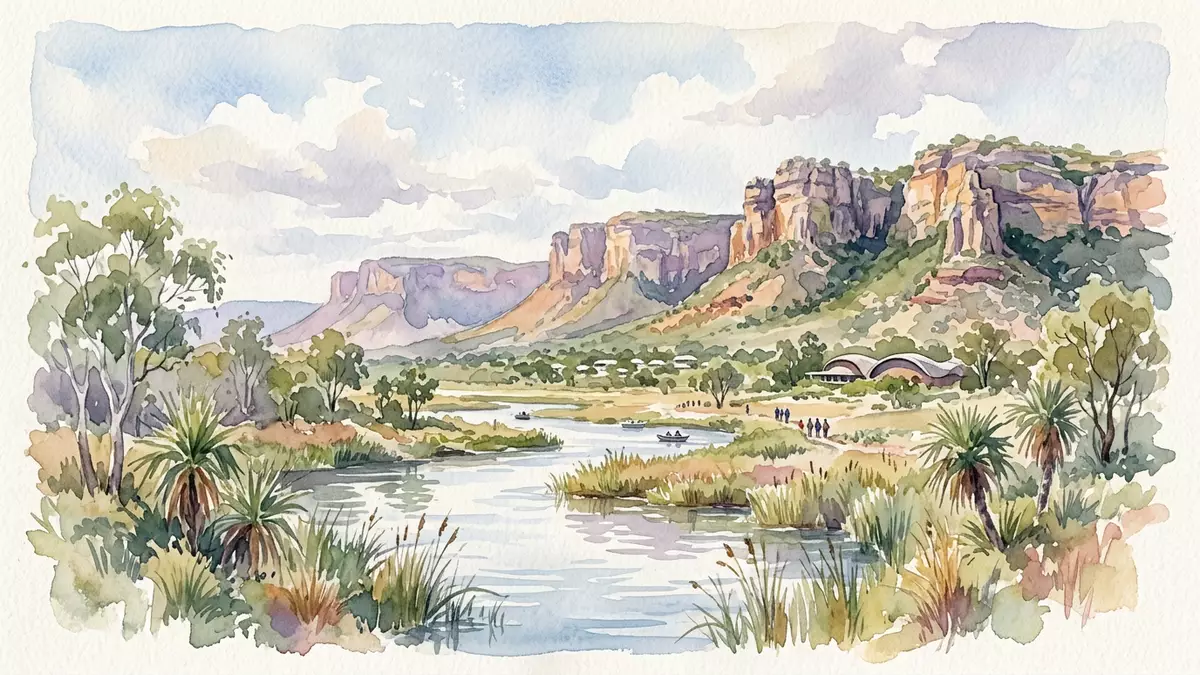
Kakadu National Park in Australia stretches east of Jabiru as a vast protected landscape where tropical wetlands, sandstone escarpments and ancient Aboriginal rock art share the same ground. Recognised as a World Heritage site since 1981 and extended in later stages, it is one of the places where natural and cultural values are formally protected together.
A vast tropical park shaped by water and stone
Kakadu National Park lies in the tropical north of Australia’s Northern Territory, east of the coastal city of Darwin and close to the township of Jabiru at its centre. The protected area covers almost 20,000 square kilometres (about 7,700 square miles), making it one of the largest national parks in the country.covers a vast 19,804 square kilometres Within this expanse, sandstone plateaus and ridges rise above floodplains, river systems and low-lying wetlands.
The park is bordered by river catchments including the East Alligator, South Alligator, West Alligator and Wildman rivers, which feed broad floodplains and billabongs across the landscape.a living cultural landscape with exceptional natural values Seasonal water brings large expanses of wetland vegetation and habitat for waterbirds, crocodiles and other wildlife. Parts of these wetlands are listed under the Ramsar Convention as Wetlands of International Importance, underlining their ecological significance.the wetlands of Kakadu National Park are listed as a Ramsar wetland site
World Heritage status for nature and culture
Kakadu National Park holds a rare dual inscription on the UNESCO World Heritage List for both natural and cultural outstanding universal values.dual-listed on the UNESCO World Heritage List The first stage of World Heritage listing took place in 1981, with additional areas added in 1987 and 1992 as the protected region was extended.inscribed on the World Heritage List in three stages This combination of listings recognises the ongoing geological and biological processes and the long continuity of Aboriginal culture in the park.
The park sits within ancient geological formations, including some of the oldest exposed rocks identified on Earth, dated to around 2,500 million years ago in places.some of the oldest exposed rocks in the world dating back 2500 million years Over long periods, shallow seas, river erosion and weathering carved the present escarpments, plateaus and valleys. The combination of these landforms with extensive wetlands and river systems creates a landscape where stone country and floodplain are closely interwoven.
Aboriginal rock art and living culture
Beyond its scale and ecology, Kakadu National Park is renowned for its concentration of Aboriginal rock art sites spread across its escarpments, gorges and rock outliers.one of the world’s greatest concentrations of rock art sites Thousands of individual art sites have been recorded, and many more are thought to exist, documenting a continuity of human presence and cultural expression over tens of thousands of years.some 5,000 art sites have been recorded
Some paintings in Kakadu are dated to as much as 20,000 years old, giving one of the longest continuous artistic records of any group of people known.some paintings are up to 20,000 years old The artworks include naturalistic depictions of animals, human figures, hunting scenes and ceremonial imagery, along with the characteristic x-ray style showing internal structures of animals.elaborate multicoloured X-ray art Major galleries such as Ubirr and Burrungkuy (Nourlangie) present these layered works on rock surfaces, reflecting ongoing cultural traditions of Bininj/Mungguy, the Aboriginal people connected to this country.Ubirr hosts some of the world’s most outstanding rock art
Visiting Kakadu National Park: what travellers from Western Europe should know
- Kakadu National Park lies in the Northern Territory of Australia, east of Darwin, with Jabiru serving as a service town inside the park; the main access routes use sealed roads suitable for vehicles.
- The terrain ranges from flat floodplains and wetlands to sandstone escarpments, with some walking routes over uneven rock surfaces and exposed plateaus that require firm footwear.
- During the tropical wet season, parts of the floodplain hold extensive surface water and some areas of country can feel remote, so travellers encounter both open wetlands and higher stone country in one visit.
- The official language is English and the currency is the Australian dollar.
- Entry requirements depend on your nationality; UK travellers can check the FCDO travel advice at gov.uk/foreign-travel-advice, Irish travellers the Department of Foreign Affairs at ireland.ie.
Searching for Kakadu National Park on social platforms
These links open searches for Kakadu National Park on each platform.Frequently asked questions about Kakadu National Park
Where is Kakadu National Park located?
Kakadu National Park is in the Northern Territory of Australia, east of Darwin, with Jabiru situated within the park’s boundaries as a service centre.
What can visitors expect on a visit to Kakadu?
Visitors encounter extensive wetlands, river systems, sandstone escarpments and Aboriginal rock art galleries, with driving and walking routes linking floodplain country to higher stone areas.
What makes Kakadu National Park distinctive?
Kakadu stands out for its combination of vast tropical landscapes, ancient geological formations and one of the longest continuous records of Aboriginal rock art protected under dual World Heritage listing.


