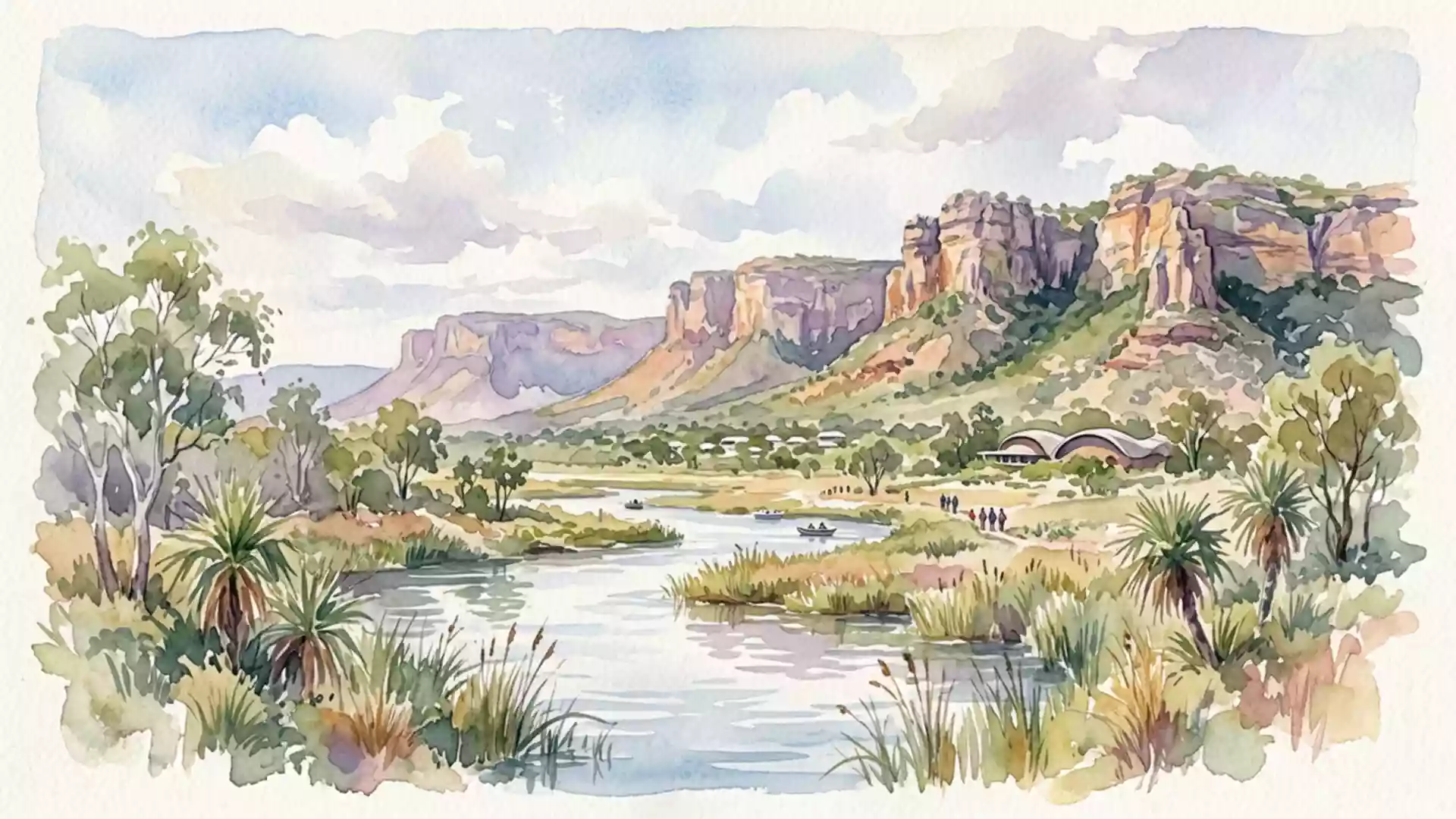
Kakadu National Park’s layered landscapes around Jabiru
Published on 09/03/2026 at 22:44 | Editorial responsibility: Rafael Müller, Editor-in-Chief AD HOC NEWS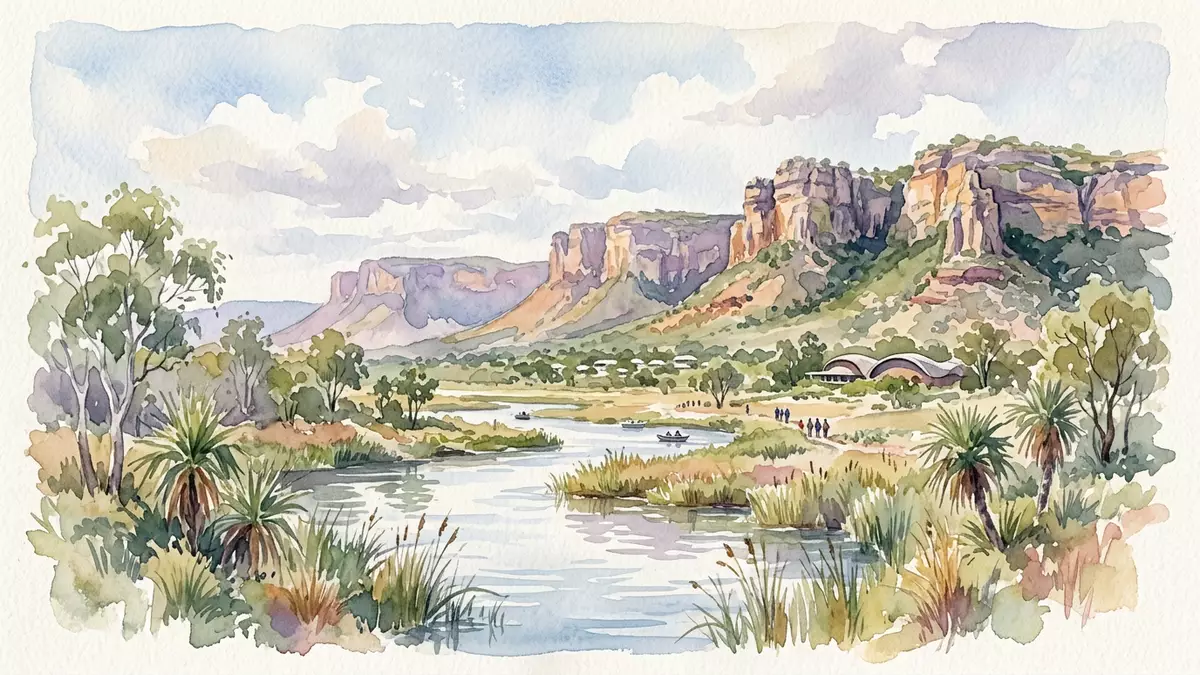
Kakadu National Park in Australia’s Northern Territory stretches across an immense tropical landscape east of Darwin, with Jabiru as its main township and service hub. The park’s scale, its mosaic of wetlands, woodlands and sandstone plateaus, and the depth of Aboriginal cultural presence together form a layered terrain where natural and human histories sit visibly side by side.
Vast country shaped by water and stone
Kakadu National Park lies in the Alligator Rivers region of the Northern Territory, with its western boundary about 150 km east of Darwin and the Bowali Visitor Centre near Jabiru further inside the park.The Bowali Visitor Centre near Jabiru The protected area covers almost 20,000 square kilometres (around 7,700 square miles), extending nearly 200 km from north to south and more than 100 km from east to west.covers an area of 19,804 km²
From the northern coastline and estuaries the land grades inland through floodplains and billabongs into lowlands, before lifting into rocky ridges and the sandstone “Stone Country” towards the south.runs from the coast and estuaries Savanna woodlands, open forest and pockets of monsoon rainforest occupy these zones, together preserving a richer variety of ecosystems than any other single protected area on the Australian continent.variety of ecosystems on the Australian continent Rivers spread across wide floodplains in the wet season, then retreat into channels and billabongs, leaving cracked mud, grasses and exposed rock.
World Heritage status and deep time
Kakadu National Park was designated as a national park in three stages between 1979 and 1991, and inscribed on the UNESCO World Heritage List in 1981, 1987 and 1992 for both outstanding natural and cultural values.inscribed on the World Heritage List in three stages It is one of the largest national parks in Australia and one of the few Australian sites recognised for a combination of ecological processes and living traditions.the largest national park in Australia
The rocks underlying Kakadu include some of the oldest formations on the Australian continent, dated to about 2.5 billion years ago in places, and over them lie younger sandstones that form cliffs and escarpments.oldest rocks date to about 2.5 billion years The park supports remarkable biodiversity, with more than 1,600 plant species recorded and a wide range of animals including mammals, reptiles, birds, fish and invertebrates.more than 1,600 plant species Wetlands in particular provide habitat for numerous waterbirds and estuarine species, while the uplands carry different assemblages of woodland plants and animals.
Aboriginal rock art and living culture
More than half of Kakadu National Park is Aboriginal land, and the park is jointly managed by its Traditional Owners and Parks Australia under a framework that includes Aboriginal representation at board level and on-ground work.more than half the park is Aboriginal land The name “Kakadu” derives from Gagudju, one of the Aboriginal language groups spoken in the region in the early twentieth century.name Kakadu derives from the Gagudju group
Archaeological and rock art sites across the park record continuous Aboriginal occupation over tens of thousands of years, with some evidence indicating more than 40,000 years of human presence.inhabited continuously for more than 40,000 years Around 5,000 rock art sites have been identified so far, and some paintings are up to 20,000 years old, depicting animals, ancestral beings and contact with outsiders including tall ships.some being up to 20,000 years old These panels sit on cliff faces, in rock shelters and along escarpments, where visitors encounter images that show changes in environment and society over millennia.
Visiting Kakadu National Park: what travellers from Western Europe should know
- Kakadu National Park lies in the tropical north of Australia, with its nearest township Jabiru reached overland from Darwin and serving as an access point for the wider park.
- The terrain includes floodplains, wetlands and sandstone escarpments, with some approaches involving walking over uneven ground and climbing steps to reach rock shelters or lookout points.
- Within the park’s boundaries the Bowali Visitor Centre near Jabiru functions as an information hub, and road access extends to a range of rivers, billabongs and lowland areas.
- The official language is English and the currency is the Australian dollar.
- Entry requirements depend on your nationality; UK travellers can check the FCDO travel advice at gov.uk/foreign-travel-advice, Irish travellers the Department of Foreign Affairs at ireland.ie.
Searching for Kakadu National Park on social platforms
These links open searches for Kakadu National Park on each platform.
Frequently asked questions about Kakadu National Park
Where is Kakadu National Park in relation to Jabiru?
Kakadu National Park surrounds the township of Jabiru in Australia’s Northern Territory, with the Bowali Visitor Centre near Jabiru acting as a central access point.
What should visitors expect on a trip into Kakadu?
Visitors encounter wide floodplains, rivers, billabongs and sandstone plateaus, alongside Aboriginal rock art sites that are accessible at selected locations across the park.
What makes Kakadu National Park distinctive among Australian protected areas?
Kakadu combines vast tropical ecosystems with documented Aboriginal occupation over tens of thousands of years and dual inscription on the UNESCO World Heritage List for natural and cultural values.