

Jungfraujoch, where Europe’s highest railway meets the ice
Published on 08/24/2026 at 18:27 | Editorial responsibility: Rafael Müller, Editor-in-Chief AD HOC NEWS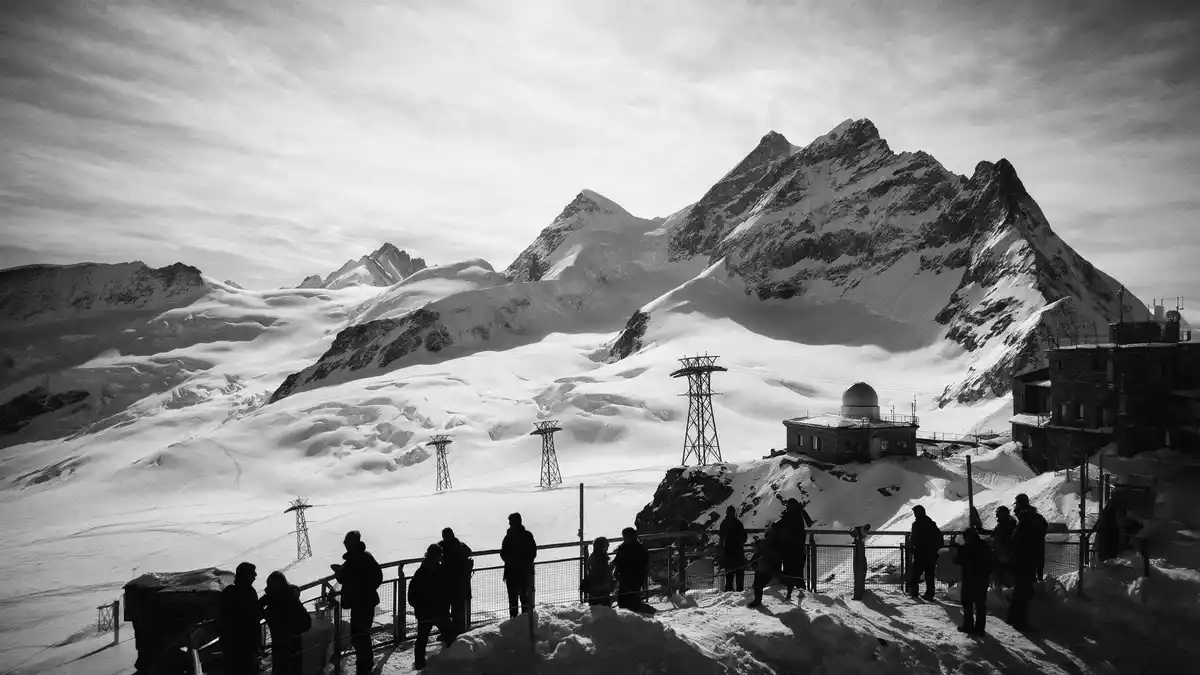
High on a broad saddle between Jungfrau and Mönch in the Bernese Alps, Jungfraujoch brings Europe’s highest railway station directly onto glacier ice and rock. At around 3,450 m (about 11,320 ft) above sea level, it forms a high-altitude crossroads between the Jungfrau region’s mountain summits and the sprawling Aletsch Glacier far below.
A high saddle above the Aletsch Glacier
Jungfraujoch is a glacier pass linking the peaks of Jungfrau and Mönch in the Bernese Alps of Switzerland, on the boundary between the cantons of Bern and Valais.glacier pass linking the peaks The saddle lies on the upper snows of the Aletsch Glacier, part of the wider Swiss Alps Jungfrau-Aletsch World Heritage landscape.Swiss Alps Jungfrau-Aletsch World Heritage This height gives Jungfraujoch its reputation as the “Top of Europe” and defines the atmosphere on the viewing terraces and snowfields.
The pass itself rises to about 3,463 m (11,362 ft), with the railway station and visitor complex slightly lower on the Valais side at around 3,454 m (11,332 ft).3,454 metres above sea level To the south, the ice flows away in the broad sweep of the Aletsch Glacier, framed by high ridges and distant summits; to the north, the rock walls of the Eiger, Mönch and Jungfrau drop towards the valleys around Grindelwald and Lauterbrunnen.
Europe’s highest railway station and the tunnel through the rock
Jungfraujoch has been reached by train since 1912, when the Jungfrau Railway completed its line from Kleine Scheidegg to the high saddle through a tunnel driven deep into the Eiger and Mönch.Jungfrau Railway completed its line The railway forms the uppermost section of a chain of mountain lines from Interlaken via either Lauterbrunnen or Grindelwald, climbing steadily from the lakeside to the high alpine snowfields.Interlaken via Grindelwald or Lauterbrunnen
The underground Jungfraujoch station stands at about 3,454 m (11,332 ft), giving it the status of the highest railway station in Europe.highest railway station in Europe Platforms, concourses and tunnels are cut into the rock, with passages leading to lifts, viewing galleries and exits onto the snow plateau. The sense of arrival is unusual: passengers step from enclosed platforms directly into a complex of corridors and halls embedded in the mountain rather than onto an open station square.
Sphinx Observatory, Ice Palace and life at altitude
Above the railway level, the Sphinx building stands on a rocky outcrop rising over Jungfraujoch, reached from within the complex by a high-speed lift.connected to the Sphinx Observatory At its summit, the Sphinx Observatory houses laboratories, a weather station and an astronomical dome, forming part of the High Altitude Research Station Jungfraujoch.High Altitude Research Station Jungfraujoch Terraces around the building offer open-air views across the Aletsch Glacier and back towards the north face of the Jungfrau massif.
Inside the visitor complex, a series of tunnels and galleries leads to attractions such as the Ice Palace, where passages and chambers are set within the glacier ice, and a snow plateau that opens directly onto compacted snowfields.Ice Palace and the plateau Restaurants, a cafeteria and shops are integrated into the same network of spaces, making Jungfraujoch a self-contained high-altitude station where trains, science facilities and visitor areas share the same rock platform.
Visiting Jungfraujoch: what travellers from Western Europe should know
- Jungfraujoch lies between Jungfrau and Mönch in the Bernese Alps, south of Interlaken in Switzerland, and is reached by mountain railways linking via Kleine Scheidegg.
- The approach from Kleine Scheidegg includes a steep cog railway and an extended tunnel section, and at Jungfraujoch most movement takes place through enclosed corridors and stairways.
- The station complex stands above 3,400 m (around 11,150 ft), and outside the buildings paths cross compacted snow and ice with exposed viewpoints over the Aletsch Glacier.
- The area forms part of the Swiss Alps Jungfrau-Aletsch World Heritage site in Switzerland, where the official language is German and the currency is the Swiss franc.
- Entry requirements depend on your nationality; UK travellers can check the FCDO travel advice at gov.uk/foreign-travel-advice, Irish travellers the Department of Foreign Affairs at ireland.ie.
Searching for Jungfraujoch on social platforms
These links open searches for Jungfraujoch on each platform.
Frequently asked questions about Jungfraujoch
Where is Jungfraujoch?
Jungfraujoch lies in the Bernese Alps of Switzerland, on the boundary between the cantons of Bern and Valais, between the summits of Jungfrau and Mönch.
What can visitors expect on a visit to Jungfraujoch?
Visitors encounter an underground high-altitude station, indoor galleries, the Ice Palace, terraces above the Aletsch Glacier and a snow plateau with access to compacted snowfields.
What makes Jungfraujoch distinctive compared with other alpine viewpoints?
Jungfraujoch combines a glacier saddle, Europe’s highest railway station, the Sphinx research observatory and direct access to the Aletsch Glacier within a single high-altitude complex.


