
Joya de Ceren, a buried Maya village in rural El Salvador
Published on 09/19/2026 at 20:02 | Editorial responsibility: Rafael Müller, Editor-in-Chief AD HOC NEWS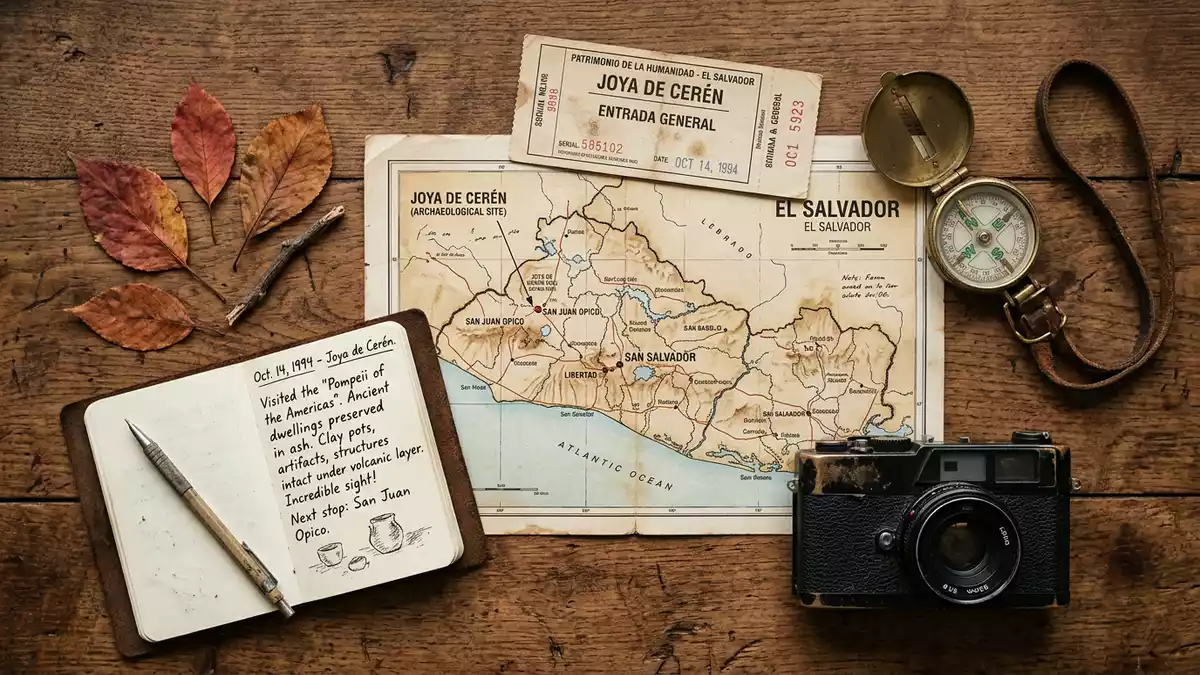
Joya de Ceren near San Juan Opico in western El Salvador is a rare glimpse of an ordinary Maya farming community preserved beneath volcanic ash in the Zapotitán Valley. In the seventh century AD a sudden eruption of the Loma Caldera volcano buried homes, fields and workspaces under deep ash, sealing a village that archaeologists later uncovered almost in situ.
A Maya village frozen under ash
The archaeological site of Joya de Ceren lies in the La Libertad Department of El Salvador, in the flat basin of the Zapotitán Valley north-west of San Salvador. Excavations have revealed a pre-Columbian farming village occupied during the Classic period, with structures dated to around the sixth and seventh centuries AD when the Loma Caldera eruption struck.pre-Hispanic farming community buried by a volcanic eruption The village stands within a wider landscape of low hills and volcanic features that mark this part of central El Salvador.
Layers of ash covered the settlement rapidly, preserving walls, floors and even traces of everyday objects. Archaeologists have uncovered several domestic buildings and work structures over a compact area, including houses, storehouses, a kitchen and a temascal, a traditional sauna used for bathing and ritual cleansing.ten prehispanic structures exposed, including houses, storehouses, a kitchen and a temascal Instead of monumental pyramids, visitors see modest earthen and adobe constructions, the scale of a small rural community.
Daily life revealed in earth and adobe
Joya de Ceren preserves traces of everyday life normally lost at sites dominated by temples and palaces. Excavation work has documented pottery, tools, storage vessels and agricultural features such as planting beds and field boundaries, giving rare detail on how people organised work and domestic routines in a Maya farming settlement.utensils, ceramics, furniture and food left behind The ash sealed floor levels and work surfaces, fixing the moment villagers fled the eruption.
Structures at the site show a mix of domestic and communal functions. Two houses stand near store buildings and a kitchen, with pathways linking them across the excavated area.Maya settlement of circa AD 650 preserved by a volcanic eruption The temascal lies close to these dwellings, reflecting its role in regular bathing and social life. Outside the roofed protection areas, portions of fields and garden plots show how crops were planted near the village, tying domestic spaces directly to the surrounding farmland.
World Heritage recognition in rural San Juan Opico
In 1993 Joya de Ceren was inscribed on the UNESCO World Heritage List as El Salvador’s only World Heritage property, recognised for the exceptional preservation of an ordinary farming village rather than elite ceremonial architecture.inscribed on the UNESCO World Heritage List in 1993 The archaeological park sits at kilometre 35 along the road from San Salvador to San Juan Opico, making it a reachable excursion from the capital while remaining firmly in a rural setting.located about 36 km north-west of San Salvador in the Zapotitán Valley
The excavated structures are protected by large shelter roofs and connected by a raised trail, forming an organised archaeological park. A small site museum explains the Classic-period context, the Loma Caldera eruption and the methods used to uncover the buried village, while displays of ceramics and tools complement the standing remains. The park layout separates the sensitive excavation area from administrative and visitor facilities, with the preserved village at its centre.
Visiting Joya de Ceren: what travellers from Western Europe should know
- Joya de Ceren lies in the municipality of San Juan Opico in La Libertad Department, reached along the road from San Salvador towards San Juan Opico where the archaeological park stands near kilometre 35.
- The archaeological trail runs over raised walkways beneath protective roofs, with steps and short ramps linking viewing platforms above the excavated structures.
- The site museum and park buildings are in the same compound as the excavated village, so a visit combines sheltered viewing of the ruins with time indoors among interpretive displays.
- The official language is Spanish and the currency is the United States dollar.
- Entry requirements depend on your nationality; UK travellers can check the FCDO travel advice at gov.uk/foreign-travel-advice, Irish travellers the Department of Foreign Affairs at ireland.ie.
Searching for Joya de Ceren on social platforms
These links open searches for Joya de Ceren on each platform.
Frequently asked questions about Joya de Ceren
Where is Joya de Ceren located?
Joya de Ceren is in the La Libertad Department of El Salvador, in the Zapotitán Valley north-west of San Salvador and within the municipality of San Juan Opico.
What can visitors expect to see at the site?
Visitors walk along raised paths under protective roofs to view excavated houses, store structures, a kitchen, a temascal and parts of surrounding fields, supported by a small site museum.
What makes Joya de Ceren distinctive among Maya sites?
Unlike temple-centred sites, Joya de Ceren preserves an ordinary farming village buried by volcanic ash, offering detailed evidence of daily life in a rural Maya community of the Classic period.


