
Joshua Tree National Park where two deserts meet stone labyrinths
Published on 09/08/2026 at 16:14 | Editorial responsibility: Rafael Müller, Editor-in-Chief AD HOC NEWS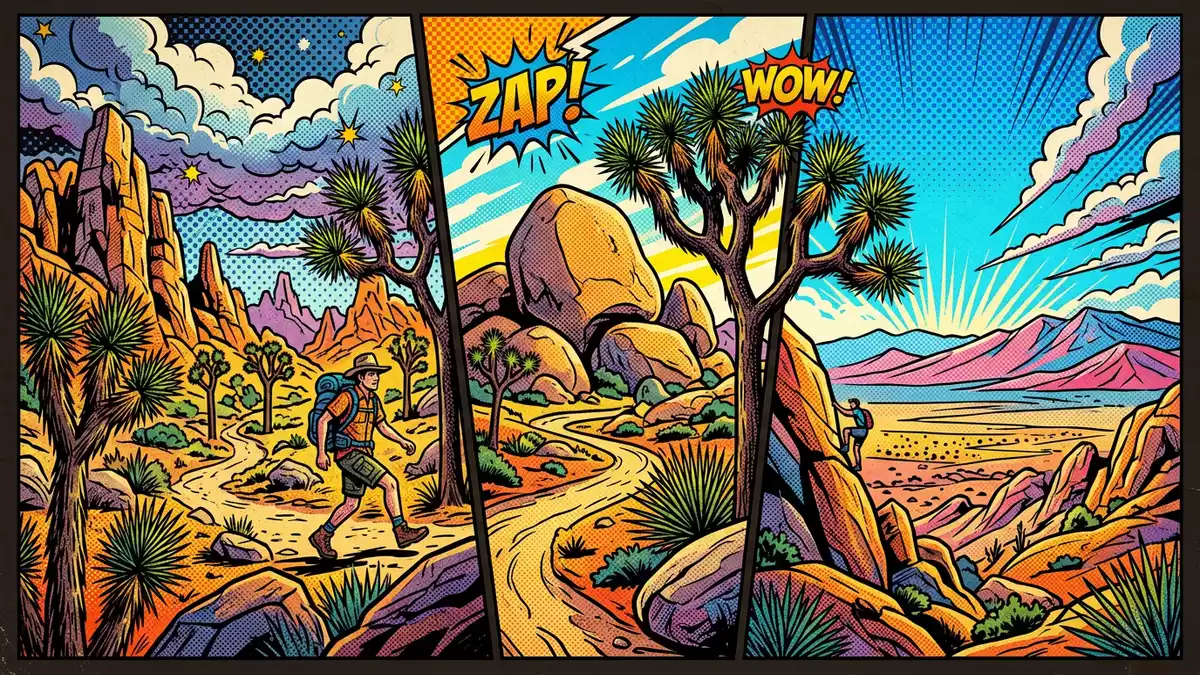
Joshua Tree National Park in southern California stretches across the high desert around the town of Joshua Tree, where sculpted granite boulder mazes rise from a meeting of two great North American deserts. Designated a national monument in 1936 and redesignated a national park in 1994, it preserves a landscape shaped over hundreds of millions of years by tectonic forces, intruding magma and slow erosion.
Granite labyrinths in the high Mojave
The most striking first impression of Joshua Tree National Park is the concentration of pale monzogranite boulders, stacked into walls, domes and corridors that form natural climbing playgrounds and sheltered hollows. These formations developed from plutonic intrusions that cooled underground and were later exposed and rounded as the overlying rocks eroded away, leaving the familiar jumbled outcrops seen along Park Boulevard and around the Wonderland of Rocks area.These plutonic intrusions are a granitic rock called monzogranite The same monzogranite appears in large parts of the Pinto, Eagle and Coxcomb mountains, unifying distant views with its light colour and rounded profiles.monzogranite common to the Wonderland of Rocks, parts of the Pinto, Eagle, and Coxcomb Mountains
Threaded between these pale masses are darker bands and outcrops of Pinto Gneiss, a much older metamorphic rock that records an earlier chapter of the region’s geological story. The oldest rocks in the park, including Pinto Gneiss in the Cottonwood, Pinto and Eagle Mountains, date back around 1.4 to 1.7 billion years, placing them in the Proterozoic Eon and giving hikers a direct encounter with deep geological time.The oldest rocks in Joshua Tree National Park are 1.4 to 1.7 billion-year old metamorphic rocks In road cuts along Pinto Basin Road these contrasting rocks stand side by side, the lighter granites intruding into and framing the darker, foliated gneiss.Another prominent visible rock type is the Pinto Gneiss, a much older dark-colored foliated metamorphic rock formed about 1.4 to 1.7 billion years ago
Where the Mojave and Colorado deserts overlap
Joshua Tree National Park straddles two distinct desert ecosystems, the higher Mojave Desert to the west and the lower Colorado Desert, part of the Sonoran Desert, to the east.The Mojave Desert (Western Portion) ... the Colorado Desert (Eastern Portion) Broadly above about 900 m (3,000 ft) the Mojave section supports the characteristic Joshua trees, branching yuccas that give the park its name and frame views of the granite hills. Below that level towards the Pinto Basin and Cottonwood Springs, the landscape shifts towards the Colorado Desert, with more open expanses, different cacti and wider alluvial fans.
This transition plays out over relatively short distances as roads climb from the lower basins up onto high desert plateaus. From viewpoints such as Keys View, on the uplifted blocks of the Little San Bernardino Mountains, visitors look south towards the Coachella Valley and the trace of the San Andreas Fault beyond the park boundary, grasping how tectonic movement has raised and folded these east–west trending ranges.Another important geologic feature of Joshua Tree National Park is its proximity to the San Andreas Fault, which is located just outside the park boundary and is strikingly visible from Keys Point The contrast between the relatively cool, tree-dotted uplands and the sparse, warmer basins below gives the park a layered desert character within a single protected area.
Protected desert since the 1930s
Joshua Tree first received federal protection on 10 August 1936, when President Franklin D. Roosevelt used the Antiquities Act to establish Joshua Tree National Monument and safeguard around 825,000 acres of California desert.In 1936, President Franklin D. Roosevelt set aside 825,000 acres of California desert as Joshua Tree National Monument The area was redesignated as Joshua Tree National Park on 31 October 1994 under the California Desert Protection Act, expanding the protected land and recognising its ecological and geological value.The monument was redesignated as a national park on October 31, 1994, by the Desert Protection Act
The park sits within the Eastern Transverse Ranges of California and lies northeast of Palm Springs, with its main northern entrances at the communities of Joshua Tree and Twentynine Palms. It protects a wide range of habitats from rocky uplands and pinyon-covered slopes to desert washes and ephemeral playas, together holding geological evidence that spans nearly two billion years of Earth history.The geologic history of Joshua Tree National Park records the effects of plate tectonics, volcanism, mountain-building, and stark erosion The official language is English and the currency is the US dollar.
Visiting Joshua Tree National Park: what travellers from Western Europe should know
- Joshua Tree National Park lies in southern California, east of Los Angeles, with main entrances near the towns of Joshua Tree and Twentynine Palms that are reached by highway.
- Most viewpoints, campgrounds and trailheads sit on rocky desert terrain, with sandy washes, uneven paths and, in some areas, granite slabs and boulder fields.
- Elevations range from lower desert basins to high desert plateaus above about 900 m, so conditions can differ markedly between the Colorado Desert lowlands and Mojave uplands.
- The nearest major urban area is Palm Springs to the south-west, from which paved roads climb into the park’s Little San Bernardino Mountains.
- Entry requirements depend on your nationality; UK travellers can check the FCDO travel advice at gov.uk/foreign-travel-advice, Irish travellers the Department of Foreign Affairs at ireland.ie.
Searching for Joshua Tree National Park on social platforms
These links open searches for Joshua Tree National Park on each platform.
Frequently asked questions about Joshua Tree National Park
Where is Joshua Tree National Park?
Joshua Tree National Park lies in southern California in the United States, east of Los Angeles, with main access from the communities of Joshua Tree and Twentynine Palms.
What can visitors expect to see in the park?
Visitors encounter extensive granite boulder formations, Joshua tree woodlands in the Mojave uplands, lower Colorado Desert landscapes and views towards the Coachella Valley and surrounding mountain ranges.
What makes Joshua Tree National Park distinctive?
The park combines billion-year-old metamorphic rocks, younger monzogranite outcrops, and the overlap of the Mojave and Colorado deserts, all protected since its designation as a monument in 1936.


