
Jiuzhaigou in Aba: coloured lakes in a high mountain valley
Published on 09/07/2026 at 18:28 | Editorial responsibility: Rafael Müller, Editor-in-Chief AD HOC NEWS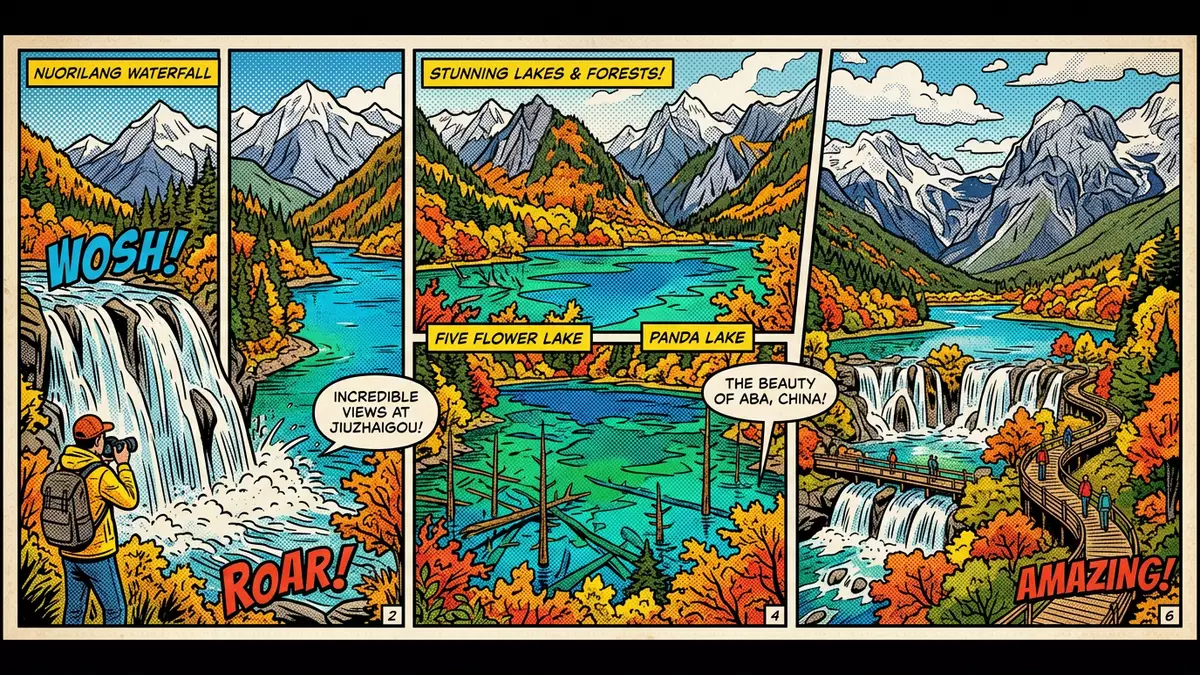
Jiuzhaigou in Aba, northern Sichuan, is a high mountain valley where clear lakes and waterfalls lie among forests and travertine terraces. Recognised as a World Heritage Site since 1992 and as a biosphere reserve since 1997, it combines alpine terrain with intensely coloured water in a landscape that feels both dramatic and intricate.World Heritage inscription
A valley of lakes, waterfalls and travertine terraces
Jiuzhaigou forms a long valley running roughly north to south in the Min Mountains on the edge of the Tibetan Plateau, in the north of Sichuan Province.location in Sichuan Streams in the valley carry carbonate-rich water that deposits travertine, a soft, porous limestone that hardens when exposed to the air.travertine terraces Over time, this rock builds natural dams across the valley floor, impounding lakes and creating broad waterfalls where the water spills over terrace edges.
The reserve covers more than 64,000 hectares of mountainous terrain, with elevations ranging from around 2,000 m (6,600 ft) to over 4,700 m (15,400 ft).biosphere reserve altitude and area Lakes often appear in chains along the gullies, separated by travertine dams and shoals. Their surfaces reflect surrounding coniferous and mixed forests, while the mineral-rich water produces shades of blue and green that vary with depth, angle and light. In some pools submerged trunks and branches remain clearly visible beneath the surface, giving the water an almost glass-like clarity.number of lakes and clarity
High mountain setting and biodiversity
Jiuzhaigou lies on the southern slopes of the Minshan Mountains, a range that forms part of the transition between the Sichuan Basin and the Qinghai–Tibet Plateau.position between basin and plateau The valley stretches across roughly 72,000 hectares in the Aba Tibetan and Qiang Autonomous Prefecture, with jagged ridges rising above forested slopes and river gullies.extent in the Min Mountains This high-altitude setting creates a sequence of vegetation zones, from mixed broadleaf and conifer forests in the lower reaches to subalpine communities higher up.
The reserve supports a range of wildlife, including numerous bird species and mammals adapted to montane forest and cliff habitats.forest ecosystems and fauna Parts of Jiuzhaigou are associated with endangered species that rely on intact forest and clean water, and the valley’s inclusion as both a national nature reserve and a World Natural Heritage Site reflects its ecological as well as visual importance.protected status Traditional Tibetan villages in and around the valley add a cultural layer to the landscape, with wooden houses and prayer flags appearing against the backdrop of forest and rock.
Colours, named lakes and waterfalls
Many of Jiuzhaigou’s lakes and waterfalls carry names drawn from their appearance or associated stories. The Five Flower Lake is particularly known for its palette of turquoise, aquamarine and deeper blue tones set against pale travertine and dark trunks lying beneath the surface.Five Flower Lake and travertine Long Lake, another well-known body of water, occupies a high basin flanked by steep forested slopes, giving it a fjord-like outline within the mountain setting.
Waterfalls such as Nuorilang and Pearl Shoal span wide terraces where water fans out over limestone, then gathers into channels lower down the slope.Nuorilang travertine waterfall dimensions In places the terraces form shallow rimmed pools, with shrubs and small trees growing among them and sending roots into the travertine. The combination of still pools, falling water and layered rock gives the valley a stepped structure when viewed from above, especially along the main gullies where lakes and waterfalls follow one another in sequence.
Visiting Jiuzhaigou: what travellers from Western Europe should know
- Jiuzhaigou is reached in the north of Sichuan Province, in the Aba Tibetan and Qiang Autonomous Prefecture. Access routes connect the valley with cities in the Sichuan Basin, and roads approach the reserve through mountain terrain.
- The terrain inside the protected area is mountainous, with significant elevation differences between valley floors and surrounding ridges. Paths and walkways cross travertine terraces and forested slopes, and some viewpoints require climbing flights of steps.
- Lakes, rivers and waterfalls lie at altitudes from around 2,000 m (6,600 ft) upwards, so travellers encounter thinner air than at sea level and changing weather linked to the mountain environment.
- Jiuzhaigou is in China, where the official language is Chinese and the currency is the renminbi (yuan).
- Entry requirements depend on your nationality; UK travellers can check the FCDO travel advice at gov.uk/foreign-travel-advice, Irish travellers the Department of Foreign Affairs at ireland.ie.
Searching for Jiuzhaigou on social platforms
These links open searches for Jiuzhaigou on each platform.
Frequently asked questions about Jiuzhaigou
Where is Jiuzhaigou and what kind of place is it?
Jiuzhaigou is a nature reserve and national park in Jiuzhaigou County, within the Aba Tibetan and Qiang Autonomous Prefecture in northern Sichuan, China. It is a high mountain valley known for lakes, waterfalls and travertine terraces.
What should travellers expect on a visit to Jiuzhaigou?
Travellers encounter chained lakes, broad waterfalls and forested slopes arranged along a long valley, with wooden walkways and paths crossing terraces and gullies at various altitudes.
What makes Jiuzhaigou distinctive among mountain landscapes?
The combination of carbonate-rich travertine terraces, clear mineral-rich lakes with visible submerged trunks, and wide waterfalls in a protected high-altitude valley gives Jiuzhaigou a character that is strongly tied to water and rock.


