
Jiuzhaigou: colour, water and forest in a high Sichuan valley
Published on 09/08/2026 at 08:26 | Editorial responsibility: Rafael Müller, Editor-in-Chief AD HOC NEWS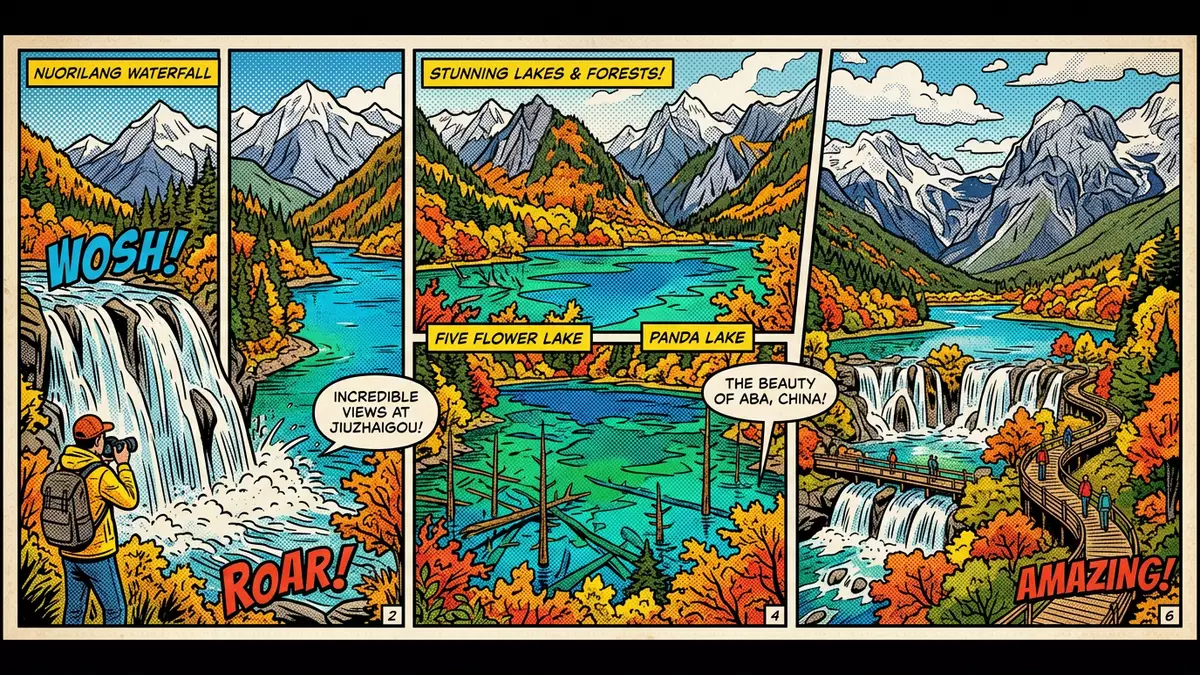
Jiuzhaigou in Aba, northern Sichuan, is a high mountain valley where clear lakes, layered waterfalls and dense forest share a protected landscape shaped by travertine terraces. Set within the Min Mountains in the north of Sichuan Province in southwestern China, the valley is recognised as both a nature reserve and a national park and has been inscribed on the UNESCO World Heritage List since 1992 as the Jiuzhaigou Valley Scenic and Historic Interest Area.
A high valley of lakes, waterfalls and forest
Jiuzhaigou forms a long, branching valley system on the southern slopes of the Min Mountains in the Aba Tibetan and Qiang Autonomous Prefecture of Sichuan in south-western China.nature reserve and national park The landscape stretches over tens of kilometres in a rough north–south alignment and is carved into steep mountain slopes covered by mixed forest. Elevations in the main valley lie around 2,000 to 2,600 m (6,562–8,530 ft), while surrounding ridges rise far higher into the Min Mountains and feed snowmelt and rainfall into the tributary streams.high-elevation valley system
Water and forest together define the valley floor. Streams rich in dissolved carbonates have built a staircase of natural travertine terraces and dams, impounding chains of clear lakes and shaping broad, multi-level waterfalls where water drops over pale limestone ledges.travertine deposits creating lakes and waterfalls The forest coverage in the reserve is high, and conifers and deciduous trees line the slopes, frame the water and reflect onto lake surfaces that carry deep blues and greens. Across the wider protected area, which extends over tens of thousands of hectares in northern Sichuan, the terrain ranges from valley floors to jagged ridges and occasional snow-capped peaks.Jiuzhaigou Valley Scenic and Historic Interest Area
Travertine terraces and the chemistry of clear water
The most distinctive physical feature of Jiuzhaigou is the way its water interacts with travertine, a soft, porous form of limestone that hardens when exposed to the air.travertine lake chains Streams flowing through the valley carry high concentrations of calcium carbonate, derived from limestone and ancient marine deposits uplifted into the Min Mountains. As this mineral-rich water moves downslope, it precipitates travertine on the valley floor, gradually building up terraces and barriers that act as natural dams. These dams hold back lakes of varying size and create shoals above and below waterfalls where small trees and bushes grow on shallow shelves of rock.
Across Jiuzhaigou, lakes often appear in linear chains separated by these carbonate dams, and many of them are known for exceptionally clear water in which submerged trunks and branches remain visible at depth.clear lakes with preserved fallen trees Mineral content, lake depth and forest reflections together produce colours that range from light turquoise to deep blue and green, a palette that has made certain lakes particularly recognisable in images of the valley. Large waterfalls such as Nuorilang and Pearl Shoal carry broad curtains of water over wide travertine ledges, forming multi-level cascades that dominate sections of the valley and sit beside terraces of shallow pools.Nuorilang and Pearl Shoal waterfalls
Nine Tibetan villages and a protected status
The name Jiuzhaigou literally means “Nine Village Valley” and refers to the nine Tibetan settlements scattered across the valley and its branches.Jiuzhai Valley literally means “Nine Village Valley” These villages, part of the Aba Tibetan and Qiang Autonomous Prefecture, have lent the valley both its Chinese name and its Tibetan identity, reflected in prayer flags, local architecture and cultural references found along the routes through the reserve. The protected landscape combines these lived-in spaces with forest, lakes and waterfalls, forming a setting in which human presence remains visibly tied to the high-altitude environment.
Jiuzhaigou was inscribed as a UNESCO World Heritage Site in 1992 and later recognised as a World Biosphere Reserve, confirming its status as a landscape of global environmental and scenic significance.UNESCO World Heritage listing Within China it is officially known as Jiuzhai Valley National Park, and the protected area covers tens of thousands of hectares in northern Sichuan centred on the valley system and its surrounding forest.Jiuzhai Valley National Park The conservation framework secures the travertine landscapes, alpine lakes, waterfalls and mixed forest ecosystems, while the nine villages remain as named communities inside the wider reserve.
Visiting Jiuzhaigou: what travellers from Western Europe should know
- Jiuzhaigou lies in Jiuzhaigou County in Aba Tibetan and Qiang Autonomous Prefecture in northern Sichuan, with access from larger Sichuan cities by road and regional transport links.
- The terrain inside the valley is mountainous and steep, with paths, boardwalks and routes that involve extended walking at altitude and sections of steps along forested slopes.
- Jiuzhaigou forms part of the Min Mountains on the northern side of the Sichuan Basin, so approaches on foot or by vehicle move from lower ground into higher, cooler mountain landscapes.
- The official language is Chinese and the currency is the renminbi (yuan).
- Entry requirements depend on your nationality; UK travellers can check the FCDO travel advice at gov.uk/foreign-travel-advice, Irish travellers the Department of Foreign Affairs at ireland.ie.
Searching for Jiuzhaigou on social platforms
These links open searches for Jiuzhaigou on each platform.
Frequently asked questions about Jiuzhaigou
Where is Jiuzhaigou and what kind of place is it?
Jiuzhaigou is a high mountain valley and protected nature reserve in Jiuzhaigou County in the Aba Tibetan and Qiang Autonomous Prefecture of northern Sichuan in south-western China.
What can visitors expect to see in Jiuzhaigou?
Visitors encounter clear alpine lakes held by travertine dams, wide multi-level waterfalls, dense forest on steep slopes and visible Tibetan village life within a large, high-altitude valley system.
What makes Jiuzhaigou distinctive among mountain landscapes?
Jiuzhaigou stands out for its carbonate-rich water building travertine terraces and dams, creating long chains of intensely coloured lakes and broad waterfalls within a forested high-altitude valley.


