
Jemaa el-Fna, Marrakesch’s open-air stage of everyday spectacle
Published on 09/19/2026 at 07:13 | Editorial responsibility: Rafael Müller, Editor-in-Chief AD HOC NEWS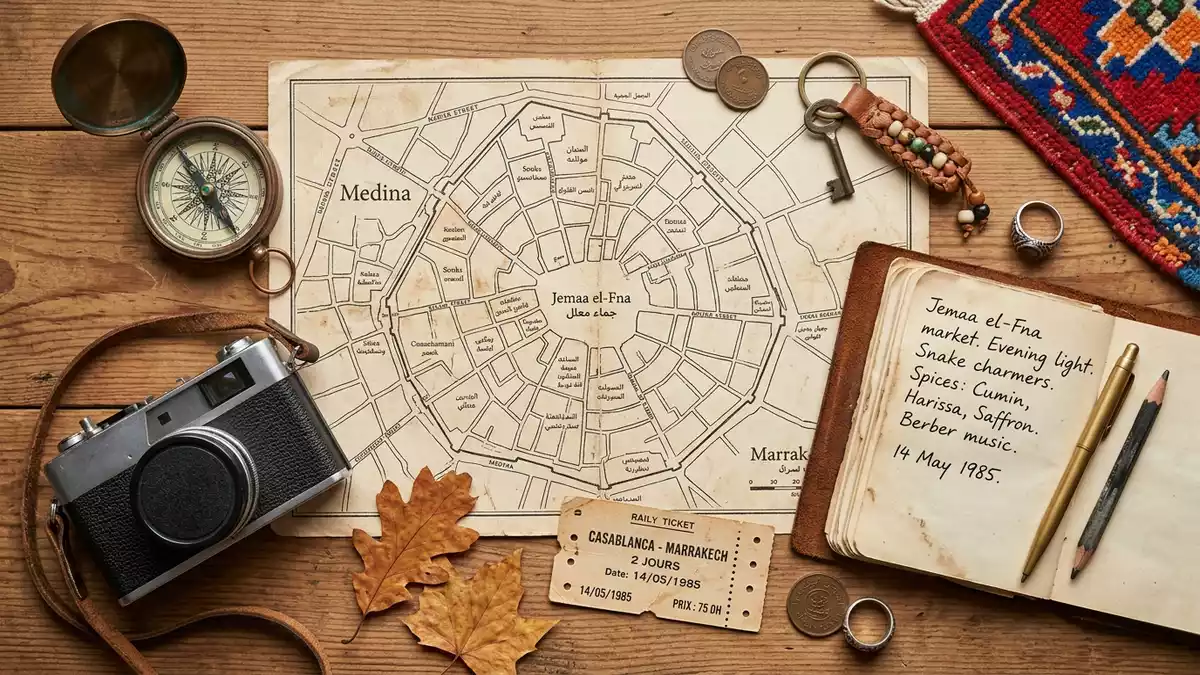
Jemaa el-Fna is the main square of Marrakesch, a broad open space in the historic medina where performance, food and everyday trade occupy the same ground from daylight into darkness. Dating back to the eleventh century, it has long served as a central meeting place and has gained UNESCO recognition for the living cultural traditions that continue to unfold there.
A triangular square at the edge of the medina
Jemaa el-Fna lies at the south-western entrance to the medina of Marrakesch, the walled old city founded in the eleventh century by the Almoravid dynasty. Streets from the newer quarters open into the square’s largely unobstructed expanse, so that the open paving forms a transition between the dense lanes of the souks and the wider avenues beyond.south-western entrance to the Marrakech medina Low buildings line its edges, with cafés, restaurants and terraces looking across the open ground rather than enclosing it behind walls, which preserves long diagonal views and a sense of the square as a single continuous surface.one of the main cultural spaces in Marrakesh
The square itself has a broadly triangular outline, a form recorded in UNESCO descriptions of Jemaa el-Fna as a symbol of Marrakesch protected as part of Morocco’s artistic heritage since 1922.triangular Jemaa el-Fna Square It sits a short walk from the minaret of the Koutoubia Mosque, so that the landmark tower and the open square together mark the western edge of the medina and form a recognisable pair in the city’s skyline.a few minutes' walk from the minaret of the Koutoubia
From Almoravid foundation to UNESCO recognition
The origins of Jemaa el-Fna are linked to the foundation of Marrakesch in 1062, when the Almoravids established the city as a political and commercial centre in Morocco.founding of Marrakech by the Almoravids in 1062 From that period onwards the square functioned as a place of justice and trade, and later dynasties maintained its role as a public gathering ground even as architectural styles and ruling powers changed.served as a place of justice and trade By the saadian period in the sixteenth century, groups of acrobats and storytellers had become enduring fixtures of the square, embedding performance into its everyday life.
Descriptions from the nineteenth century already mention scenes that remain recognisable: snake charmers, musicians and herb sellers occupying patches of the open ground.snake charmers, musicians, herb sellers In 1922 Jemaa el-Fna gained formal protection as part of Morocco’s artistic heritage, a step that helped preserve its cultural practices in the face of twentieth-century urban development.protected as part of Morocco’s artistic heritage since 1922 Later, in 1985, the wider medina of Marrakesch was inscribed on the UNESCO World Heritage List under the title “Medina of Marrakesh”, extending recognition to the surrounding urban fabric.Medina of Marrakesh inscribed on the UNESCO World Heritage List in 1985
A cultural space of UNESCO intangible heritage
What distinguishes Jemaa el-Fna in UNESCO’s records is not its buildings but the living cultural practices that take place on its paving. In May 2001 the square was proclaimed a “Masterpiece of the Oral and Intangible Heritage of Humanity”, one of the earliest cases in which a living cultural expression rather than a monument received this title.proclaimed in 2001 a Masterpiece of the Oral and Intangible Heritage of Humanity In 2008 it was inscribed on UNESCO’s Representative List of the Intangible Cultural Heritage of Humanity, confirming the square as a recognised cultural space whose significance rests on performance, oral expression and shared practices.inscribed in 2008 on the Representative List of the Intangible Cultural Heritage of Humanity
UNESCO texts describe Jemaa el-Fna as a place where storytellers, musicians, healers and various performers work alongside food vendors and traders, forming a concentration of traditions in a single urban square.unique concentration of popular Moroccan cultural traditions The listing emphasises that protection extends to practices such as storytelling circles, musical performances and oral transmission of knowledge, treating the performers and their audiences as part of an intangible heritage that coexists with the physical heritage of the medina around them.city’s unique historical and central meeting-place
Visiting Jemaa el-Fna: what travellers from Western Europe should know
- Jemaa el-Fna lies at the south-western edge of the Marrakesch medina, a short walk from the Koutoubia Mosque, and is reached on foot from the surrounding streets.
- The square is fully paved and largely level, but its open surface is intersected by clusters of stalls and mobile carts, so visitors cross active trading and performance areas rather than a quiet plaza.
- Marrakesch is in Morocco, where the official language is Arabic and the currency is the Moroccan dirham.
- Entry requirements depend on your nationality; UK travellers can check the FCDO travel advice at gov.uk/foreign-travel-advice, Irish travellers the Department of Foreign Affairs at ireland.ie.
Searching for Jemaa el-Fna on social platforms
These links open searches for Jemaa el-Fna on each platform.
Frequently asked questions about Jemaa el-Fna
Where is Jemaa el-Fna located within Marrakesch?
Jemaa el-Fna is a large triangular square at the south-western entrance to the medina of Marrakesch, near the Koutoubia Mosque and within the historic walled city.
What should visitors expect on a visit to Jemaa el-Fna?
Visitors encounter an open paved square where food stalls, street performers, storytellers and everyday trade share the same space, with activity changing in character between daytime and night.
What makes Jemaa el-Fna distinctive among public squares?
Its distinction lies in UNESCO recognition of the square’s living cultural practices, including storytelling and musical performance, as intangible heritage linked to the wider World Heritage medina.


