
Jasper National Park’s wild valleys and ice-shaped peaks
Published on 08/29/2026 at 08:42 | Editorial responsibility: Rafael Müller, Editor-in-Chief AD HOC NEWS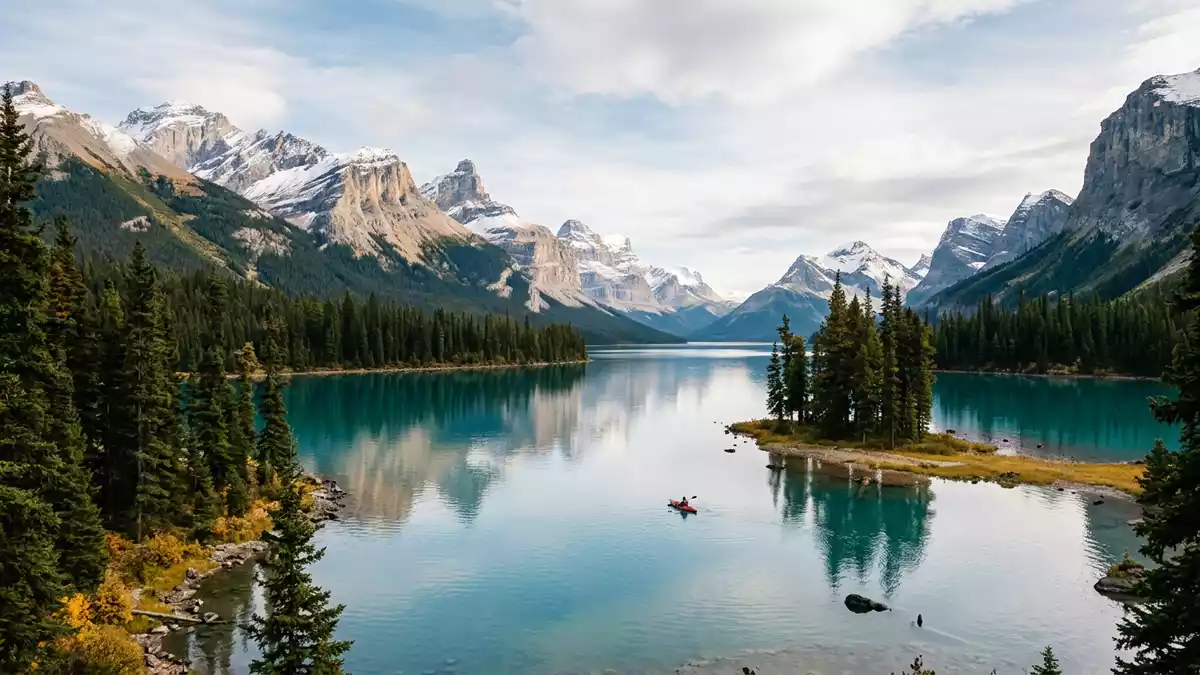
Jasper National Park in Alberta adds a vast, rugged chapter to the Canadian Rockies, with the town of Jasper sitting inside its boundaries as a small hub amid broad valleys and high peaks.Established in 1907, the park reaches across thousands of square kilometres of mountains, forests, rivers and glaciers along the eastern slopes of the range.
Mountains, icefields and river-carved valleys
Jasper National Park lies on the eastern flank of the Rocky Mountains, north of Banff National Park, with ranges aligned roughly northwest to southeast and valleys cutting across them.The park spans more than 10,000 square kilometres, making it the largest and most northerly of the Canadian Rocky Mountain national parks.Many of its mountains rise to elevations above 3,000 m (9,843 ft), with high points such as Mount Columbia forming part of the Continental Divide.
The Columbia Icefield reaches into Jasper’s southern tip as one of the largest accumulations of ice in the Rockies, feeding outlet glaciers that descend towards valley floors.Glaciers, lakes, waterfalls and mountains dominate the southern landscape, while broad valleys further north carry the Athabasca River and its tributaries across the park.The Athabasca River drains much of Jasper, linking ice-covered headwaters with lower montane forests.
Forests, meadows and wildlife across three zones
Jasper’s plant life follows altitude, and three broad vegetation zones mark the climb from valley floor to mountain crest.In the montane valleys Douglas fir, lodgepole pine and trembling aspen share space with white spruce, balsam poplar, buffaloberry and wild rose.Moist river flats and open slopes alternate between dense forest patches and meadow clearings, and these lower areas carry much of the park’s road system and the railway corridor.
Higher slopes lie in the subalpine zone, where Engelmann spruce, subalpine fir and lodgepole pine form darker, cooler forest bands broken by rock outcrops, wetlands and small tarns.Above the treeline, alpine ridges support hardy plants such as dwarf birch and mountain avens, clinging to thin soils between boulder fields and late-lying snow.Grassy meadows and open slopes in these upper zones provide summer pasture for mountain goats and bighorn sheep, while valleys and wetlands support elk, deer and smaller mammals.
World Heritage, dark skies and the town within the park
Jasper National Park stands within a wider protected mosaic recognised as the Canadian Rocky Mountain Parks World Heritage Site.UNESCO inscribed Jasper alongside Banff, Kootenay and Yoho national parks and several provincial parks in 1990 for exceptional mountain scenery and classic glacial landforms.Icefields, canyons, waterfalls and extensive cave systems all contribute to that designation, and Jasper’s share includes the Columbia Icefield, deep gorges and karst features.
Within this landscape, the town of Jasper sits beside the Athabasca River as a compact service centre, surrounded by protected forest and linked to the wider region by rail and road.The park is recognised as a dark-sky preserve, giving clear views of stars and the Milky Way from sites such as Pyramid Island, Maligne Lake and the toe of the Athabasca Glacier.Across more than 10,000 square kilometres of protected land, Jasper combines high mountain terrain, river valleys and accessible viewpoints in a single contiguous park.
Visiting Jasper National Park: what travellers from Western Europe should know
- Jasper National Park lies in western Alberta on the eastern slopes of the Rocky Mountains, with the town of Jasper located inside the park and served by highway and rail links.
- The terrain ranges from broad valley floors around 985 m (3,232 ft) above sea level to peaks near 3,800 m (12,467 ft), with steep gradients, long slopes and some high passes.
- Trails and viewpoints reach forest, river and glacier areas; many routes involve uneven ground, altitude changes and sections exposed to mountain weather.
- Jasper sits in Canada, where the official languages are English and French and the currency is the Canadian dollar.
- Entry requirements depend on your nationality; UK travellers can check the FCDO travel advice at gov.uk/foreign-travel-advice, Irish travellers the Department of Foreign Affairs at ireland.ie.
Searching for Jasper National Park on social platforms
These links open searches for Jasper National Park on each platform.Frequently asked questions about Jasper National Park
Where is Jasper National Park?
Jasper National Park is in western Alberta, Canada, on the eastern slopes of the Rocky Mountains with the town of Jasper inside its boundaries.
What can visitors expect on a visit to Jasper National Park?
Visitors encounter broad river valleys, mountain ranges, forests, glaciers, lakes and dark night skies, with viewpoints and trails accessing different elevation zones.
What makes Jasper National Park distinctive among the Canadian Rockies?
Jasper combines extensive high mountain terrain, large icefields, a dark-sky preserve designation and an inhabited town within a single, continuous national park area.


