
Jardin Majorelle, where colour and botany reshape Marrakesch
Published on 08/28/2026 at 06:46 | Editorial responsibility: Rafael Müller, Editor-in-Chief AD HOC NEWS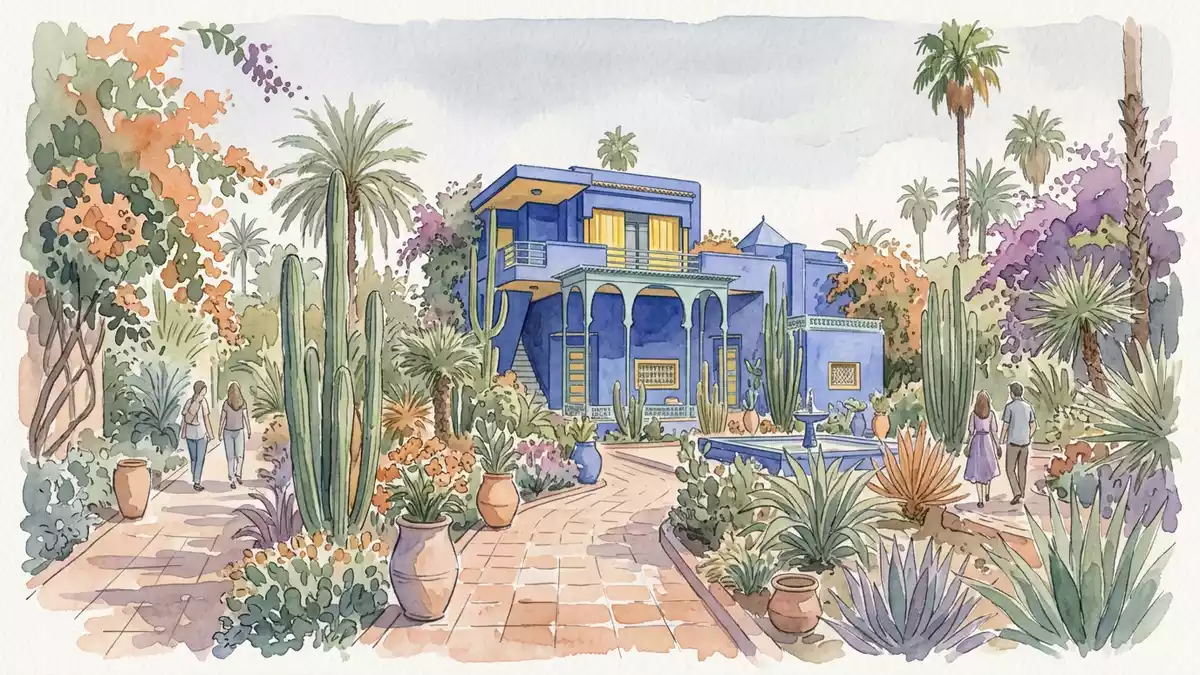
On the northern edge of Marrakesch, Jardin Majorelle brings together an artist’s garden, a Cubist villa and dense planting in a single, intensely coloured enclosure. Conceived by the French painter Jacques Majorelle during the twentieth century and later restored by Yves Saint Laurent and Pierre Bergé, it is a place where architecture and botany share the foreground rather than one merely framing the other.
An artist’s garden shaped over decades
The story of Jardin Majorelle begins with Jacques Majorelle, a French painter born in 1886 who settled in Marrakesch in 1919 and made the city his long-term base.Jacques Majorelle (1886–1962) arrived as part of a wider movement of European artists drawn to Morocco’s light and architecture, and he soon began looking for a site that could support both painting and gardening.
In the early 1920s Majorelle acquired a palm grove on the outskirts of Marrakesch and gradually transformed it into a private residence and experimental garden.a palm grove in the El Hassania district Over roughly forty years he expanded both the planting and the built structures, turning the plot into a layered composition rather than a simple house with a few trees.created over the course of forty years The garden opened to the public in 1947, bringing visitors into a space that had grown out of one painter’s sustained attention to plants and pathways.
Majorelle blue and a Cubist villa
Among the garden’s most striking features is the bold relationship between built volumes and vegetation. In 1931 Majorelle commissioned French architect Paul Sinoir to design a modern atelier on the site, a building whose Cubist geometry stands above the surrounding planting and forms a visual anchor inside the garden.an Art Deco-style workshop The villa and workshop combine Art Deco and Moorish influences, with straight-edged masses set against ornamental details such as balustrades and latticework.
The buildings are painted in a vivid cobalt shade long associated with the site and widely known as Majorelle blue.a shade of cobalt blue known as Majorelle Blue This colour recurs on walls, pergolas and planters, where it sets up clear contrasts with citrus trees, bamboo and cacti. Pathways finished in complementary tones lead through planted areas and past basins and fountains, so that visitors move between enclosed pockets of greenery and framed views back to the blue villa. The saturated colour and geometric architecture together give Jardin Majorelle a character distinct from many historic riads in the city, where internal courtyards remain more inward-looking.
Botanical collections and a second life under Yves Saint Laurent
Majorelle treated the garden as a botanical “laboratory”, assembling exotic species from several continents alongside local plants.a sanctuary and botanical ‘laboratory’ Over time the plot grew into a dense network of alleyways bordered by bamboo, palms, bougainvillea and extensive collections of cacti, all enclosed by outer walls that separate the garden from the surrounding streets.extensive collection of cacti Water features punctuate the planting, with basins and channels reflecting both vegetation and architecture and introducing an additional layer of pattern through tiled surfaces.
After Majorelle’s death in 1962 the garden entered a period of neglect and was threatened by property development before Pierre Bergé and Yves Saint Laurent acquired it in 1980.acquired the garden in 1980 They undertook a substantial restoration, expanding the botanical collections and maintaining the characteristic colour scheme while adapting Majorelle’s villa into the Villa Oasis.renamed the Villa Oasis Alongside the garden, a museum dedicated to Berber arts and the nearby Yves Saint Laurent Museum add further layers of cultural context, linking the site to both Moroccan craft traditions and twentieth-century fashion.
Visiting Jardin Majorelle: what travellers from Western Europe should know
- Jardin Majorelle lies in the modern neighbourhoods north of the historic medina of Marrakesch, reached by road from the city centre and from the wider palm grove district.
- Inside the enclosure, paths form a criss-crossing network with level changes, occasional steps and narrow passages between dense planting, so walking involves frequent turns and short ramps.
- The garden stands within the city at low altitude, but shade from trees and built structures means that light levels and exposure vary markedly between different parts of the site.
- The official language is Arabic and the currency is the Moroccan dirham.
- Entry requirements depend on your nationality; UK travellers can check the FCDO travel advice at gov.uk/foreign-travel-advice, Irish travellers the Department of Foreign Affairs at ireland.ie.
Searching for Jardin Majorelle on social platforms
These links open searches for Jardin Majorelle on each platform.Frequently asked questions about Jardin Majorelle
Where is Jardin Majorelle located in Marrakesch?
Jardin Majorelle lies in a neighbourhood north of the historic medina of Marrakesch, within the broader urban area rather than out in the High Atlas.
What can visitors expect inside Jardin Majorelle?
The garden combines dense planting, water features and striking cobalt-blue architecture, with paths that lead through shaded pockets of vegetation and open views towards the Cubist villa.
What makes Jardin Majorelle distinctive among Marrakesch gardens?
Its combination of Majorelle blue buildings by Paul Sinoir, twentieth-century botanical collections and a later association with Yves Saint Laurent gives Jardin Majorelle a layered identity that links art, design and horticulture.


