
Jardin Majorelle, where colour and botany reshape Marrakesch
Published on 08/23/2026 at 10:30 | Editorial responsibility: Rafael Müller, Editor-in-Chief AD HOC NEWS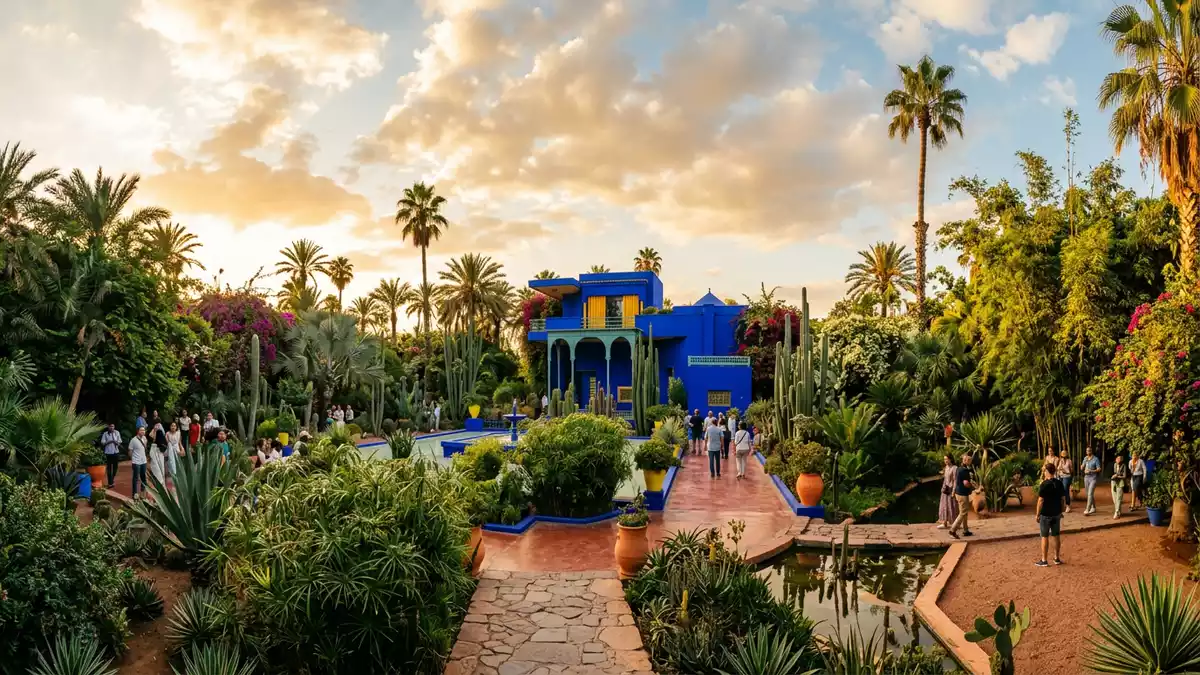
Jardin Majorelle in Marrakesch is a compact botanical garden where intense colour, layered planting and a striking villa turn a former palm grove into a carefully composed work of art. Conceived by the French painter Jacques Majorelle in the early twentieth century, the garden later entered a new chapter under Yves Saint Laurent and Pierre Bergé, who preserved its distinctive atmosphere.
A painter’s garden shaped over decades
The story of Jardin Majorelle begins with Jacques Majorelle, a French painter born in 1886 who settled in Marrakesch in 1919 and made the city his home. In the early 1920s he acquired a plot on the outskirts of the city and started creating a private residence set within a garden, a project that unfolded over several decades.Jacques Majorelle took up residence in Marrakech in 1919 The site lies in what is now the Guéliz district, beyond the densely built medina, and the garden is enclosed by outer walls that mark it out as a separate, inward-facing world.The Jardin Majorelle is located in the Guéliz district
From the beginning, the project combined architecture with planting. Majorelle built an early villa on the property and then, in 1931, commissioned French architect Paul Sinoir to design an Art Deco workshop on the site.In 1931 he commissioned the architect Paul Sinoir The result is a Cubist-influenced building whose geometric volumes rise above the planting and serve as a focal point inside the garden.features a Cubist villa designed by French architect Paul Sinoir in the 1930s Over the course of roughly forty years Majorelle kept refining both the structures and the vegetation, turning the plot into a coherent ensemble rather than a simple collection of plants.Created over the course of forty years
Colour, layout and exotic planting
Jardin Majorelle is a walled garden laid out as a network of intersecting paths that lead through dense planting and past architectural elements. The site extends over roughly 9,000 m², which makes it small enough to feel contained yet large enough to accommodate contrasting spaces.extends over 9,000 m² Paths run on different levels, with steps and gentle gradients that bring visitors close to trunks, shrubs and architectural surfaces, while water channels and basins introduce reflective accents into the composition.
The most striking feature is the use of saturated colour on built elements. The villa and associated structures carry the intense shade that has come to be known as Majorelle blue, set against other bold tones on railings, pots and walls.the shade itself is named in tribute to him; “Majorelle bleu” This colour field forms a deliberate contrast with the greens of bamboo, palms and other foliage and with the earthy hues of the paths. The planting itself is drawn from several continents, with species of cactus, succulents and trees arranged in clusters that read almost like botanical galleries.an elaborate garden with over 135 species of plant from five continents
From artist’s retreat to shared cultural site
During Majorelle’s lifetime the garden functioned as both an artistic retreat and, later, a place open to visitors. He first opened the garden to the public in the mid-twentieth century, allowing access while continuing to live and work there.He opened the gardens to the public in 1947 After his death in 1962 the site went through a period of decline, and its future as a garden was not assured.
A new phase began in 1980, when fashion designer Yves Saint Laurent and his partner Pierre Bergé acquired the property and undertook a comprehensive restoration.In 1980, Pierre Bergé and Yves Saint Laurent acquired the garden They reinforced Majorelle’s original concept, introduced professional horticultural care and ensured that the garden remained accessible as a cultural site rather than being replaced by other forms of development.purchased the Jardin Majorelle to save it from destruction at the hands of hotel developers The villa on the property became the Villa Oasis, and additional institutions were established nearby, including a museum dedicated to Berber arts and, later, a museum honouring Yves Saint Laurent’s work and his connection to Morocco.Majorelle’s former villa also houses a Berber Museum
Visiting Jardin Majorelle: what travellers from Western Europe should know
- Jardin Majorelle stands in the Guéliz district north-west of the historic medina of Marrakesch, reachable by road from other parts of the city.
- Within the garden, paths form a compact network with sections of steps and narrow walkways, so movement often involves short climbs and descents between different levels.
- The garden sits on level urban ground, with shade from tall bamboo and trees in many areas and more exposed sections around cactus beds and open courtyards.
- For visitors arriving from outside the UK, Ireland and the European Union, entry requirements depend on nationality; UK travellers can check the FCDO travel advice at gov.uk/foreign-travel-advice, Irish travellers the Department of Foreign Affairs at ireland.ie.
- The official language is Arabic and the currency is the Moroccan dirham.
Searching for Jardin Majorelle on social platforms
These links open searches for Jardin Majorelle on each platform.
Frequently asked questions about Jardin Majorelle
Where is Jardin Majorelle in Marrakesch?
Jardin Majorelle is in the Guéliz district of Marrakesch, in urban surroundings beyond the historic medina but still within the city’s built-up area.
What can visitors expect inside the garden?
Visitors move along paved paths through dense planting, past water features and boldly coloured buildings, with bamboo, palms and cacti arranged in distinct areas.
What makes Jardin Majorelle distinctive among gardens?
The combination of saturated architectural colour, a Cubist villa by Paul Sinoir and botanically varied planting conceived by Jacques Majorelle gives the garden a recognisable character.


