
Jardin des Tuileries, the formal garden between Louvre and Concorde
Published on 09/07/2026 at 20:59 | Editorial responsibility: Rafael Müller, Editor-in-Chief AD HOC NEWS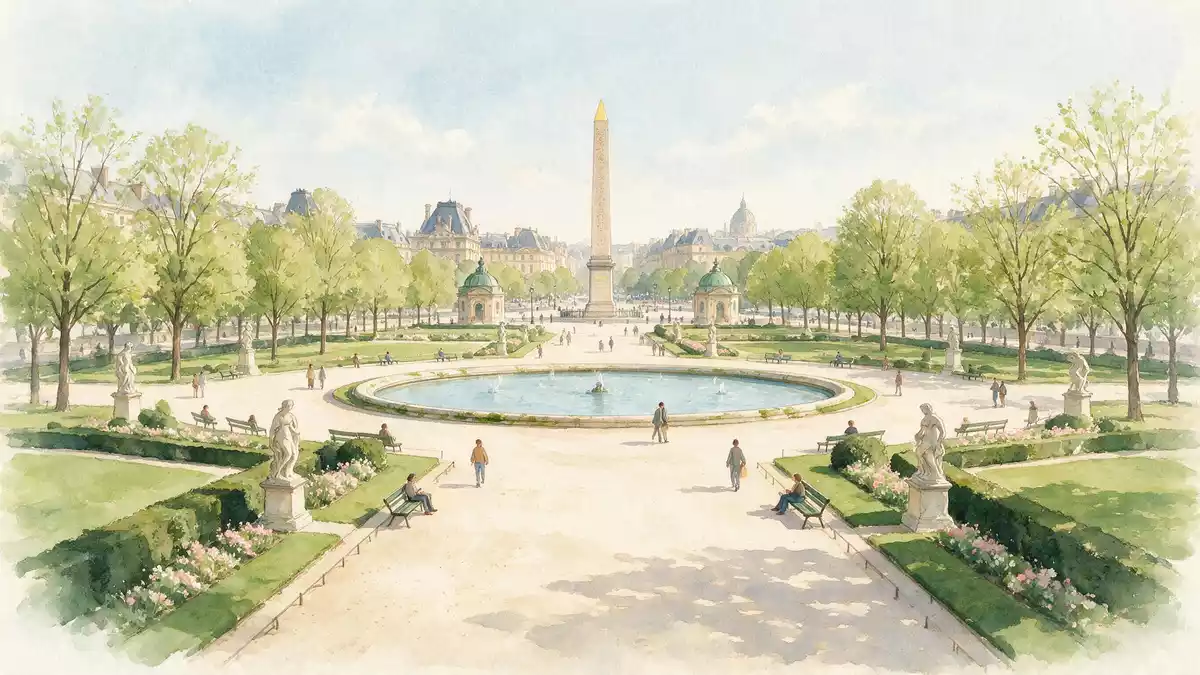
Jardin des Tuileries is the long formal garden that links the Louvre to Place de la Concorde, a historic stretch of greenery laid out for Catherine de’ Medici in 1564 and reshaped in the seventeenth century into the classic French garden visitors see today.Catherine de’ Medici’s garden of 1564
From royal palace garden to public park
The story of Jardin des Tuileries begins when Catherine de’ Medici, widow of King Henri II, ordered a new palace and garden on land outside the Paris city walls in 1564.A new palace and garden built in 1564 The garden took its name from the tile workshops that occupied the site, “tuileries” in French, and for more than a century it formed the private grounds of the Tuileries Palace.
In 1664, Louis XIV’s landscape gardener André Le Nôtre redesigned the grounds as a formal French garden, with long straight paths, clipped trees and ornamental water, establishing the geometry that still structures the park.André Le Nôtre’s redesign in 1664 Access widened over time: parts of the garden were opened to select visitors in the seventeenth century, and after the French Revolution the space evolved into a public park, fully open to all after the destruction of the palace in 1871.From royal garden to public park after 1871
A garden of axes, terraces and water
Standing in Jardin des Tuileries, the most striking feature is the long central axis that runs between the Louvre’s western facade and the open space of Place de la Concorde, extended further by the line of the Champs-Élysées.Central axis towards Place de la Concorde Straight gravel paths cut through lawns and formal bosquets, with terraces edging the river side and broad openings towards the surrounding streets.
Near the Louvre end of the garden, ornamental basins reflect the sky, ringed by chairs and planters; further west, the landscape opens into wider lawns and tree-lined walks framed by stone balustrades.Formal layout with walks and basins Throughout, the planting is organised to emphasise symmetry: clipped hedges, aligned trees and geometric parterres create vistas that lead the eye towards statues, fountains and the silhouettes of neighbouring monuments.
Sculpture, pavilions and traces of history
Jardin des Tuileries is also an open-air sculpture gallery, dotted with works from different periods set among the lawns and avenues, with classical figures, allegorical groups and more modern pieces placed at intersections and around water features.Statues throughout the garden At the western edge, two buildings dating from the reign of Napoleon III, the Jeu de Paume and the Orangerie, frame the park and now house art spaces that overlook the trees and paths.Jeu de Paume and Orangerie at the west end
The palace that once gave the garden its name no longer stands: it was set on fire during the turmoil of 1871 and later demolished, leaving the garden as an independent public space between the Louvre and the river.Destruction of the Tuileries Palace in 1871 Yet traces of its former status remain in the layout, from ceremonial terraces along the Seine to the grand perspectives that once linked palace facades with distant monuments.
Visiting Jardin des Tuileries: what travellers from Western Europe should know
- Jardin des Tuileries stretches between the Louvre and Place de la Concorde in central Paris, bordered by Rue de Rivoli to the north and the Seine to the south.
- The terrain is largely level, with long gravel paths and wide lawns, and movement between terraces involves staircases and broad steps rather than steep climbs.
- The garden sits within the 1st arrondissement, with entrances from Rue de Rivoli, Place de la Concorde and riverside quays, so it can be combined easily with visits to nearby museums and squares.
- The official language is French and the currency is the euro.
Searching for Jardin des Tuileries on social platforms
These links open searches for Jardin des Tuileries on each platform.Frequently asked questions about Jardin des Tuileries
Where is Jardin des Tuileries in Paris?
Jardin des Tuileries lies in the 1st arrondissement, occupying the space between the Louvre and Place de la Concorde, with the Seine forming its southern boundary.
What can visitors expect when walking through the garden?
Visitors encounter long straight paths, formal lawns, ornamental basins and scattered sculpture, with terraces and tree-lined walks creating perspectives towards surrounding monuments.
What makes Jardin des Tuileries distinctive among Paris parks?
Its combination of André Le Nôtre’s seventeenth-century geometry, its role as the former garden of the Tuileries Palace and its position on the main east–west axis gives it a character that ties landscape design closely to the city’s historical core.


