
Jameos del Agua, where Lanzarote’s lava tunnel becomes a cultural stage
Published on 09/12/2026 at 18:35 | Editorial responsibility: Rafael Müller, Editor-in-Chief AD HOC NEWS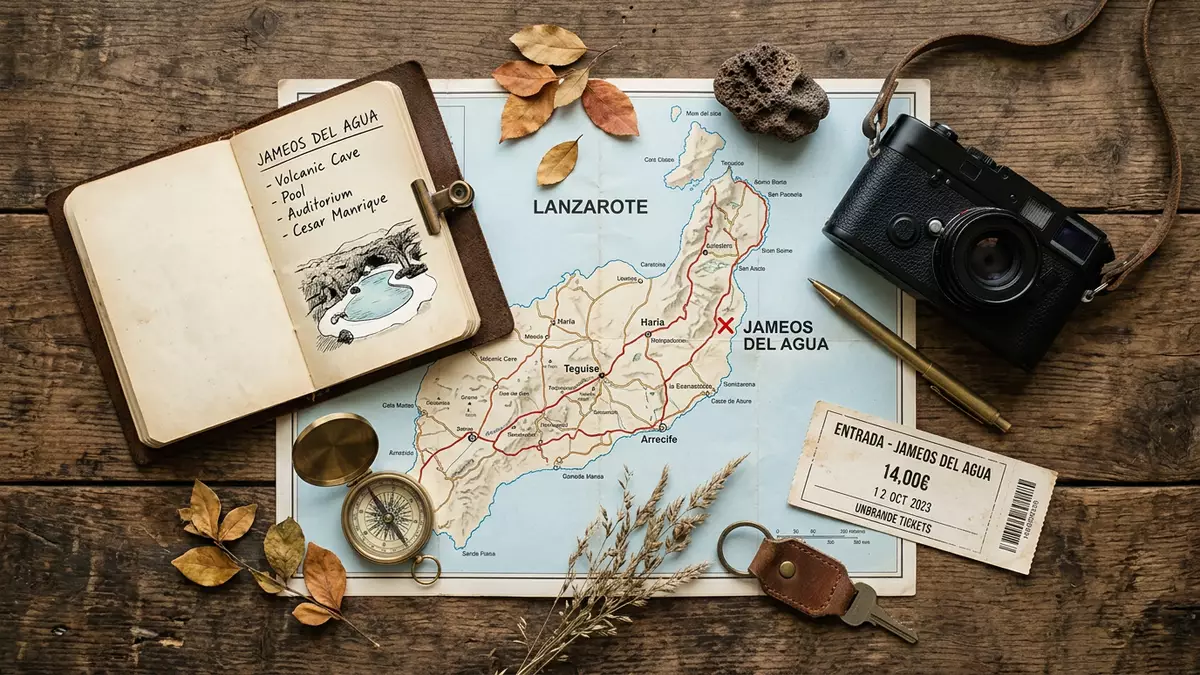
Jameos del Agua on Lanzarote is a volcanic lava tube reworked into a layered world of subterranean lake, cultural venue and palm-framed pool by César Manrique in the 1960s. Conceived as a Centre of Art, Culture and Tourism in northern Lanzarote, it sits within the tunnel formed by the eruption of Volcán de la Corona and brings architecture directly into contact with the island’s basalt terrain.
A lava tunnel turned into a sequence of spaces
At Jameos del Agua, the starting point is the volcanic tube created by an eruption of the Corona volcano thousands of years ago, one of the longest lava tunnels on the island and part of a system that extends from the crater towards the Atlantic.This tunnel, over 6 kilometres in length runs from the volcano’s cone down to the coast and continues beneath the seabed as the section known as the Túnel de la Atlántida.Los Jameos del Agua sits near the end of this system.
The term “jameo” on Lanzarote refers to a point where the roof of such a tube has fallen in, opening a hollow that exposes the interior along parts of the route.The Jameos del Agua complex occupies several of these caverns, stepping visitors down from daylight into the cooled basalt and back up again towards the ocean. Manrique’s project works with this sequence, linking collapsed sections and enclosed chambers into a continuous path.
Nature, art and the blind albino crab
One of the defining spaces at Jameos del Agua is the subterranean salt-water lake inside the lava tube, fed by seawater that filters through the volcanic rock from the nearby coast.This interior lake gives the site its name and forms a natural basin below the visitor path. Its quiet surface reflects both the basalt walls and the interventions in white plaster and stone that edge the chamber.
Within this lake lives a small endemic crustacean, the blind albino crab Munidopsis polymorpha, which has become closely associated with the place.These tiny crabs inhabit the salt lake beneath the visitor platforms, standing out against the dark lava with their pale carapaces. The presence of this species underlines how closely the attraction is tied to Lanzarote’s geology and marine environment, because it exists naturally only in this kind of enclosed, tidal cave pool.
César Manrique’s first Centre of Art, Culture and Tourism
Jameos del Agua is strongly linked to César Manrique, the Lanzarote-born artist and architect whose work helped shape the island’s approach to tourism. The complex was his first Centre of Art, Culture and Tourism, with initial works carried out in the mid-1960s and further stages completed into the 1980s.The earliest interventions between 1964 and 1966 focused on the area known as Jameo Chico, while subsequent decades brought the conditioning of Jameo Grande, the auditorium and the Casa de los Volcanes.
The layout today reflects this layered history. The entrance leads through Jameo Chico, where basalt walls are framed by steps, planted terraces and a restaurant tucked into the cave. Further along, Jameo Grande opens out as a broad hollow, with a turquoise pool, white surfaces and palms set against the lava, forming a sheltered open-air courtyard. Deeper inside the tube, the auditorium occupies a cavern known as Jameo de la Cazuela, with rows of seating facing a stage backed by the rock face.
Casa de los Volcanes and Lanzarote’s volcanic context
Above the underground spaces rises the Casa de los Volcanes, a building dedicated to explaining Lanzarote’s volcanic nature and the science of eruptions.This scientific interpretation centre occupies the upper levels of the complex, with exhibition rooms looking at the processes that formed the Corona tube and the wider volcanic fields of the island. Instruments and models illustrate seismic activity, magma movement and the structure of lava tunnels, connecting the physical experience underground with broader geological understanding.
The connection to Volcán de la Corona is central. In the northern part of Lanzarote, at the foot of this volcano whose last eruption is dated to around 3,000 years ago, begins the cave and tube system into which Jameos del Agua is woven.The Corona lava tube runs from the cone to the sea, and both Jameos del Agua and the nearby Cueva de los Verdes share this origin. Standing in the complex therefore also means standing inside a preserved cross-section of Lanzarote’s volcanic past.
Visiting Jameos del Agua: what travellers from Western Europe should know
- Jameos del Agua lies in the municipality of Haría on the north-east coast of Lanzarote, alongside the road linking the villages of Arrieta and Órzola.
- The approach runs across solidified lava and down steps into the volcanic tube, with staircases and uneven stone surfaces inside the caves and around the pools.
- The surrounding terrain sits close to sea level on the Atlantic coast, with views towards basalt cliffs and the ocean from the upper parts of the complex.
- The official language is Spanish and the currency is the euro.
Searching for Jameos del Agua on social platforms
These links open searches for Jameos del Agua on each platform.
Frequently asked questions about Jameos del Agua
Where on Lanzarote is Jameos del Agua located?
Jameos del Agua stands in the municipality of Haría on Lanzarote’s north-east coast, beside the road corridor between Arrieta and Órzola and near the Atlantic shoreline.
What can visitors expect inside the complex?
Visitors move through volcanic caverns with a salt-water lake, restaurant, planted terraces, an open-air pool courtyard, an underground auditorium and the Casa de los Volcanes exhibition centre above.
What makes Jameos del Agua distinctive compared with other lava caves?
The site combines a naturally formed lava tube, an endemic blind albino crab living in its interior lake and a multi-level cultural centre designed by César Manrique, all within a single continuous route.


