
Jameos del Agua, where Lanzarote’s lava tube becomes architecture
Published on 09/07/2026 at 07:51 | Editorial responsibility: Rafael Müller, Editor-in-Chief AD HOC NEWS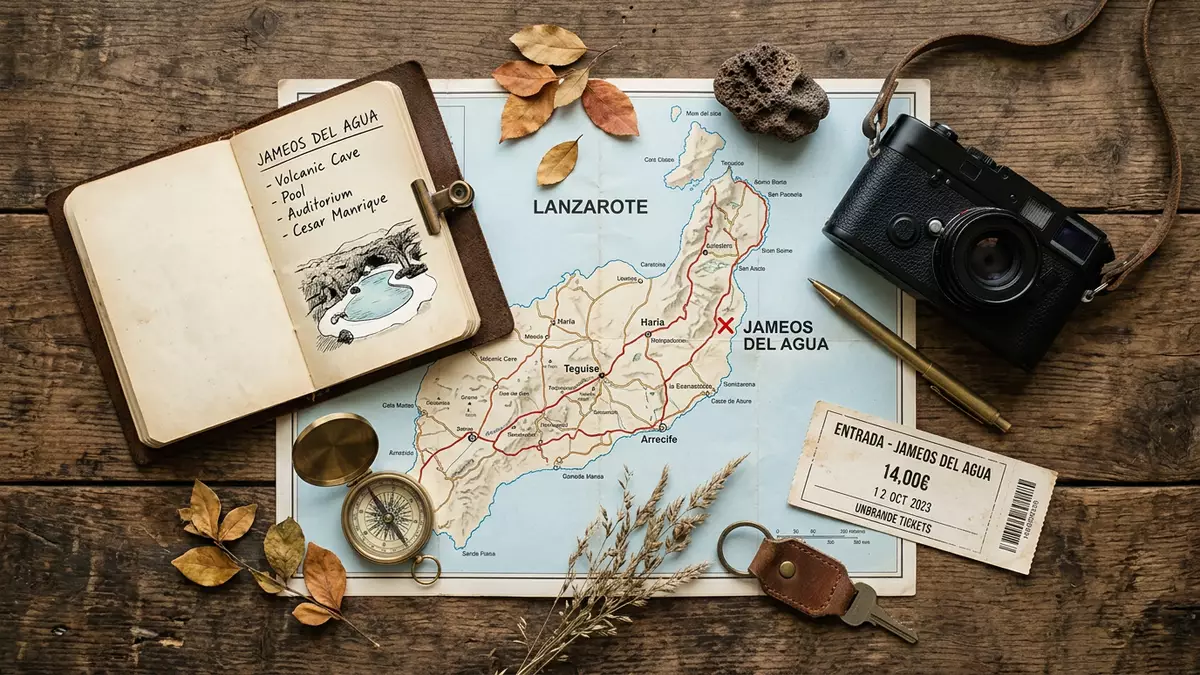
On the northern coast of Lanzarote, Jameos del Agua occupies a section of the long lava tube created by the Corona volcano and turns it into a constructed landscape of rock, water and architecture. Conceived in the 1960s by Lanzarote-born artist and architect César Manrique, it became the island’s first Centre of Art, Culture and Tourism and set the pattern for how volcanic terrain and built structures could be combined on the island.
A lava tube reimagined as a cultural space
Jameos del Agua lies in the municipality of Haría, where the lava tunnel from Corona reaches the coast and forms a sequence of collapsed caverns known locally as “jameos”.Jameos del Agua is a series of lava caves The complex occupies several of these openings and the solid rock tunnel between them, so every route on foot passes between the dark basalt walls and the platforms Manrique inserted among them.The term jameos refers to volcanic tubes with collapsed roofs
The site is part of the same volcanic system as Cueva de los Verdes, both belonging to the tube created by the Corona volcano’s eruption thousands of years ago.Jameos del Agua forms part of the La Corona lava tunnel Within this natural structure Manrique defined three principal areas: Jameo Chico with the entrance and restaurant, Jameo Grande with terraces and a garden around an artificial pool, and Jameo de la Cazuela, used for an auditorium and further interventions.The complex is formed by three main openings
Salt lake, rare species and crafted garden
At the heart of Jameos del Agua lies a subterranean salt lake, formed where seawater filters inland through the porous lava and collects in the floor of one of the caverns.Its name refers to the interior lake fed by marine filtrations The water is clear and still, and hosts a small crustacean known locally as the “white crab”, a blind, albino species (Munidopsis polymorpha) that is endemic to Lanzarote and has become one of the symbols of the site.The subterranean salt lake contains an endemic albino crab
Beyond the lake, the path emerges into Jameo Grande, where Manrique constructed terraces, planted palms and other subtropical species, and set an emerald-coloured pool against the dark lava surroundings.Rock, water and light shape the route through the centre White-rendered surfaces, natural stone paving and the contrast between bright water and black basalt give this outdoor chamber a stage-like quality. The auditorium occupies another cavity in the tube, using the existing rock walls as its enclosure and forming a venue where performances take place within the volcanic structure.An auditorium was created in the zone known as Jameo de la Cazuela
César Manrique’s first Centre of Art, Culture and Tourism
Jameos del Agua was the first of Lanzarote’s Centres of Art, Culture and Tourism, inaugurated in 1968 after several years of work in the lava tube.It was the first architectural attraction designed by César Manrique in 1968 Early interventions in Jameo Chico took place in the mid-1960s, followed by the shaping of Jameo Grande and later stages in the 1980s when the auditorium and upper-level structures were added.The first works were carried out between 1964 and 1966, with later stages completed in the 1980s
The complex is managed by the Cabildo de Lanzarote as part of the island’s network of cultural centres, and includes the Casa de los Volcanes, a scientific exhibition space above the lava tube that introduces visitors to the vulcanology of Lanzarote.The Casa de los Volcanes functions as a vulcanology centre Together, the underground route, the crafted garden and the exhibition rooms present the Corona lava tube as both a geological structure and a designed environment.
Visiting Jameos del Agua: what travellers from Western Europe should know
- Jameos del Agua stands on the Arrieta–Órzola road (LZ-1) in northern Lanzarote, close to Punta Mujeres in the municipality of Haría.
- The visit involves walking on stone steps and ramps through cavern interiors and open-air terraces within the lava tube.
- The surrounding landscape belongs to the Corona volcano lava field on the Atlantic coast, so the approach roads cross exposed volcanic terrain.
- Spanish is the official language and the currency is the euro.
Searching for Jameos del Agua on social platforms
These links open searches for Jameos del Agua on each platform.
Frequently asked questions about Jameos del Agua
Where is Jameos del Agua on Lanzarote?
Jameos del Agua is in Haría in northern Lanzarote, along the Arrieta–Órzola road on the Atlantic coast within the Corona volcano lava field.
What can visitors expect inside the complex?
Visitors encounter a subterranean salt lake with endemic white crabs, terraces and gardens around an emerald-coloured pool, an auditorium in the lava tube and the Casa de los Volcanes exhibition space.
What makes Jameos del Agua distinctive among Lanzarote’s sites?
It combines a natural lava tube, an underground lake and rare species with architecture and landscaping by César Manrique, creating Lanzarote’s first integrated art, culture and tourism centre.


