
Itsukushima Jinja and the floating shrine-scape of Miyajima
Published on 09/16/2026 at 19:45 | Editorial responsibility: Rafael Müller, Editor-in-Chief AD HOC NEWS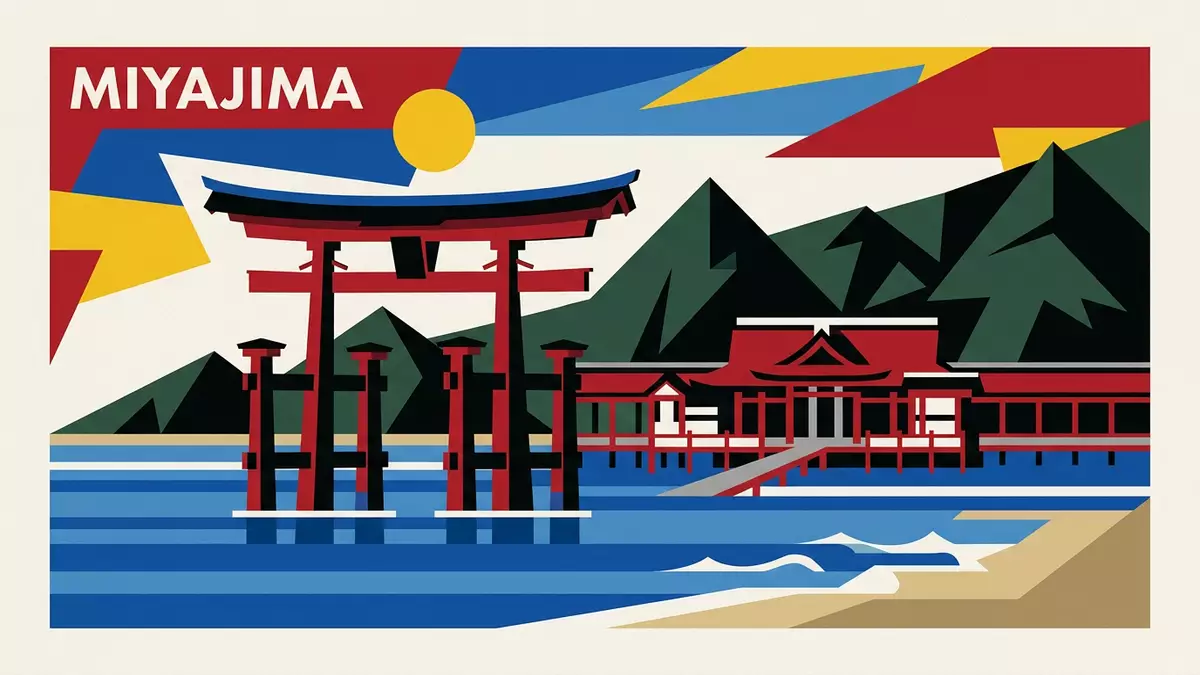
On the island of Miyajima in Japan, Itsukushima Jinja is a Shinto shrine complex laid out above the tidal shallows of the Seto Inland Sea, with buildings on timber structures and a celebrated offshore torii gate aligned against Mount Misen. The shrine in its present form is closely associated with the twelfth century and with the military leader Taira no Kiyomori, whose patronage fixed both its scale and its characteristic arrangement over the water.
A shrine built into sea and mountain
The island of Itsukushima, better known to travellers as Miyajima, has been regarded as a holy place of Shintoism for many centuries, and shrine buildings are traditionally dated to the sixth century.The first shrine buildings stood on an island where the surrounding sea and the forested flanks of Mount Misen were already objects of devotion. In 1168, Taira no Kiyomori re-established Itsukushima Jinja, having it rebuilt in the shinden-zukuri style that had developed for aristocratic mansions of the Heian period, and extended its reach above the intertidal zone.Kiyomori rebuilt the shrine
The main sanctuary and its associated halls are linked by covered corridors in painted timber, forming an elongated complex which looks outward to the sea and inward towards the sacred peak of Mount Misen behind.The buildings are oriented so that the axis connects the shrine, the offshore torii gate and the mountain, tying the complex into both water and landscape. The result is a shrine-scape where the distinction between land and sea is softened by the long decks, galleries and verandas that run immediately above the tidal surface.
Architecture over the tides
Itsukushima Jinja’s core buildings belong to the tradition of Japanese Shinto architecture in which a natural feature is revered from a constructed shrine, but here that relationship is emphasised by the way timber halls, stages and galleries are carried above the shallow water on supports rather than turning inland.The buildings of Itsukushima-jinja are arranged as a sequence of reception spaces, worship halls and subsidiary sanctuaries, laid out with a palace-like clarity characteristic of shinden-zukuri. Long corridors connect pavilions that open towards the sea, and painted timber railings define edges where visitors move above the tidal flats.
The architectural style reflects late twelfth and thirteenth-century forms, preserved through accurate reconstructions after fires and other damage, so that major surviving shrine buildings date from reconstructions completed in 1241 while continuing to express late Heian-period construction.Reconstruction in 1241 Many components are built in timber with vivid vermilion surfaces over structural members, contrasted with more natural finishes in the interior and with roofs that sit above the ritual spaces and corridors. The complex includes main halls, worship spaces and auxiliary shrines linked by these walkways, giving the impression of a continuous platform over the sea rather than a single compact building on dry ground.
The floating torii gate and World Heritage status
Out in front of the main shrine, a large torii gate stands in the shallow waters of the Seto Inland Sea, visually separated from the shore when the tide is high and set into exposed sand at low tide. A torii has been recorded at this site since the twelfth century, marking the transition between ordinary seascape and ritual space, and the current structure dates from 1875, continuing that long-established presence in front of Itsukushima Jinja.The current torii dates from 1875 The shrine complex on Miyajima and the torii together form one of the most recognisable compositions of building and landscape in Japan, with timber elements, painted surfaces and natural surroundings arranged in a deliberate alignment.
Itsukushima Shinto Shrine was inscribed on the UNESCO World Heritage List in 1996 under criteria that recognise the artistic and technical skill of its construction and its value as an outstanding example of shrine architecture integrated with the surrounding landscape.Inscription on the World Heritage List The listing emphasises the way the complex plays on contrasts between the colours and forms of mountain and sea and the carefully composed shrine buildings. For travellers, this means that the view of Itsukushima Jinja is not only a religious site but also a formally recognised cultural landscape where architecture, tide and topography are closely linked.
Visiting Itsukushima Jinja: what travellers from Western Europe should know
- Itsukushima Jinja stands on the island of Miyajima in the Seto Inland Sea, south-west of Hiroshima, reached by regional rail services to the mainland ferry terminal and by boat across to the island.
- Within the shrine complex, movement between halls and viewing platforms follows covered corridors and timber decks above the tidal flats, with numerous steps and changes in level along the way.
- The sacred Mount Misen rises behind the shrine, and paths in the wider area combine paved sections with natural terrain, including forested slopes and rocky viewpoints above the sea.
- The official language is Japanese and the currency is the yen.
- Entry requirements depend on your nationality; UK travellers can check the FCDO travel advice at gov.uk/foreign-travel-advice, Irish travellers the Department of Foreign Affairs at ireland.ie.
Searching for Itsukushima Jinja on social platforms
These links open searches for Itsukushima Jinja on each platform.
Frequently asked questions about Itsukushima Jinja
Where is Itsukushima Jinja located?
Itsukushima Jinja stands on the island of Miyajima in the Seto Inland Sea of Japan, south-west of Hiroshima, with the shrine complex extending above the tidal shore.
What should visitors expect during a visit?
Visitors encounter a sequence of timber halls, corridors and platforms raised above shallow water, aligned with an offshore torii gate and backed by the forested slopes of Mount Misen.
What makes Itsukushima Jinja distinctive among shrines?
The shrine is distinctive for its over-water layout in shinden-zukuri style, its large torii gate standing in the sea and its recognised status as a UNESCO World Heritage cultural landscape.


