
Itchan Kala, Khiva’s walled inner town of clay and minarets
Published on 08/27/2026 at 09:35 | Editorial responsibility: Rafael Müller, Editor-in-Chief AD HOC NEWS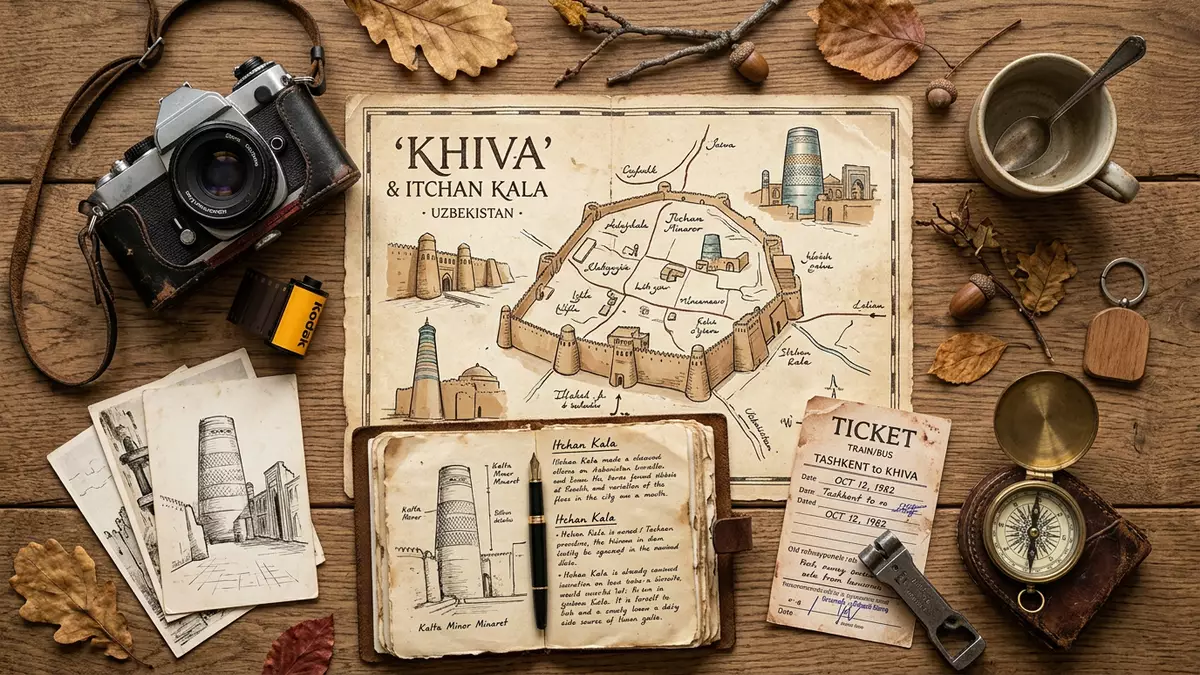
Itchan Kala is the walled inner town of Chiwa (Khiva) in Uzbekistan, enclosed by high brick fortifications and packed with mosques, madrasas and palaces from the khanate era. This compact core of the oasis city, protected by UNESCO as a World Heritage Site since 1990, preserves a dense ensemble of Islamic architecture from roughly the fourteenth to the nineteenth century.
Mudbrick walls and the shape of the inner town
Seen from outside, Itchan Kala reads as a single fortified rectangle of mudbrick rising above the surrounding streets of Khiva. The World Heritage inscription describes the inner town as a regular rectangle, elongated from south to north and enclosed by brick walls that reach about ten metres high.regular rectangle These fortifications run for roughly 2.2 km around the perimeter, with four main gates aligned to the cardinal points and giving direct access into the streets within.four gates at each side
The enclosed area of the World Heritage property is recorded at around 37.5 hectares, effectively corresponding to the historic city walls and a small extension by the Said Shaliker Bei complex.37.5 hectares Within this rectangle the street grid is tight, with lanes leading towards monuments and domestic courtyards pressed close to religious and civic buildings. Walking along the ramparts reveals the thickness of the walls, described in surveys as 6 to 8 metres wide in places, with walkways along the top and views over minarets and domes rising from the clay-coloured roofs.walls more than 10 metres high
Monuments, houses and a preserved khanate capital
Inside the walls, Itchan Kala functions as a coherent ensemble of Islamic architecture from the Khorezm region spanning several centuries. Documentation for the World Heritage listing notes more than 50 historic monuments and around 250 traditional houses, many dating from the eighteenth and nineteenth centuries, clustered inside the mudbrick enclosure.more than 50 historic monuments Among the most prominent structures are mosques such as the Djuma Mosque, madrasas, mausoleums, caravanserais and palaces erected for Khiva’s khans.
The Djuma Mosque offers one of the most distinctive interiors in Itchan Kala, with a hypostyle hall carried by 112 carved wooden columns that incorporate elements taken from earlier structures.Djuma Mosque hypostyle hall The building is associated with an original foundation in the tenth century and a later reconstruction in 1788–89, while retaining the forest of timber supports that has become a hallmark of Khiva’s religious architecture.rebuilt from 1788 to 1789 Elsewhere in the inner town stand madrasas such as Muhammad Rahim Khan and Alla Kuli Khan, as well as the Pahlawan Mahmud memorial complex and two palaces built for Alla Kuli Khan in the early nineteenth century, which introduce richly tiled courtyards and reception spaces into the compact urban fabric.palaces built by Alla Kuli Khan
Silk Road crossroads and UNESCO protection
Geographically, Khiva and its inner fortress Itchan Kala occupy an oasis south of the Amu Darya River, known in antiquity as the Oxus, in the Khorezm region of Uzbekistan.Khorezm region of Uzbekistan For caravans moving between Central Asia and Iran or Persia, this oasis formed a last resting place before crossing the desert, and the fortified inner town reflects that role in its caravanserais, markets and defensive walls.final resting-place of caravans The architecture combines local building traditions in mudbrick and timber with decorative programmes influenced by broader Persian–Islamic styles along the Silk Road.intact examples of Persian–Islamic architecture
In 1967 Itchan Kala was granted legal status as a State Architectural and Historic Reserve within the Uzbek SSR, and from 1969 it functioned as a museum and reserve, reflecting growing recognition of its heritage value.State Architectural and Historic Reserve In 1990 the inner town became the first site in Uzbekistan to be inscribed on the UNESCO World Heritage List, recognised under criteria (iii), (iv) and (v) for its outstanding universal value as a well-preserved Central Asian khanate capital enclosed within complete city walls.first site in Uzbekistan on the UNESCO list
Visiting Itchan Kala: what travellers from Western Europe should know
- Itchan Kala lies within the modern city of Chiwa (Khiva) in the Khorezm region of western Uzbekistan, south of the Amu Darya River, and is reached overland or by domestic transport links from larger Uzbek cities.
- The inner town is entirely enclosed by high brick fortifications, and exploring its monuments involves walking cobbled and paved lanes, climbing staircases inside towers and navigating uneven surfaces shaped by historic mudbrick construction.
- The climate of this desert-edge region brings marked seasonal contrasts, with hot summers and cold winters, and the exposed walls and open courtyards reflect those extremes in their materials rather than through any enclosed, climate-controlled spaces.
- Uzbek is widely spoken in Khiva alongside other regional languages, and the national currency is the Uzbekistani som.
- Entry requirements depend on your nationality; UK travellers can check the FCDO travel advice at gov.uk/foreign-travel-advice, Irish travellers the Department of Foreign Affairs at ireland.ie.
Searching for Itchan Kala on social platforms
These links open searches for Itchan Kala on each platform.Frequently asked questions about Itchan Kala
Where is Itchan Kala and what kind of place is it?
Itchan Kala is the walled inner town of Chiwa (Khiva) in the Khorezm region of Uzbekistan, forming the historic core of an oasis city enclosed by mudbrick fortifications.
What should a visitor expect inside the walls?
Inside the walls, visitors encounter mosques, madrasas, mausoleums, palaces and traditional houses arranged along narrow lanes, together forming a preserved Central Asian khanate capital built largely in mudbrick and timber.
What makes Itchan Kala distinctive among Silk Road cities?
Itchan Kala is distinctive for its complete circuit of high brick walls, its compact rectangular plan, and its concentration of more than 50 historic monuments within a relatively small, formally protected World Heritage area.


