
Islas Galapagos: Puerto Ayora between harbour town and Pacific wildlife
Published on 09/19/2026 at 15:17 | Editorial responsibility: Rafael Müller, Editor-in-Chief AD HOC NEWS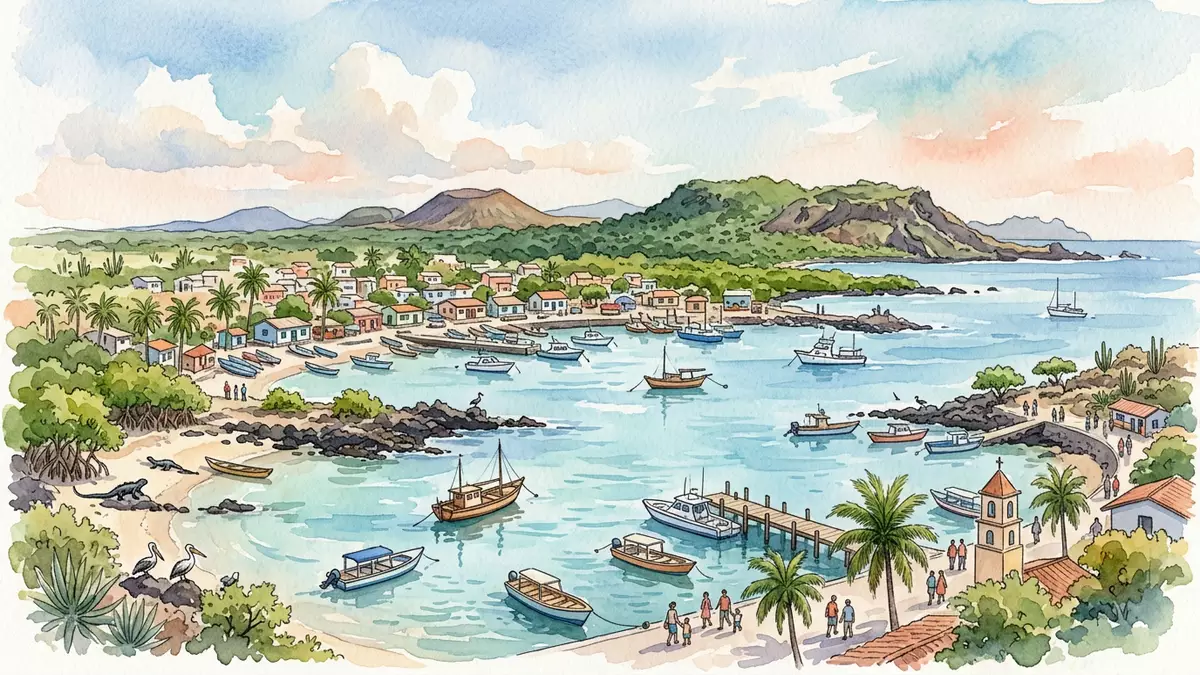
Islas Galapagos become tangible in Puerto Ayora, a harbour town on the southern coast of Santa Cruz Island in Ecuador where everyday streets meet protected Pacific wildlife beside Academy Bay. Puerto Ayora grew during the twentieth century into the main urban centre of the archipelago, with its waterfront and low-rise streets forming a compact hub for travel, science and local life in Islas Galapagos.
Puerto Ayora at Academy Bay
Puerto Ayora stands on the southern shore of Santa Cruz Island, facing Academy Bay in the Galápagos Province of Ecuador, in the central part of Islas Galapagos. The town forms part of Santa Cruz Canton and functions as its cantonal seat, giving it an administrative role across the central islands.Puerto Ayora stands on the southern shore Low-rise buildings cluster along streets that run parallel and perpendicular to the bay, creating a simple grid that keeps the water in sight from many corners of town.
Academy Bay itself shapes the setting: boats at anchor sit beyond dark volcanic rock and small landing points, while the outlines of Santa Cruz’s coastal vegetation rise behind the town. Along the waterfront, paved paths pass piers and small docks used by fishing boats, dive vessels and inter-island transport, so harbour activity is a constant presence alongside sea birds resting on railings and marine iguanas on the rocks.Situated in Academy Bay on the southern coast of Santa Cruz
A twentieth-century town in an older archipelago
The human story at Puerto Ayora sits within a much longer history of Islas Galapagos as an oceanic archipelago in the eastern Pacific Ocean belonging to Ecuador.Islas Galapagos form an oceanic archipelago of Ecuador The first recorded human habitation in what is now Puerto Ayora dates to a group of sailors in 1905, and the town itself was founded in the 1920s by settlers from Norway, giving this harbour a defined twentieth-century origin in contrast with the older volcanic landscape around it.Puerto Ayora was founded in the 1920s
Puerto Ayora later developed into the largest settlement in Islas Galapagos and the main town of Santa Cruz Island, concentrating services and harbour activity in one place while remaining modest in size.Puerto Ayora is the largest town in the Galapagos Islands The town lies at low elevation and has a warm semi-arid climate, with conditions shaped by the surrounding Pacific and the position of Santa Cruz within the archipelago.warm semi-arid climate of 23.9 °C on average
Science, conservation and everyday harbour life
Puerto Ayora has a dual role as a harbour town and a centre for science and conservation in Islas Galapagos. On the outskirts of town stands the Charles Darwin Research Station, a complex dedicated to research and conservation programmes across the islands, alongside the headquarters of the Galápagos National Park.headquarters of the Galápagos National Park and the Charles Darwin Research Station This combination of research facilities and park administration gives Puerto Ayora a distinct scientific presence that sits beside its role as a base for tours, diving and day trips.
Within the town, streets carry a mixture of everyday services and travel-focused businesses. Small hotels, guesthouses and restaurants line the main routes, along with banks and shops serving residents of Santa Cruz Island and visiting travellers.Puerto Ayora offers the most services in Galápagos The harbour remains central: fishing boats bring in catches to be prepared in local eateries, tour vessels depart for nearby sites on Santa Cruz, and water taxis link the town with points around Academy Bay, so land-based and marine activity interlock throughout the day.
Visiting Islas Galapagos: what travellers from Western Europe should know
- Puerto Ayora lies on the southern coast of Santa Cruz Island in Ecuador’s Galápagos Province and is reached by road across Santa Cruz after crossing from the airport area on neighbouring Baltra Island.
- The town sits at low elevation beside Academy Bay, with paved streets and harbour paths; walking around the centre involves level ground, short stretches of pavement and occasional steps near the waterfront.
- Santa Cruz Island has a paved road running north–south between the Itabaca Channel and Puerto Ayora, and transfers between the ferry landing and town use this road across the island’s interior.
- Puerto Ayora is in Ecuador, where the official language is Spanish and the currency is the US dollar.
- Entry requirements depend on your nationality; UK travellers can check the FCDO travel advice at gov.uk/foreign-travel-advice, Irish travellers the Department of Foreign Affairs at ireland.ie.
Searching for Islas Galapagos on social platforms
These links open searches for Islas Galapagos on each platform.
Frequently asked questions about Islas Galapagos
Where are Islas Galapagos and Puerto Ayora located?
Islas Galapagos lie in the eastern Pacific Ocean and form an Ecuadorian archipelago, with Puerto Ayora on the southern coast of Santa Cruz Island in Academy Bay.
What should visitors expect on a visit to Puerto Ayora?
Visitors encounter a small harbour town with paved streets beside Academy Bay, working boats at anchor, local services and nearby scientific and conservation centres on Santa Cruz Island.
What makes Puerto Ayora distinctive within Islas Galapagos?
Puerto Ayora is distinctive as the largest town in the archipelago and as a base where harbour life, travel services and institutions such as the Charles Darwin Research Station share the same compact setting.


